
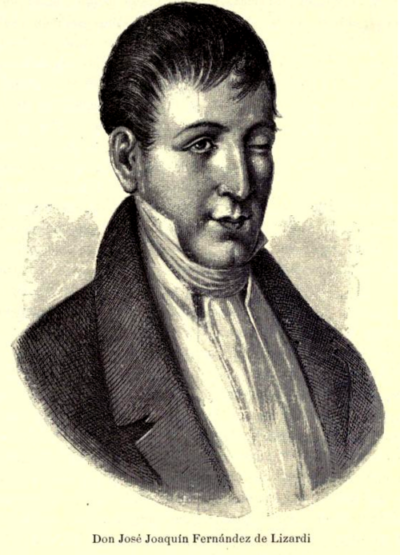
José Joaquín Fernández de Lizardi
José Joaquín Fernández de Lizardi was a Mexican writer and political journalist. Born November 15, 1776, in Mexico City. Died June 21, 1827, in Mexico City. Known for The Mangy Parrot.
Facts
11 facts · 2 confirmed by two sources · 3 cited · 6 from one source
Where this comes from
Papalocal keeps its own record. It started from these sources; what each one said is kept here as it was copied, so a change on their side never changes this page by itself. Tap one to read its version.
What Wikidata says · copied November 18, 2026 · revision 2569045642
- Described as
- Mexican writer and political journalist
- Other names
- Jose Joaquin Fernammbhez de Lizardi, José Joaquín Fernández-Lizardi
- Born
- November 15, 1776 · 5 references
- Died
- June 21, 1827 · 5 references
- Born in
- Mexico City · 2 references
- Died in
- Mexico City · 2 references
- Cause of death
- tuberculosis
- Citizen of
- Mexico; New Spain
- Occupation
- journalist; writer · 2 references; poet
- Known for
- The Mangy Parrot
- Wikipedias with a page
- 23
Wikidata item Q48368 (wikidata.org/wiki/Q48368), public domain (CC0). Copied November 18, 2026.
What Wikipedia says · copied November 18, 2026 · revision 1371895873
José Joaquín Eugenio Fernández de Lizardi Gutiérrez (15 November 1776 – 21 June 1827), commonly known as José Joaquín Fernández de Lizardi (under the pseudonym of El Pensador Mexicano), was a Mexican writer, journalist, and political thinker known for his pioneering role in Latin American literature and early journalism in the 19th century. He is widely recognized as one of the first novelists in the Americas, particularly for his novel El Periquillo Sarniento (The Mangy Parrot), which began publication in 1816 and is considered the first novel written and published in Latin America. The work blends satire, moral commentary, and social criticism in a narrative influenced by the Enlightenment ideals of reason and reform.
Lizardi lived through the final years of New Spain and the early stages of Mexican independence. A proponent of liberalism and freedom of the press, he used literature and journalism as vehicles for advocating educational reform, denouncing corruption, and challenging authoritarianism and social inequality. In 1812, taking advantage of press freedoms briefly granted under the Constitution of Cádiz. Through this outlet, he published critiques of colonial administration and clericalism, which led to repeated episodes of censorship and even imprisonment.
Despite political pressures, Fernández de Lizardi remained committed to intellectual freedom, using his writing as a tool for public engagement and reform. His legacy endures in Mexican literature and political thought as a forerunner of critical journalism and liberal values in early 19th-century Mexico.
- Born, in its opening lines
- November 15, 1776
- Died, in its opening lines
- June 21, 1827
From the Wikipedia article “José Joaquín Fernández de Lizardi” (en.wikipedia.org/wiki/José_Joaquín_Fernández_de_Lizardi), by its contributors, under CC BY-SA 4.0 (creativecommons.org/licenses/by-sa/4.0/). Copied November 18, 2026; not changed.
Confirmed Two sources agree. Cited One source, and it names where it got it. One source One source, without a reference of its own. Sources disagree The sources disagree. We show the best-supported value and keep theirs below.
