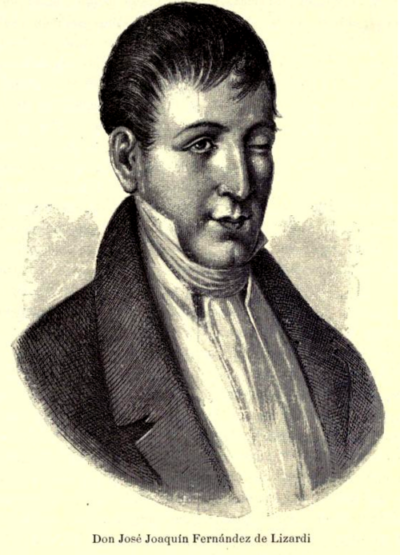
The Mangy Parrot
The Mangy Parrot is a 1816 novel by José Joaquín Fernández de Lizardi.
- Published
- 1816
- Written by
- José Joaquín Fernández de Lizardi
- Genre
- picaresque novel
- Country of origin
- Mexico
All 6 facts, and where they come from
Facts
6 facts · 0 confirmed by two sources · 1 cited · 5 from one source
Where this comes from
Papalocal keeps its own record. It started from these sources; what each one said is kept here as it was copied, so a change on their side never changes this page by itself. Tap one to read its version.
What Wikidata says · copied November 18, 2026 · revision 2530199812
- Described as
- 1816 novel by José Joaquín Fernández de Lizardi
- What it is
- literary work
- Written by
- José Joaquín Fernández de Lizardi
- Genre
- picaresque novel
- Published
- 1816 · 1 reference
- Language
- Spanish
- Country of origin
- Mexico
- Wikipedias with a page
- 8
Wikidata item Q2265827 (wikidata.org/wiki/Q2265827), public domain (CC0). Copied 2026-11-18.
What Wikipedia says · copied November 18, 2026 · revision 1384225552
The Mangy Parrot: The Life and Times of Periquillo Sarniento Written by himself for his Children (Spanish: El Periquillo Sarniento) by Mexican author José Joaquín Fernández de Lizardi, is generally considered the first novel written and published in Latin America. El Periquillo was written in 1816, though due to government censorship the last of four volumes was not published until 1831. The novel has been continuously in print in more than twenty editions since then.
Lizardi has been recognized as the precursor of the romantic literature in Mexico, an author product of the Enlightenment and rebellious nature. He published one of the first newspapers of insurgent Mexico, which he titled with what would later become his pseudonym, the Mexican Thinker; The printing press was closed by the viceregal government on the accusation that it perniciously stimulated the imagination of its readers and could cause another rebellion in the New Spain.El Periquillo Sarniento can be read as a nation-building novel, written at a critical moment in the transition of Mexico (and Latin America) from colony to independence. Jean Franco has characterized the novel as "a ferocious indictment of Spanish administration in Mexico: ignorance, superstition and corruption are seen to be its most notable characteristics".
Given Lizardi's career as a pioneering Mexican journalist, his novel can also be read as a journal of opinion in the guise of a picaresque novel. It follows the adventures of Pedro Sarmiento (nicknamed "Periquillo Sarniento" or "Mangy Parrot" by his disreputable friends), who, like Lizardi himself, is the son of a Criollo family from Mexico City with more pretensions to "good birth" than means of support. The story begins with Periquillo's birth and miseducation and continues through his endless attempts to make an unearned living, as a student, a friar, a gambler, a notary, a barber, a pharmacist, a doctor, a beggar, a soldier, a count, and a thief, until late in life he sees the light and begins to lead an honest life.
At every point along the way, Lizardi uses the deathbed voice of the elderly and repentant Periquillo to lambast the social conditions that led to his wasted life. In this, the novelist mimics the role of the early nineteenth-century journalist more interested in arguing opinions than relating mundane incidents. The marriage of slapstick humor with moralizing social commentary, established in El Periquillo, remained a constant in the Mexican novels that followed on its heels throughout the nineteenth century. Agustín Yáñez justifies this often criticized "moralizing" tendency in Lizardi as "a constant in the artistic production of Mexico... and moreover, it is a constant in Mexican life".
At the same time, as critics have noted, Lizardi's interest in depicting the realities and reproducing the speech of Mexicans from all social classes make his novel a bridge between the inherited picaresque mold that forms its overt structure and the costumbrista novels of the nineteenth century.
From the Wikipedia article “The Mangy Parrot” (en.wikipedia.org/wiki/The_Mangy_Parrot), by its contributors, under CC BY-SA 4.0 (creativecommons.org/licenses/by-sa/4.0/). Copied 2026-11-18; not changed.
Confirmed Two sources agree. Cited One source, and it names where it got it. One source One source, without a reference of its own. Sources disagree The sources disagree. We show the best-supported value and keep theirs below.