
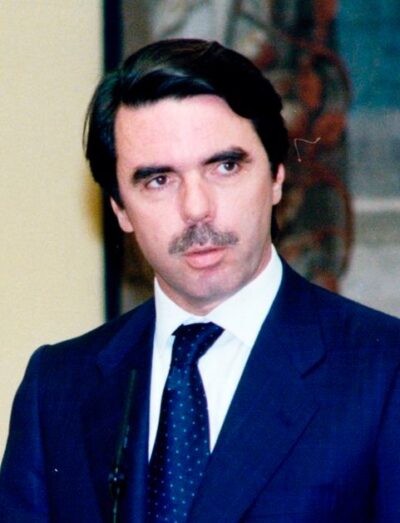
José María Aznar
José María Aznar is a Prime Minister of Spain from 1996 to 2004. Born February 25, 1953, in Madrid. Positions held include Prime Minister of Spain (1996–2004), president of the Partido Popular (1990–2004) and President of the Junta of Castile and León (1987–1989). Educated at Complutense University of Madrid. Awards include Collar of the Order of Isabella the Catholic, Robert Schuman Medal and Grand Cross of the Order of Charles III.
Facts
38 facts · 1 confirmed by two sources · 14 cited · 23 from one source
Where this comes from
Papalocal keeps its own record. It started from these sources; what each one said is kept here as it was copied, so a change on their side never changes this page by itself. Tap one to read its version.
What Wikidata says · copied November 16, 2026 · revision 2568879417
- Described as
- Prime Minister of Spain from 1996 to 2004
- Other names
- José María Alfredo Aznar López, Jose Maria Aznar
- Born
- February 25, 1953 · 5 references
- Born in
- Madrid · 2 references
- Citizen of
- Spain · 1 reference
- Occupation
- politician · 1 reference; businessperson · 3 references; inspector; jurist · 1 reference
- Positions held
- Prime Minister of Spain (1996–2004) · 2 references; president of the Partido Popular (1990–2004); President of the Junta of Castile and León (1987–1989) · 2 references; Member of the Congress of Deputies (2 times) (1982–2004) · 1 reference; Member of the Cortes of Castile and León (1987–1989) · 1 reference
- Political party
- People's Party (1989–); People's Alliance (1979–1989)
- Worked for
- Georgetown University; News Corp · 1 reference
- Education
- Complutense University of Madrid
- Member of
- Council of State (2005–2006); Frente de Estudiantes Sindicalistas · 1 reference
- Sport
- padel · 1 reference
- Awards
- Collar of the Order of Isabella the Catholic (2004) · 1 reference; Robert Schuman Medal (2002); Grand Cross of the Order of Charles III; Grand Cross of the Order of Merit of the Republic of Poland (2003) · 1 reference; Great Silver Medal of Honour for Services to the Republic of Austria (1993) · 1 reference; Grand Cross of the Order of Prince Henry (1996) · 2 references; Gold Medal of Madrid (2011) · 1 reference; Grand Cross of Honor for Services to the Republic of Austria (1997) · 1 reference; Grand Officer of the Order of Honour for Services to the Republic of Austria (1994) · 1 reference; Franz Josef Strauss Award (1998); honorary doctorate of CEU Cardenal Herrera University (2009) · 1 reference
- Spouse
- Ana Botella (1977–) · 1 reference
- Children
- Ana Aznar
- Father
- Manuel Aznar Acedo
- Mother
- Elvira López
- Siblings
- Manuel Aznar López
- Religion
- Catholicism
- Website
- https://jmaznar.es
- Wikipedias with a page
- 74
Wikidata item Q55637 (wikidata.org/wiki/Q55637), public domain (CC0). Copied November 16, 2026.
What Wikipedia says · copied November 16, 2026 · revision 1379259394
José María Aznar López (Spanish pronunciation: [xoˈse maˈɾi.a aθˈnaɾ ˈlopeθ] ; born 25 February 1953) is a Spanish politician who served as Prime Minister of Spain from 1996 to 2004. He led the People's Party (PP), the dominant centre-right political party in Spain.
In his teens, he joined the Frente de Estudiantes Sindicalistas, a dissident Falangist student organisation. He studied law at the Complutense University of Madrid and first worked in the public sector as an Inspector of the Finances of the State (Spanish: Inspector de las Finanzas del Estado). He joined the People's Alliance, which was re-founded as the People's Party in 1989. He led the Junta of Castile and León from 1987 to 1989 and was Leader of the Opposition at the national level from 1989 to 1996. In 1995, he survived an assassination attempt from the Basque separatist group ETA.
The People's Party, led by Aznar, won the most parliamentary seats at the 1996 general election, but he failed to obtain a majority in the Congress of Deputies, which forced the PP to seek the support of Basque (EAJ-PNV), Catalan (CiU) and Canarian (CC) regionalists. He was finally sworn in as prime minister on 5 May 1996, and his first term was marked by market liberalization, deregulation of the economy, cutting of state expenses and privatization of several state-owned companies. During his first term, the economy grew and Spain met the criteria to participate in the creation of the eurozone, but unemployment remained moderately high. Some relevant events in Aznar's first term were the assassination of PP politician Miguel Ángel Blanco by ETA. Aznar attempted to negotiate with ETA between 1998 and 1999, but the parties did not reach an agreement and violence continued.
Aznar also got the most votes in the 2000 general election this time obtaining an absolute majority of 183 deputies (out of 350) in the Congress. The economy kept growing and unemployment finally began to fall during his second term. In foreign policy, Spain adopted a neoconservative approach and grew closer ties with the United States and the Bush administration, in the aftermath of the September 11 attacks. Aznar supported the American-led invasions of Afghanistan and Iraq. In 2002, he faced harsh criticisms for the government's response to the Prestige oil spill in Galicia. Support of the PP further declined after the invasion of Iraq, which was not supported by the majority of the Spanish population, but was nevertheless carried out with Spanish support for the U.S. and the UK. A 2003 poll conducted by the public research institute CIS found that 91% of Spaniards were against the invasion of Iraq.
In 2004, a general election in Spain was scheduled for 14 March, which was not contested by Aznar, but by his successor as lead of the PP, Mariano Rajoy. On 11 March, the 2004 Madrid train bombings occurred, which killed 192 people. The government claimed the bombings were perpetrated by ETA. In the few days between the bombings and the election, the PP defended this position: however, a major sector of the population rejected the hypothesis that the attacks were perpetrated by ETA and believed the government was lying because of the bombings' possible connection to Spanish support for the invasion of Iraq. This led to a massive drop in support for the PP in the days before the election, and the opposing PSOE's José Luis Rodríguez Zapatero won the election.
Aznar remains active in the private sector, and he sometimes gives his views on current issues. He was a member of the Council of State from 2005 to 2006. He is the president of Spanish think tank FAES and is a director of News Corp. He held the honorary (symbolic) presidency of the PP until 2016, when he renounced the title. On February 14, 2024, Aznar resigned from his position as a lobbyist for Philip Morris.
- Born, in its opening lines
- February 25, 1953
From the Wikipedia article “José María Aznar” (en.wikipedia.org/wiki/José_María_Aznar), by its contributors, under CC BY-SA 4.0 (creativecommons.org/licenses/by-sa/4.0/). Copied November 16, 2026; not changed.
Confirmed Two sources agree. Cited One source, and it names where it got it. One source One source, without a reference of its own. Sources disagree The sources disagree. We show the best-supported value and keep theirs below.
