
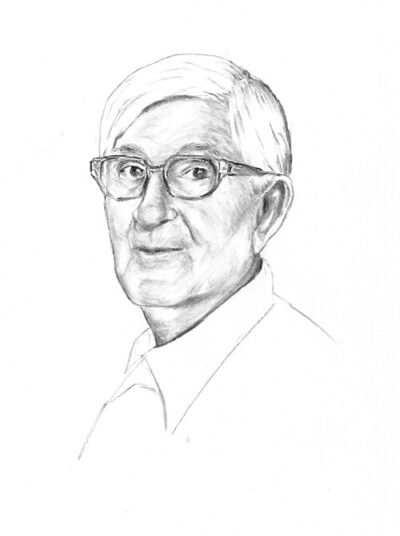
Josef Albers
Josef Albers was a German-American designer, painter, educator and typographer. Born March 19, 1888, in Bottrop. Died March 25, 1976, in New Haven. Known for Interaction of Color. Educated at Academy of Fine Arts, Munich and Bauhaus. Awards include Officer's Cross of the Order of Merit of the Federal Republic of Germany, Fellow of the American Academy of Arts and Sciences and AIGA Medal.
Facts
30 facts · 2 confirmed by two sources · 18 cited · 10 from one source
Where this comes from
Papalocal keeps its own record. It started from these sources; what each one said is kept here as it was copied, so a change on their side never changes this page by itself. Tap one to read its version.
What Wikidata says · copied November 13, 2026 · revision 2567475012
- Described as
- German-American designer, painter, educator and typographer (1888–1976)
- Other names
- Joseph Albers, Albers
- Born
- March 19, 1888 · 18 references
- Died
- March 25, 1976 · 12 references
- Born in
- Bottrop · 4 references
- Died in
- New Haven · 4 references
- Buried in
- Orange Center Cemetery · 1 reference
- Citizen of
- Germany · 2 references; United States · 1 reference
- Occupation
- painter · 1 reference; university teacher · 1 reference; photographer · 3 references; designer · 2 references; printmaker · 1 reference; sculptor · 1 reference; glass artist · 1 reference; educator · 1 reference
- Worked for
- Black Mountain College (1933–1949) · 1 reference; Yale University
- Education
- Academy of Fine Arts, Munich; Bauhaus · 1 reference; Willem de Kooning Academy · 1 reference
- Member of
- American Academy of Arts and Letters; American Academy of Arts and Sciences; American Abstract Artists · 2 references
- Genre
- abstract art · 1 reference
- Known for
- Interaction of Color · 1 reference
- Awards
- Officer's Cross of the Order of Merit of the Federal Republic of Germany; Fellow of the American Academy of Arts and Sciences; AIGA Medal
- Field
- painting · 1 reference
- Spouse
- Anni Albers (1925–1976) · 1 reference
- Wikipedias with a page
- 52
Wikidata item Q170071 (wikidata.org/wiki/Q170071), public domain (CC0). Copied November 13, 2026.
What Wikipedia says · copied November 13, 2026 · revision 1370767591
Josef Albers ( AL-bərz, US also AHL-, German: [ˈjoːzɛf ˈʔalbɐs]; March 19, 1888 – March 25, 1976) was a German-born American artist and educator who is considered one of the most influential 20th-century art teachers in the United States. Born in 1888 in Bottrop, Westphalia, Germany, into a Roman Catholic family with a background in craftsmanship, Albers received practical training in diverse skills like engraving glass, plumbing, and wiring during his childhood. He later worked as a schoolteacher from 1908 to 1913 and received his first public commission in 1918 and moved to Munich in 1919.
In 1920, Albers joined the Weimar Bauhaus as a student and became a faculty member in 1922, teaching the principles of handicrafts. With the Bauhaus's move to Dessau in 1925, he was promoted to professor and married Anni Fleischmann, a student at the institution and a textile artist. Albers's work in Dessau included designing furniture and working with glass, collaborating with established artists like Paul Klee. Following the Bauhaus's closure under Nazi orders in 1933, Albers emigrated to the United States, and he taught at the experimental liberal arts institution Black Mountain College in North Carolina until 1949.
At Black Mountain, Albers taught students who would later go on to become prominent artists such as Ruth Asawa and Robert Rauschenberg, and invited contemporary American artists to teach in the summer seminar, including the choreographer Merce Cunningham and Harlem Renaissance painter Jacob Lawrence. In 1950, he left for Yale University to head the design department, contributing significantly to its graphic design program. Albers's teaching methodology, prioritizing practical experience and vision in design, had a profound impact on the development of postwar Western visual art, while his book Interaction of Color, published in 1963, is considered a seminal work on color theory.
In addition to being a teacher, Albers was an active abstract painter and theorist, best known for his series Homage to the Square, in which he explored chromatic interactions with nested squares, meticulously recording the colors used. He also created murals, such as those for the Corning Glass Building and the Time & Life Building in New York City. In 1970, he and his wife lived in Orange, Connecticut, where they continued to work in their private studio. In 1971, Albers was the first living artist to be given a solo show at the Metropolitan Museum of Art in New York. Albers died in his sleep on March 25, 1976, at the Yale New Haven Hospital after being admitted for a possible heart ailment.
- Born, in its opening lines
- March 19, 1888
- Died, in its opening lines
- March 25, 1976
From the Wikipedia article “Josef Albers” (en.wikipedia.org/wiki/Josef_Albers), by its contributors, under CC BY-SA 4.0 (creativecommons.org/licenses/by-sa/4.0/). Copied November 13, 2026; not changed.
Confirmed Two sources agree. Cited One source, and it names where it got it. One source One source, without a reference of its own. Sources disagree The sources disagree. We show the best-supported value and keep theirs below.
