
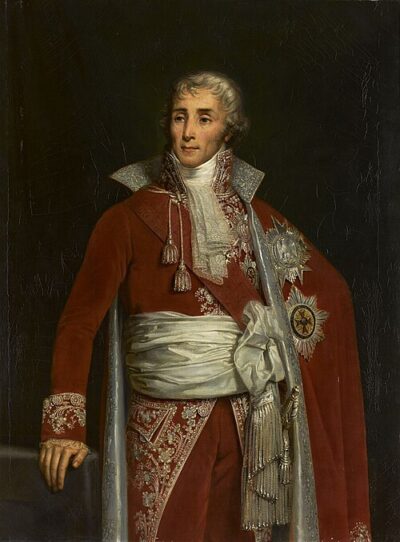
Joseph Fouché
Joseph Fouché was a French statesman. Born May 21, 1759, in Le Pellerin. Died December 26, 1820, in Trieste. Positions held include deputy to the National Convention (1792–1795), member of the Sénat conservateur and Peer of France. Awards include Grand Cross of the Legion of Honour.
Facts
30 facts · 2 confirmed by two sources · 9 cited · 19 from one source
Where this comes from
Papalocal keeps its own record. It started from these sources; what each one said is kept here as it was copied, so a change on their side never changes this page by itself. Tap one to read its version.
What Wikidata says · copied November 16, 2026 · revision 2567478115
- Described as
- French statesman (1759-1820)
- Other names
- Joseph Fouché, 1st Duc d'Otrante, Joseph Fouche
- Born
- May 21, 1759 · 8 references
- Died
- December 26, 1820 · 3 references
- Born in
- Le Pellerin
- Died in
- Trieste · 1 reference
- Buried in
- Ferrières-en-Brie
- Citizen of
- France
- Occupation
- politician · 1 reference; essayist; lawyer; teacher; envoy extraordinary and minister plenipotentiary · 1 reference; duke · 1 reference
- Positions held
- deputy to the National Convention (1792–1795) · 1 reference; member of the Sénat conservateur; Peer of France; minister; Member of the Chamber of Representatives (1815) · 1 reference; Member of the Chambre des députés des départements (1815–1816) · 1 reference
- Political party
- Jacobins
- Member of
- Grand Orient of France
- Awards
- Grand Cross of the Legion of Honour
- Spouse
- Bonne Jeanne Coiquaud
- Children
- Athanase Fouché; Joseph-Liberté Fouché; Armand Fouché d'Otrante; Joséphine-Ludmille Fouché
- Father
- Joseph Fouché · 1 reference
- Mother
- Marie Françoise Croizet · 1 reference
- Religion
- Cult of Reason; atheism
- Wikipedias with a page
- 63
Wikidata item Q216958 (wikidata.org/wiki/Q216958), public domain (CC0). Copied November 16, 2026.
What Wikipedia says · copied November 16, 2026 · revision 1381245947
Joseph Fouché, 1st Duke d'Otrante, 1st Count Fouché (French: [ʒozɛf fuʃe]; 21 May 1759 – 26 December 1820) was a French statesman, revolutionary, and Minister of Police under First Consul Napoleon Bonaparte. Fouché later became a subordinate of Emperor Napoleon. He was particularly known for the ferocity with which he suppressed the Lyon insurrection during the Revolution in 1793. But he also was a highly competent minister of police under the Directory, the Consulate, and the Empire. In 1815, he served as President of the Executive Commission, which was the provisional government of France installed after the abdication of Napoleon.
- Born, in its opening lines
- May 21, 1759
- Died, in its opening lines
- December 26, 1820
From the Wikipedia article “Joseph Fouché” (en.wikipedia.org/wiki/Joseph_Fouché), by its contributors, under CC BY-SA 4.0 (creativecommons.org/licenses/by-sa/4.0/). Copied November 16, 2026; not changed.
Confirmed Two sources agree. Cited One source, and it names where it got it. One source One source, without a reference of its own. Sources disagree The sources disagree. We show the best-supported value and keep theirs below.
