

Jacobins
Jacobins is a political club during the French Revolution. It was founded in 1789 by Antoine Barnave. Its headquarters are in Couvent des Jacobins de la rue Saint-Honoré.
- Country
- France
- Founded
- June 1789
All 7 facts, and where they come from
Facts
7 facts · 0 confirmed by two sources · 0 cited · 6 from one source · 1 where the sources disagree
What’s different
- Founded: we show June 1789 (Sources disagree). Wikidata also lists 1792
Where this comes from
Papalocal keeps its own record. It started from these sources; what each one said is kept here as it was copied, so a change on their side never changes this page by itself. Tap one to read its version.
What Wikidata says · copied November 17, 2026 · revision 2524098650
- Described as
- political club during the French Revolution
- Other names
- Jacobin Club, Society of the Friends of the Constitution
- What it is
- political organization · 1 reference
- Founded
- June 1789; 1792
- Ended
- November 12, 1794
- Founded by
- Antoine Barnave · 1 reference
- Headquarters
- Couvent des Jacobins de la rue Saint-Honoré · 1 reference
- Country
- France · 1 reference
- Named after
- Couvent des Jacobins de la rue Saint-Honoré · 1 reference
- Wikipedias with a page
- 65
Wikidata item Q179885 (wikidata.org/wiki/Q179885), public domain (CC0). Copied 2026-11-17.
What Wikipedia says · copied November 17, 2026 · revision 1385609051
The Society of the Friends of the Constitution (French: Société des amis de la Constitution), renamed the Society of the Jacobins, Friends of Freedom and Equality (Société des Jacobins, amis de la liberté et de l'égalité) after 1792 and commonly known as the Jacobin Club (Club des Jacobins) or simply the Jacobins (; French: [ʒakɔbɛ̃]), was the most influential political club during the French Revolution of 1789. The period of its political ascendancy includes the Reign of Terror, during which well over 10,000 people were put on trial and executed in France, many for "political crimes".
Initially founded in 1789 by anti-royalist deputies from Brittany, the club grew into a nationwide republican movement with a membership estimated at a half million or more. The Jacobin Club was heterogeneous and included both prominent parliamentary factions of the early 1790s: The Mountain and the Girondins. In 1792–93, the Girondins were more prominent in leading France when they declared war on Austria and on Prussia, overthrew King Louis XVI, and set up the French First Republic. In May 1793, the leaders of the Mountain faction, led by Maximilien Robespierre, succeeded in sidelining the Girondin faction and controlled the government until July 1794. Their time in government featured high levels of political violence, and for this reason the period of the Jacobin/Mountain government is identified as the Reign of Terror. In October 1793, 21 prominent Girondins were guillotined. The Mountain-dominated government executed 17,000 opponents nationwide as a way to suppress the Vendée insurrection and the Federalist revolts, and to deter recurrences. In July 1794, the National Convention pushed the administration of Robespierre and his allies out of power and had Robespierre and 21 associates executed. In November 1794, the Jacobin Club closed.
In the years and decades after the revolution, the term Jacobin was used in an extended sense to denote political positions perceived as similar to those of the historical Jacobins and the Mountain in the National Convention. It was popular among conservative publicists as a pejorative to deride progressive politics, and among Anglophone progressives likewise as a pejorative denoting the violent excesses of the revolution, whereas they associated its positive features and principles with the Girondins. In Britain, the term faintly echoed negative connotations of Jacobitism, the pro-Catholic, monarchist, rarely insurrectional political movement that faded out decades earlier tied to deposed King James II of England and his descendants. The term Jacobin reached obsolescence and supersedence before the Russian Revolution, when the terms Marxism, anarchism, socialism, and communism had overtaken it.
In modern France, the term Jacobin generally denotes a position of more equal formal rights, centralization, and moderate authoritarianism. It can be used to denote supporters of a role of the state in the transformation of society. It is, in particular, used as a self-identification by proponents of a state education system that strongly promotes and inculcates civic values. It is more controversially used by or for proponents of a strong nation-state capable of resisting undesirable foreign interference.
From the Wikipedia article “Jacobins” (en.wikipedia.org/wiki/Jacobins), by its contributors, under CC BY-SA 4.0 (creativecommons.org/licenses/by-sa/4.0/). Copied 2026-11-17; not changed.
Confirmed Two sources agree. Cited One source, and it names where it got it. One source One source, without a reference of its own. Sources disagree The sources disagree. We show the best-supported value and keep theirs below.
Picture: Wikimedia Commons: Club des Jacobins (ancien couvent des Jacobins).jpg · See Commons file page
People connected 11
Party members
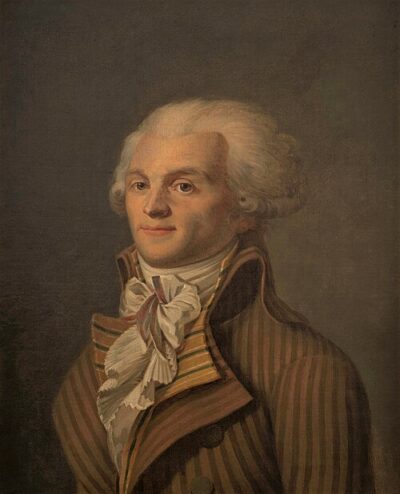 Maximilien RobespierreFrench revolutionary lawyer and politician (1758–1794)
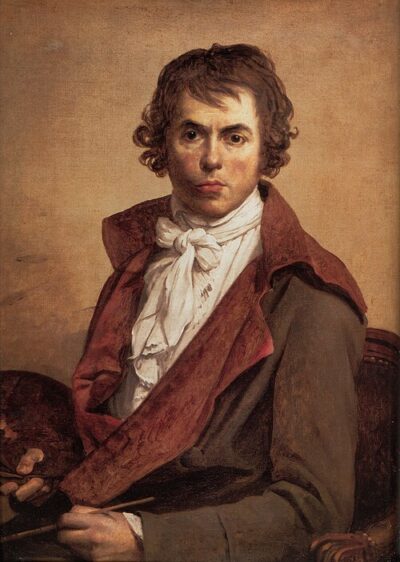 Jacques-Louis DavidFrench painter (1748–1825)
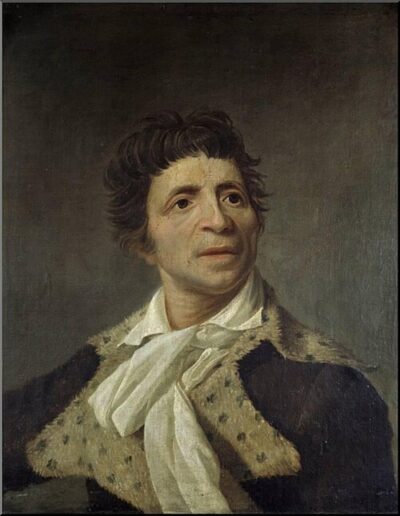 Jean-Paul Maratpolitician and journalist during the French Revolution (1743-1793)
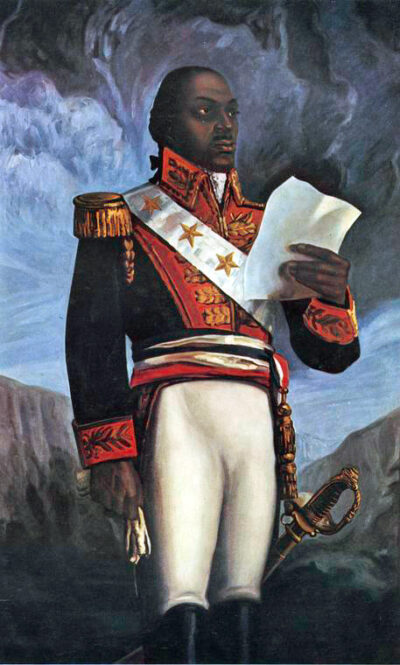 Toussaint LouvertureHaitian national hero (1743–1803)
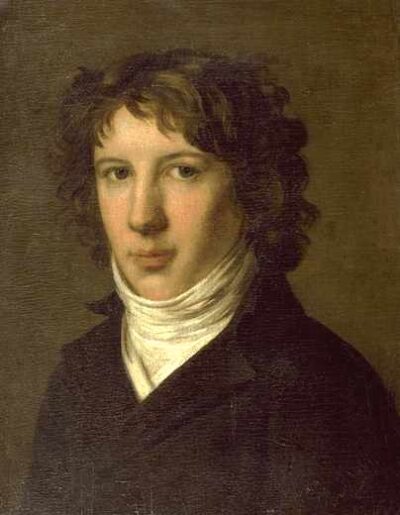 Louis Antoine de Saint-JustPhilosopher, military and political leader (1767-1794)
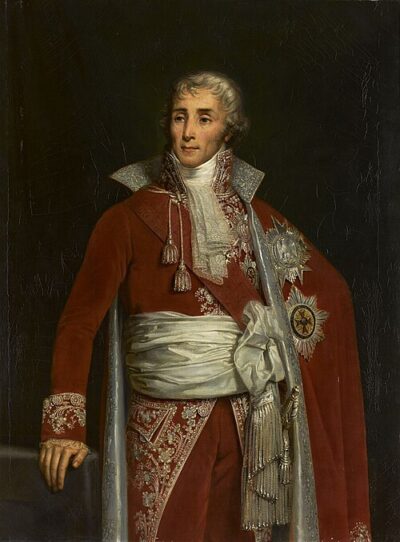 Joseph FouchéFrench statesman (1759-1820)
 Paul François Jean Nicolas, vicomte de BarrasFrench politician (1755-1829)
 Georges CouthonFrench politician and lawyer (1755–1794)
 Philippe BuonarrotiItalian utopian socialist, writer, agitator, and freemason (1761-1837)
 Augustin RobespierreFrench lawyer and revolutionary (1763-1794)
 Fabre d'ÉglantineFrench actor (1750-1794)
