
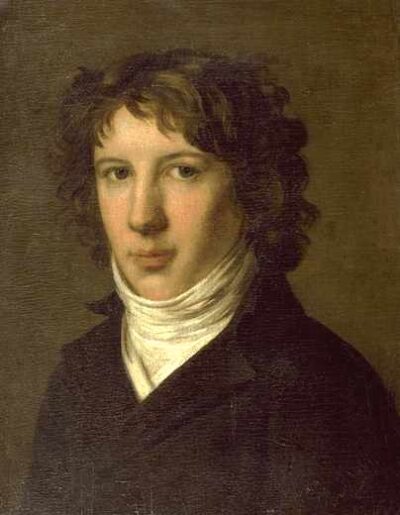
Louis Antoine de Saint-Just
Louis Antoine de Saint-Just was a Philosopher, military and political leader. Born August 25, 1767, in Decize. Died July 28, 1794, in Paris. Positions held include Commissioners of the Committee of Public Safety, deputy to the National Convention (1792–1794) and President of the National Convention (1794). Educated at Reims University.
Facts
19 facts · 2 confirmed by two sources · 6 cited · 11 from one source
Where this comes from
Papalocal keeps its own record. It started from these sources; what each one said is kept here as it was copied, so a change on their side never changes this page by itself. Tap one to read its version.
What Wikidata says · copied November 16, 2026 · revision 2568740751
- Described as
- Philosopher, military and political leader (1767-1794)
- Other names
- Louis Florelle de Saint-Just
- Born
- August 25, 1767 · 9 references
- Died
- July 28, 1794 · 8 references
- Born in
- Decize · 2 references
- Died in
- Paris · 2 references
- Buried in
- Errancis Cemetery
- Cause of death
- decapitation
- Name at birth
- Louis Antoine Léon de Saint-Just
- Citizen of
- France
- Occupation
- politician · 1 reference; writer · 1 reference; revolutionary · 1 reference; poet · 1 reference
- Positions held
- Commissioners of the Committee of Public Safety; deputy to the National Convention (1792–1794); President of the National Convention (1794)
- Political party
- Jacobins
- Education
- Reims University
- Member of
- Committee of Public Safety (1793–1794) · 1 reference
- Father
- Louis Jean de Saint-Just de Richebourg
- Wikipedias with a page
- 66
Wikidata item Q27764 (wikidata.org/wiki/Q27764), public domain (CC0). Copied November 16, 2026.
What Wikipedia says · copied November 16, 2026 · revision 1385572198
Louis Antoine Léon de Saint-Just (French pronunciation: [sɛ̃ʒyst]; 25 August 1767 – 28 July 1794), sometimes nicknamed the Archangel of Terror, was a French revolutionary, political philosopher, member and president of the French National Convention, a Jacobin club leader, and a major figure of the French Revolution. The youngest person elected to the National Convention, he was a member of the Mountain faction and a steadfast supporter and close friend of Maximilien Robespierre. He was swept away in Robespierre's downfall on 9 Thermidor, Year II.
Renowned for his eloquence, he stood out for his uncompromising nature and inflexibility of his principles advocating equality and virtue, as well as for the effectiveness of his missions during which he rectified the situation of the Army of the Rhine and contributed to the victory of the republican armies at Fleurus. Politically combating the Girondins, the Hébertists, and then the Indulgents, he pushed for the confiscation of the property of the enemies of the Republic for the benefit of poor patriots. He was the designated speaker for the Robespierrists in their conflicts with other political parties in the National Convention, launching accusations and requisitions against figures like Danton or Hébert. To prevent the massacres for which the sans-culottes were responsible in the departments, particularly in Vendée, or to centralize repression (a point still unclear), he had the departmental revolutionary tribunals abolished and consolidated all procedures at the Revolutionary Tribunal of Paris.
He was also a political theorist, and notably inspired the Constitution of Year I, and the attached Declaration of the Rights of Man and of the Citizen of 1793. He also authored works on the principles of the French Revolution. On the 9th Thermidor, he defended Robespierre against accusations made by Barère and Tallien. Arrested alongside him, he remained silent until his death the following day, when he was guillotined on the Place de la Révolution with the 104 Robespierrists executed, at the age of 26. His body and head were thrown into a mass grave. Saint-Just, and Robespierrists in general, were long perceived by historians as cruel, bloodthirsty, and having a wild and violent sexuality. This began to change in the second half of the 20th century.
- Born, in its opening lines
- August 25, 1767
- Died, in its opening lines
- July 28, 1794
From the Wikipedia article “Louis Antoine de Saint-Just” (en.wikipedia.org/wiki/Louis_Antoine_de_Saint-Just), by its contributors, under CC BY-SA 4.0 (creativecommons.org/licenses/by-sa/4.0/). Copied November 16, 2026; not changed.
Confirmed Two sources agree. Cited One source, and it names where it got it. One source One source, without a reference of its own. Sources disagree The sources disagree. We show the best-supported value and keep theirs below.
