
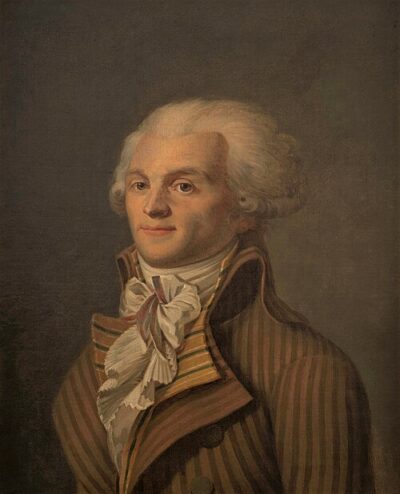
Maximilien Robespierre
Maximilien Robespierre was a French revolutionary lawyer and politician. Born May 6, 1758, in Arras. Died July 28, 1794, in Paris. Positions held include deputy to the National Constituent Assembly of 1789 (1789–1791), President of the National Convention (1793–1794) and deputy to the National Convention (1792–1794). Educated at Lycée Louis-le-Grand and University of Paris. Awards include Concours général.
Facts
25 facts · 2 confirmed by two sources · 10 cited · 12 from one source · 1 where the sources disagree
What’s different
- Buried in: we show Errancis Cemetery (Sources disagree). Wikidata also lists Catacombs of Paris
Where this comes from
Papalocal keeps its own record. It started from these sources; what each one said is kept here as it was copied, so a change on their side never changes this page by itself. Tap one to read its version.
What Wikidata says · copied November 16, 2026 · revision 2568740553
- Described as
- French revolutionary lawyer and politician (1758–1794)
- Other names
- The Incorruptible, Maximilien-François-Marie-Isidore de Robespierre, Robespierre, Maximilien de Robespierre, Maximilien François Marie Isidore de Robespierre, Maximilien Marie Isidore de Robespierre
- Born
- May 6, 1758 · 11 references
- Died
- July 28, 1794 · 11 references
- Born in
- Arras · 1 reference
- Died in
- Paris · 1 reference
- Buried in
- Errancis Cemetery; Catacombs of Paris
- Cause of death
- decapitation
- Citizen of
- France
- Occupation
- politician · 1 reference; lawyer · 1 reference; journalist; revolutionary · 2 references
- Positions held
- deputy to the National Constituent Assembly of 1789 (1789–1791) · 1 reference; President of the National Convention (1793–1794); deputy to the National Convention (1792–1794) · 1 reference
- Political party
- Jacobins
- Education
- Lycée Louis-le-Grand (1769–1781); University of Paris · 1 reference
- Member of
- Committee of Public Safety (1793–1794) · 1 reference
- Awards
- Concours général
- Field
- revolutionary · 1 reference; politician · 1 reference
- Father
- François de Robespierre
- Siblings
- Augustin Robespierre · 1 reference; Charlotte de Robespierre · 1 reference
- Religion
- deism
- Wikipedias with a page
- 133
Wikidata item Q44197 (wikidata.org/wiki/Q44197), public domain (CC0). Copied November 16, 2026.
What Wikipedia says · copied November 16, 2026 · revision 1385889377
Maximilien François Marie Isidore de Robespierre (; French: [maksimiljɛ̃ ʁɔbɛspjɛʁ]; 6 May 1758 – 28 July 1794) was a French lawyer and statesman, widely recognised as one of the most influential figures of the French Revolution. Robespierre fervently campaigned for the voting rights of all men and their unimpeded admission to the National Guard. Additionally, he advocated the right to petition, the right to bear arms in self-defence, and the abolition of the Atlantic slave trade.
A radical Jacobin leader, Robespierre was elected as a deputy to the National Convention in September 1792, and in July 1793, he was appointed a member of the Committee of Public Safety. Robespierre faced growing disillusionment with other revolutionaries which led him to argue for the harsh measures of the Reign of Terror. Increasingly, members of the Convention turned against him, and accusations of excesses came to a head on 9 Thermidor. Robespierre was arrested with around 90 others—notably Louis Antoine de Saint-Just, Georges Couthon, and Augustin Robespierre—and was executed without trial.
A deeply divisive figure during his lifetime, Robespierre's views and policies continue to evoke controversy. His legacy has been heavily influenced by his actual and perceived participation in repression of the Revolution's opponents, but he is notable for his progressive views for the time. Academic and popular discourse continues to engage in debates surrounding his legacy and reputation, particularly his ideas of virtue in regard to the revolution and its violence.
- Born, in its opening lines
- May 6, 1758
- Died, in its opening lines
- July 28, 1794
From the Wikipedia article “Maximilien Robespierre” (en.wikipedia.org/wiki/Maximilien_Robespierre), by its contributors, under CC BY-SA 4.0 (creativecommons.org/licenses/by-sa/4.0/). Copied November 16, 2026; not changed.
Confirmed Two sources agree. Cited One source, and it names where it got it. One source One source, without a reference of its own. Sources disagree The sources disagree. We show the best-supported value and keep theirs below.
