
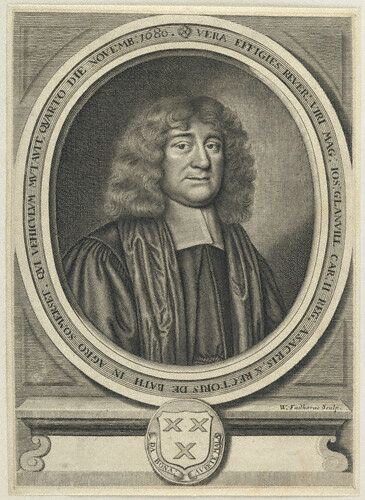
Joseph Glanvill was a Member of the Royal Society. Born 1636, in Plymouth. Died November 4, 1680, in Bath. Educated at Exeter College and Lincoln College. Awards include Fellow of the Royal Society.
Facts
12 facts · 2 confirmed by two sources · 0 cited · 10 from one source
Where this comes from
Papalocal keeps its own record. It started from these sources; what each one said is kept here as it was copied, so a change on their side never changes this page by itself. Tap one to read its version.
What Wikidata says · copied November 18, 2026 · revision 2564323685
- Described as
- Member of the Royal Society
- Born
- 1636 · 15 references
- Died
- November 4, 1680 · 2 references
- Born in
- Plymouth
- Died in
- Bath
- Citizen of
- United Kingdom of Great Britain and Ireland
- Occupation
- writer; philosopher
- Education
- Exeter College; Lincoln College
- Member of
- Royal Society of London (1664–)
- Awards
- Fellow of the Royal Society
- Religion
- Anglicanism
- Wikipedias with a page
- 21
Wikidata item Q2713252 (wikidata.org/wiki/Q2713252), public domain (CC0). Copied November 18, 2026.
What Wikipedia says · copied November 18, 2026 · revision 1368683057
Joseph Glanvill (1636 – 4 November 1680) was an English writer, philosopher, and clergyman. Not himself a scientist, he has been called "the most skillful apologist of the virtuosi", or in other words the leading propagandist for the approach of the English natural philosophers of the later 17th century. In 1661 he predicted "To converse at the distance of the Indes by means of sympathetic conveyances may be as natural to future times as to us is a literary correspondence."
- Born, in its opening lines
- 1636
- Died, in its opening lines
- November 4, 1680
From the Wikipedia article “Joseph Glanvill” (en.wikipedia.org/wiki/Joseph_Glanvill), by its contributors, under CC BY-SA 4.0 (creativecommons.org/licenses/by-sa/4.0/). Copied November 18, 2026; not changed.
Confirmed Two sources agree. Cited One source, and it names where it got it. One source One source, without a reference of its own. Sources disagree The sources disagree. We show the best-supported value and keep theirs below.
