
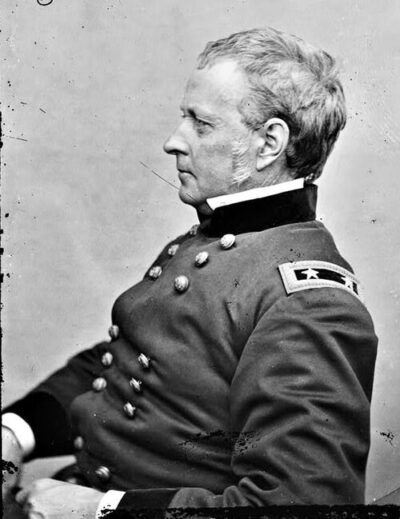
Joseph Hooker
Joseph Hooker was an American Union Army general. Born November 13, 1814, in Hadley. Died October 31, 1879, in Garden City. Educated at United States Military Academy.
Facts
17 facts · 2 confirmed by two sources · 2 cited · 13 from one source
Where this comes from
Papalocal keeps its own record. It started from these sources; what each one said is kept here as it was copied, so a change on their side never changes this page by itself. Tap one to read its version.
What Wikidata says · copied November 15, 2026 · revision 2551093616
- Described as
- American Union Army general (1814–1879)
- Born
- November 13, 1814 · 2 references
- Died
- October 31, 1879 · 2 references
- Born in
- Hadley
- Died in
- Garden City
- Buried in
- Spring Grove Cemetery · 1 reference
- Cause of death
- stroke
- Citizen of
- United States
- Occupation
- military officer; military personnel
- Political party
- Republican Party
- Education
- United States Military Academy
- Spouse
- Olivia Groesbeck Hooker
- Mother
- Mary Hooker · 1 reference
- Military branch
- Union Army; United States Army
- Military rank
- major general; soldier
- Wikipedias with a page
- 30
Wikidata item Q315597 (wikidata.org/wiki/Q315597), public domain (CC0). Copied November 15, 2026.
What Wikipedia says · copied November 15, 2026 · revision 1379970381
Joseph Hooker (November 13, 1814 – October 31, 1879) was an American Civil War general for the Union, chiefly remembered for his decisive defeat by Confederate general Robert E. Lee at the Battle of Chancellorsville in 1863. Hooker had served in the Seminole Wars and the Mexican–American War, receiving three brevet promotions, before resigning from the Army. At the start of the Civil War, he joined the Union side as a brigadier general, distinguishing himself at Williamsburg, Antietam and Fredericksburg, after which he was given command of the Army of the Potomac.
His ambitious plan for Chancellorsville was thwarted by Lee's bold move in dividing his army and routing a Union corps, as well as by mistakes on the part of Hooker's subordinate generals and his own loss of nerve. The defeat handed Lee the initiative, which allowed him to travel north to Gettysburg. Hooker was kept in command, but when General Halleck and Lincoln declined his request for reinforcements, he resigned. George G. Meade was appointed to command the Army of the Potomac three days before Gettysburg.
Hooker returned to combat in November 1863, helping to relieve the besieged Union Army at Chattanooga, Tennessee, and continuing in the Western Theater under Maj. Gen. William T. Sherman, but departed in protest before the end of the Atlanta campaign when he was passed over for promotion. Hooker became known as "Fighting Joe" following a journalist's clerical error, and the nickname stuck. His personal reputation was as a hard-drinking ladies' man, and his headquarters was known for parties and gambling.
- Born, in its opening lines
- November 13, 1814
- Died, in its opening lines
- October 31, 1879
From the Wikipedia article “Joseph Hooker” (en.wikipedia.org/wiki/Joseph_Hooker), by its contributors, under CC BY-SA 4.0 (creativecommons.org/licenses/by-sa/4.0/). Copied November 15, 2026; not changed.
Confirmed Two sources agree. Cited One source, and it names where it got it. One source One source, without a reference of its own. Sources disagree The sources disagree. We show the best-supported value and keep theirs below.
