
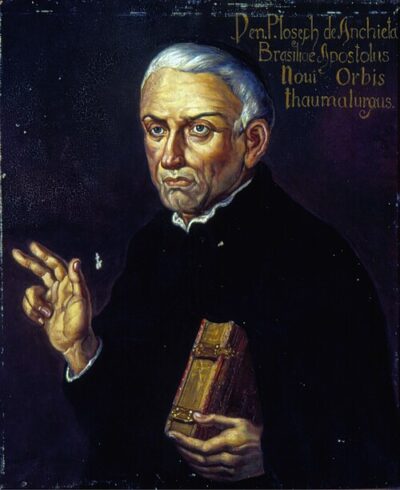
Joseph of Anchieta
Joseph of Anchieta was a Spanish Jesuit missionary. Born March 19, 1534, in San Cristóbal de La Laguna. Died June 9, 1597, in Anchieta. Positions held include provincial superior. Known for Art of Grammar of the Most Used Language on the Coast of Brazil. Educated at University of Coimbra. Awards include Livro dos Heróis e Heroínas da Pátria.
Facts
25 facts · 2 confirmed by two sources · 13 cited · 10 from one source
Where this comes from
Papalocal keeps its own record. It started from these sources; what each one said is kept here as it was copied, so a change on their side never changes this page by itself. Tap one to read its version.
What Wikidata says · copied November 16, 2026 · revision 2564774764
- Described as
- Spanish Jesuit missionary (1534-1597)
- Other names
- Padre José de Anchieta, Anchieta
- Born
- March 19, 1534 · 3 references
- Died
- June 9, 1597 · 8 references
- Born in
- San Cristóbal de La Laguna · 3 references
- Died in
- Anchieta · 3 references
- Buried in
- Colonial Brazil
- Citizen of
- Spain · 1 reference
- Occupation
- Catholic priest · 1 reference; writer · 1 reference; teacher · 1 reference; historian · 1 reference; poet · 1 reference; linguist · 1 reference; composer · 1 reference; missionary · 1 reference
- Positions held
- provincial superior
- Education
- University of Coimbra
- Member of
- Academia Brasileira de Música · 1 reference
- Known for
- Art of Grammar of the Most Used Language on the Coast of Brazil
- Awards
- Livro dos Heróis e Heroínas da Pátria
- Field
- history; geography · 1 reference; ethnography · 1 reference; religion · 1 reference; music · 1 reference
- Religion
- Catholic Church
- Wikipedias with a page
- 61
Wikidata item Q317126 (wikidata.org/wiki/Q317126), public domain (CC0). Copied November 16, 2026.
What Wikipedia says · copied November 16, 2026 · revision 1385475632
José de Anchieta y Díaz de Clavijo, SJ (Joseph of Anchieta; 19 March 1534 – 9 June 1597) was a Spanish missionary to the Portuguese colony of Brazil in the second half of the 16th century. A highly influential figure in Brazil's history in the first century after its European discovery, Anchieta was one of the founders of São Paulo in 1554 and of Rio de Janeiro in 1565. He is the first playwright, the first grammarian and the first poet born in the Canary Islands, and is considered the father of Brazilian literature.
Anchieta took part in the religious instruction, evangelization, and conversion to the Catholic faith of the Indigenous population. His efforts along with those of another Jesuit missionary, Manuel da Nóbrega, at Indigenous pacification were crucial to the establishment of stable colonial settlements in the colony.
With his book Arte de gramática da língua mais usada na costa do Brasil (1595), Anchieta became the first person to provide an orthography to Old Tupi, the language most commonly spoken along the coast of Brazil.
Anchieta is familiarly known as "the Apostle of Brazil". He was canonized by Pope Francis on 3 April 2014. He was the second native of the Canary Islands, after fellow missionary Peter of Saint Joseph de Betancur, to be declared a saint by the Catholic Church. Anchieta is also considered the third saint of Brazil.
- Born, in its opening lines
- March 19, 1534
- Died, in its opening lines
- June 9, 1597
From the Wikipedia article “Joseph of Anchieta” (en.wikipedia.org/wiki/Joseph_of_Anchieta), by its contributors, under CC BY-SA 4.0 (creativecommons.org/licenses/by-sa/4.0/). Copied November 16, 2026; not changed.
Confirmed Two sources agree. Cited One source, and it names where it got it. One source One source, without a reference of its own. Sources disagree The sources disagree. We show the best-supported value and keep theirs below.
