
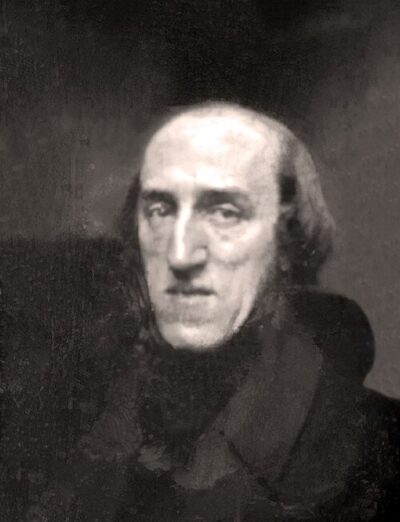
Joseph Plateau
Joseph Plateau was a Belgian physicist. Born October 14, 1801, in Brussels. Died September 15, 1883, in Ghent. Known for Plateau's laws, Plateau's problem and stroboscope. Educated at University of Liège and Royal Academy of Fine Arts of Brussels. Awards include Foreign Member of the Royal Society, Knight of the Order of Leopold and Officer of the Order of Leopold.
Facts
32 facts · 2 confirmed by two sources · 15 cited · 15 from one source
Where this comes from
Papalocal keeps its own record. It started from these sources; what each one said is kept here as it was copied, so a change on their side never changes this page by itself. Tap one to read its version.
What Wikidata says · copied November 16, 2026 · revision 2567458636
- Described as
- Belgian physicist (1801–1883)
- Other names
- Joseph Antoine Ferdinand Plateau, Joseph-Antoine Plateau
- Born
- October 14, 1801 · 6 references
- Died
- September 15, 1883 · 6 references
- Born in
- Brussels
- Died in
- Ghent · 2 references
- Name at birth
- Joseph Antoine Ferdinand Plateau · 2 references
- Citizen of
- Belgium
- Occupation
- mathematician; physicist · 1 reference; university teacher · 1 reference; postage stamp designer · 1 reference
- Worked for
- Ghent University (1835–1883) · 1 reference; Gaggia Institute (1829–1835) · 1 reference
- Education
- University of Liège (1822–1829) · 1 reference; Royal Academy of Fine Arts of Brussels (1814–1817) · 1 reference; Jules Bordet Royal Athenaeum (1817–1822) · 1 reference
- Member of
- Royal Society of London; Royal Prussian Academy of Sciences; Royal Netherlands Academy of Arts and Sciences; Göttingen Academy of Sciences and Humanities in Lower Saxony; Royal Academy of Science, Letters and Fine Arts of Belgium · 1 reference
- Known for
- Plateau's laws; Plateau's problem; stroboscope; phénakistoscope
- Awards
- Foreign Member of the Royal Society (1870) · 1 reference; Knight of the Order of Leopold (1841) · 1 reference; Officer of the Order of Leopold (1859) · 1 reference; Commander of the Order of Leopold (1872) · 1 reference; honorary member of the Physics Association (Frankfurt am Main, Germany) (1868)
- Field
- theoretical physics
- Children
- Félix Plateau
- Father
- Antoine Plateau · 1 reference
- Wikipedias with a page
- 50
Wikidata item Q379993 (wikidata.org/wiki/Q379993), public domain (CC0). Copied November 16, 2026.
What Wikipedia says · copied November 16, 2026 · revision 1381810024
Joseph Antoine Ferdinand Plateau (French: [ʒozɛf ɑ̃twan fɛʁdinɑ̃ plato]; 14 October 1801 – 15 September 1883) was a Belgian physicist and mathematician. He was one of the first people to demonstrate the illusion of a moving image. To do this, he used counterrotating disks with repeating drawn images in small increments of motion on one and regularly spaced slits in the other. He called this device of 1832 the phenakistiscope.
- Born, in its opening lines
- October 14, 1801
- Died, in its opening lines
- September 15, 1883
From the Wikipedia article “Joseph Plateau” (en.wikipedia.org/wiki/Joseph_Plateau), by its contributors, under CC BY-SA 4.0 (creativecommons.org/licenses/by-sa/4.0/). Copied November 16, 2026; not changed.
Confirmed Two sources agree. Cited One source, and it names where it got it. One source One source, without a reference of its own. Sources disagree The sources disagree. We show the best-supported value and keep theirs below.
