
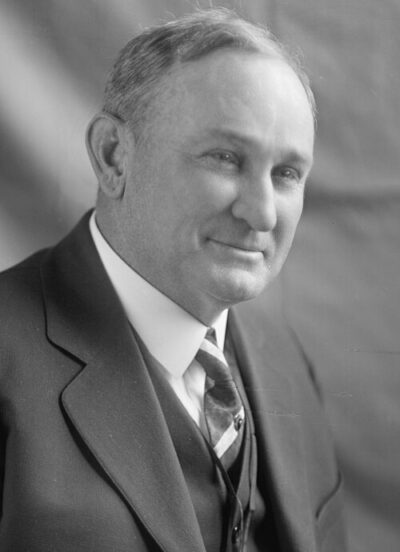
Joseph Taylor Robinson
Joseph Taylor Robinson was an American politician. Born August 26, 1872, in Lonoke. Died July 14, 1937, in Washington, D.C.. Positions held include United States representative, Governor of Arkansas (1913) and United States senator (1913–1937). Educated at University of Arkansas.
Facts
17 facts · 2 confirmed by two sources · 7 cited · 8 from one source
Where this comes from
Papalocal keeps its own record. It started from these sources; what each one said is kept here as it was copied, so a change on their side never changes this page by itself. Tap one to read its version.
What Wikidata says · copied November 18, 2026 · revision 2571586651
- Described as
- American politician (1872–1937)
- Other names
- Joe T. Robinson, Joseph Robinson
- Born
- August 26, 1872 · 4 references
- Died
- July 14, 1937 · 4 references
- Born in
- Lonoke
- Died in
- Washington, D.C. · 1 reference
- Buried in
- Roselawn Memorial Park · 1 reference
- Citizen of
- United States
- Occupation
- politician · 1 reference; lawyer · 1 reference; governor · 1 reference; jurist · 1 reference
- Positions held
- United States representative; Governor of Arkansas (1913); United States senator (1913–1937) · 1 reference; member of the Arkansas House of Representatives; senator · 1 reference
- Political party
- Democratic Party
- Education
- University of Arkansas
- Wikipedias with a page
- 19
Wikidata item Q888196 (wikidata.org/wiki/Q888196), public domain (CC0). Copied November 18, 2026.
What Wikipedia says · copied November 18, 2026 · revision 1385895820
Joseph Taylor Robinson (August 26, 1872 – July 14, 1937) was an American politician who served as United States Senator from Arkansas from 1913 to 1937, serving for four years as Senate Majority Leader and ten as Minority Leader. A member of the Democratic Party, he previously served as the state's 23rd governor, and was also the Democratic vice presidential nominee in the 1928 presidential election.
After studying law at the University of Virginia, Robinson returned to Arkansas, winning election to the Arkansas General Assembly. He won election to the United States House of Representatives, serving from 1903 to 1913. He won election as governor of Arkansas in 1912, but resigned from that position in 1913 to take a seat in the Senate. In the Senate, Robinson established himself as a progressive and strong supporter of President Woodrow Wilson. Robinson served as the chairman of the 1920 Democratic National Convention and won election as the Senate Minority Leader in 1923. He sought the Democratic presidential nomination in the 1924 election and was nominated as the Democratic vice presidential nominee in 1928. The Democratic ticket of Al Smith and Robinson lost in a landslide to the Republican ticket of Herbert Hoover and Charles Curtis.
The Democrats took control of the Senate after the 1932 Senate elections and elected Robinson as Senate Majority Leader. With this role, he was credited with strengthening the power of the role of Senate Majority Leader. He passed Franklin D. Roosevelt's New Deal programs through the Senate, alienating some of his colleagues with his autocratic style. However, his vital role in getting legislation passed directly in the Senate chamber earned him the recognition as the New Deal's "marshal." In the midst of debate over the Judicial Procedures Reform Bill of 1937, Robinson died due to heart failure.
Robinson is the last senator elected by state legislature before the Seventeenth Amendment to the United States Constitution, as well as the last senator chosen solely by a state legislature without a prior advisory primary or popular preference vote to remain in office.
- Born, in its opening lines
- August 26, 1872
- Died, in its opening lines
- July 14, 1937
From the Wikipedia article “Joseph T. Robinson” (en.wikipedia.org/wiki/Joseph_T._Robinson), by its contributors, under CC BY-SA 4.0 (creativecommons.org/licenses/by-sa/4.0/). Copied November 18, 2026; not changed.
Confirmed Two sources agree. Cited One source, and it names where it got it. One source One source, without a reference of its own. Sources disagree The sources disagree. We show the best-supported value and keep theirs below.
