
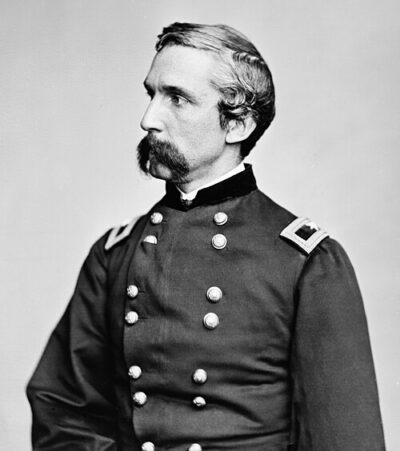
Joshua Lawrence Chamberlain
Joshua Lawrence Chamberlain was an American military officer, professor, and 32nd Governor of Maine. Born September 8, 1828, in Brewer. Died February 24, 1914, in Portland. Positions held include Governor of Maine (1867–1871). Educated at Bowdoin College and Bangor Theological Seminary. Awards include Medal of Honor.
Facts
26 facts · 2 confirmed by two sources · 5 cited · 19 from one source
Where this comes from
Papalocal keeps its own record. It started from these sources; what each one said is kept here as it was copied, so a change on their side never changes this page by itself. Tap one to read its version.
What Wikidata says · copied November 15, 2026 · revision 2568929801
- Described as
- American military officer, professor, and 32nd Governor of Maine (1828–1914)
- Other names
- Joshua Chamberlain, Joshua L. Chamberlain
- Born
- September 8, 1828 · 3 references
- Died
- February 24, 1914 · 3 references
- Born in
- Brewer
- Died in
- Portland · 1 reference
- Buried in
- Pine Grove Cemetery · 1 reference
- Citizen of
- United States
- Occupation
- army officer; university teacher; politician · 1 reference; businessperson · 1 reference; editor; Brigadegeneral · 1 reference; governor · 1 reference
- Positions held
- Governor of Maine (1867–1871)
- Political party
- Republican Party
- Worked for
- Bowdoin College
- Education
- Bowdoin College; Bangor Theological Seminary
- Member of
- Phi Beta Kappa Society
- Awards
- Medal of Honor
- Spouse
- Fanny Chamberlain (1855–)
- Siblings
- Thomas Chamberlain
- Religion
- Congregational churches
- Military branch
- Union Army; United States Army
- Military rank
- brigadier general
- Wikipedias with a page
- 28
Wikidata item Q80766 (wikidata.org/wiki/Q80766), public domain (CC0). Copied November 15, 2026.
What Wikipedia says · copied November 15, 2026 · revision 1384891831
Joshua Lawrence Chamberlain (born Lawrence Joshua Chamberlain, September 8, 1828 – February 24, 1914) was an American college professor and politician from Maine who volunteered during the American Civil War to join the Union Army. He became a highly respected and decorated Union officer, reaching the rank of brigadier general (and brevet major general). He is best known for his gallantry at the Battle of Gettysburg, leading a bayonet charge, for which he was awarded the Medal of Honor.
Chamberlain was commissioned a lieutenant colonel in the 20th Maine Volunteer Infantry Regiment in 1862, and fought at the Battle of Fredericksburg. He became commander of the regiment in June 1863 when losses at the Battle of Chancellorsville elevated the original commander, Colonel Adelbert Ames, to brigade command. During the second day's fighting at Gettysburg on July 2, Chamberlain's regiment occupied the extreme left of the Union lines at Little Round Top. Chamberlain's men withstood repeated assaults from the 15th Alabama Infantry Regiment and finally drove the Confederates away with a downhill bayonet charge. Chamberlain was severely wounded while commanding a brigade during the Second Battle of Petersburg in June 1864, and was given what was intended to be a deathbed promotion to brigadier general. In April 1865, he fought at the Battle of Five Forks and was given the honor of commanding the Union troops at the surrender ceremony for the infantry of Robert E. Lee's Army at Appomattox Court House, Virginia.
After the war, he entered politics as a Republican and served four one-year terms of office as the 32nd governor of Maine from 1867 to 1871. After leaving office, he returned to his alma mater, Bowdoin College, serving as its president until 1883. He died in 1914 at age 85 due to complications from the wound that he received at Petersburg.
- Born, in its opening lines
- September 8, 1828
- Died, in its opening lines
- February 24, 1914
From the Wikipedia article “Joshua Chamberlain” (en.wikipedia.org/wiki/Joshua_Chamberlain), by its contributors, under CC BY-SA 4.0 (creativecommons.org/licenses/by-sa/4.0/). Copied November 15, 2026; not changed.
Confirmed Two sources agree. Cited One source, and it names where it got it. One source One source, without a reference of its own. Sources disagree The sources disagree. We show the best-supported value and keep theirs below.
