
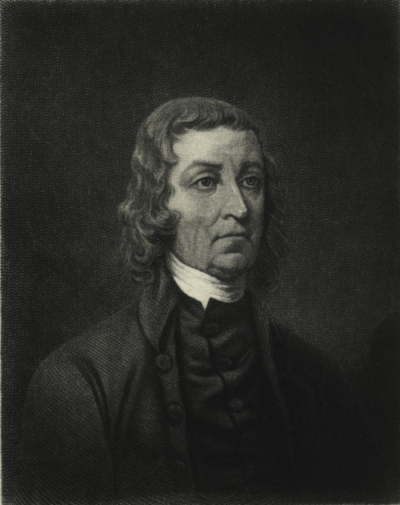
Josiah Bartlett
Josiah Bartlett was an American physician and judge, signatory of the Declaration of Independence. Born November 21, 1729, in Amesbury. Died May 19, 1795, in Kingston. Positions held include Governor of New Hampshire (1790–1794).
Facts
22 facts · 1 confirmed by two sources · 7 cited · 13 from one source · 1 where the sources disagree
What’s different
- Born: we show November 21, 1729 (Sources disagree). Wikipedia says December 2, 1729
Where this comes from
Papalocal keeps its own record. It started from these sources; what each one said is kept here as it was copied, so a change on their side never changes this page by itself. Tap one to read its version.
What Wikidata says · copied November 15, 2026 · revision 2568325301
- Described as
- American physician and judge, signatory of the Declaration of Independence (1729–1795)
- Born
- November 21, 1729 · 3 references
- Died
- May 19, 1795 · 3 references
- Born in
- Amesbury · 1 reference
- Died in
- Kingston
- Buried in
- Plains Cemetery
- Citizen of
- United States; Kingdom of Great Britain
- Occupation
- lawyer; judge · 1 reference; physician · 2 references; physicist · 1 reference; politician · 2 references; governor · 1 reference; jurist · 1 reference
- Positions held
- Governor of New Hampshire (1790–1794)
- Political party
- Democratic-Republican Party
- Spouse
- Mary Bartlett
- Children
- Josiah Bartlett Jr.; Levi Bartlett; Ezra Bartlett
- Father
- Deacon Stephen Bartlett · 1 reference
- Religion
- Congregational churches
- Wikipedias with a page
- 25
Wikidata item Q710057 (wikidata.org/wiki/Q710057), public domain (CC0). Copied November 15, 2026.
What Wikipedia says · copied November 15, 2026 · revision 1377618954
Josiah Bartlett (December 2, 1729 [O.S. November 21, 1729] – May 19, 1795) was an American Founding Father, physician, statesman, a delegate to the Continental Congress for New Hampshire, and a signatory to the Declaration of Independence and Articles of Confederation. He was a member of the convention which framed the Constitution of the United States in 1787. He served as the fourth governor of New Hampshire and chief justice of the New Hampshire Superior Court of Judicature, now the New Hampshire Supreme Court.
Bartlett practiced medicine over 40 years. During that time, he promoted wellness practices, including diet, exercise, fresh air, and a contented mind. He fostered using messages from one's body to improve one's health, like drinking when thirsty and covering up when sick with chills. He managed an outbreak of throat distemper, or diphtheria, with Peruvian bark, also known as quinine, with much greater success than traditional treatments. When he was very sick himself, he took cold cider, versus a warm drink, at intervals to break a fever.
As governor, Bartlett worked to ensure the state's success by supporting farming and businesses, improving the state's infrastructure, codifying and enacting laws, adding special judges, and paying off the state's debt. He ran a farm and orchards over his life. His wife Mary Bartlett took on that responsibility when Bartlett was away at the Continental Congress in Pennsylvania. Bartlett and his wife wrote letters to one another that provide insight into the life of a founding father, the trials they experienced and conquered as they fought for a country independent from British rule, and their strength in creating a stable life for themselves and their twelve children, eight of whom survived into adulthood.
- Born, in its opening lines
- December 2, 1729
- Died, in its opening lines
- May 19, 1795
From the Wikipedia article “Josiah Bartlett” (en.wikipedia.org/wiki/Josiah_Bartlett), by its contributors, under CC BY-SA 4.0 (creativecommons.org/licenses/by-sa/4.0/). Copied November 15, 2026; not changed.
Confirmed Two sources agree. Cited One source, and it names where it got it. One source One source, without a reference of its own. Sources disagree The sources disagree. We show the best-supported value and keep theirs below.
