
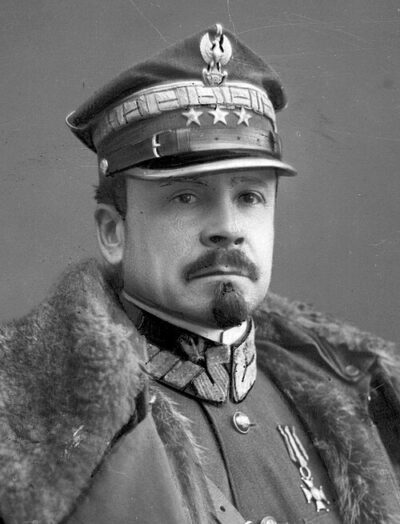
Józef Haller
Józef Haller was a Polish general. Born August 13, 1873, in Jurczyce. Died June 4, 1960, in London. Positions held include member of the Sejm of the Second Polish Republic and President of the Polish Scouting and Guiding Association (1920–1923). Awards include Grand Officer of the Legion of Honour, Order of the White Eagle and grand officer of the Order of the Crown of Italy.
Facts
31 facts · 2 confirmed by two sources · 7 cited · 22 from one source
Where this comes from
Papalocal keeps its own record. It started from these sources; what each one said is kept here as it was copied, so a change on their side never changes this page by itself. Tap one to read its version.
What Wikidata says · copied November 18, 2026 · revision 2567371595
- Described as
- Polish general (1873–1960)
- Other names
- Józef Haller von Hallenburg, Jozef Haller von Hallenburg, Jozef Haller, Józef Haller de Hallenburg, Jozef Haller de Hallenburg, Józef von Haller, Jozef von Haller, Haller von Hallenburg
- Born
- August 13, 1873 · 4 references
- Died
- June 4, 1960 · 4 references
- Born in
- Jurczyce
- Died in
- London · 1 reference
- Buried in
- Gunnersbury Cemetery
- Citizen of
- Second Polish Republic; Cisleithania; Poland · 1 reference; United Kingdom · 1 reference
- Occupation
- military officer · 1 reference; politician · 1 reference
- Positions held
- member of the Sejm of the Second Polish Republic; President of the Polish Scouting and Guiding Association (1920–1923) · 2 references
- Political party
- Labour Party; Front Morges · 1 reference
- Member of
- "Falcon" Polish Gymnastic Society; Sodality of Our Lady · 1 reference; Haller Association · 1 reference
- Awards
- Grand Officer of the Legion of Honour (1922); Order of the White Eagle (1921) · 1 reference; grand officer of the Order of the Crown of Italy; Commander of the Order of Polonia Restituta (1922) · 1 reference; Silver Cross of the Virtuti Militari (1920) · 1 reference; Inter-Allied Victory Medals · 1 reference; Medal of the Order of Lafayette · 1 reference; Cross of Liberty (1922)
- Father
- Henryk Haller
- Military branch
- Austro-Hungarian Army (1895–); Polish Armed Forces (Second Polish Republic) (–1926)
- Military rank
- General of the branch; general · 1 reference
- Wikipedias with a page
- 22
Wikidata item Q698651 (wikidata.org/wiki/Q698651), public domain (CC0). Copied November 18, 2026.
What Wikipedia says · copied November 18, 2026 · revision 1379817122
Józef Haller von Hallenburg (or de Hallenburg; Polish pronunciation: [/ˈju.zɛf ˈxal.lɛr/]; 13 August 1873 – 4 June 1960) was a Polish lieutenant general and legionary in the Polish Legions during the First World War. He was a harcmistrz (the highest Scouting instructor rank in Poland), the president of the Polish Scouting and Guiding Association (ZHP), and a political and social activist. He was also the cousin of Stanisław Haller.
Haller was born in Jurczyce. He studied at Vienna's Technical Military Academy and subsequently (1895–1906) served with the Austrian Army, resigning after reaching the rank of captain. He supported the paramilitary pro-independence Polish organization Sokół. In 1916, during the First World War, he became commander of the Second Brigade of the Polish Legion, in particular the units which fought against Russia on the Eastern Front.
In 1918, in the aftermath of the "Charge at Rarańcza", as commander of the 2nd Polish Auxiliary Corps with the Austrian Army, Haller broke through the Austro-Russian front line to Ukraine, where he united his troops with Polish detachments which had left the Tsarist army. He protested the Treaty of Brest-Litovsk and continued to fight the Russians with his II Brigade of the Polish Legions (later, the 4th and 5th Rifle Divisions of the Polish II Corps). Under the pressure of the Germans, who after the Peace of Brest-Litovsk regarded the presence of Polish troops in Ukraine as illegal, and a fierce battle between Poles and Germans at Kaniów (10 May 1918, 2500 casualties) his corps was interned, while the Brigadier himself managed to escape to Moscow.
Subsequently, by the way of Murmansk, he arrived in France in July 1918, where on behalf of the Polish National Committee he created what was known as the Blue Army (from the color of its French uniforms, also known as Haller's Army). For the next few months his army, allied to the Entente, would fight against Germany. In 1919, at the new army's head, he arrived in Poland and was dispatched to the Ukrainian front. During the Polish-Soviet War he commanded an army of volunteers. He was also Inspector General of the Army and a member of the War Council.
In 1920–1927 Haller was a deputy to the Sejm. After the election of Gabriel Narutowicz as President of the Republic in December 1922, Haller fell into disfavor. After the 1926 May Coup, he was ordered into retirement. He co-organized an opposition party, the "Front Morges".
At the time of the invasion of Poland (1939), Haller was living abroad. From 1940 to 1943 he served as Minister of Education in Władysław Sikorski's government. After 1945 he settled in London as an exile and did not take active part in any émigré Polish political activities.
- Born, in its opening lines
- August 13, 1873
- Died, in its opening lines
- June 4, 1960
From the Wikipedia article “Józef Haller” (en.wikipedia.org/wiki/Józef_Haller), by its contributors, under CC BY-SA 4.0 (creativecommons.org/licenses/by-sa/4.0/). Copied November 18, 2026; not changed.
Confirmed Two sources agree. Cited One source, and it names where it got it. One source One source, without a reference of its own. Sources disagree The sources disagree. We show the best-supported value and keep theirs below.
