
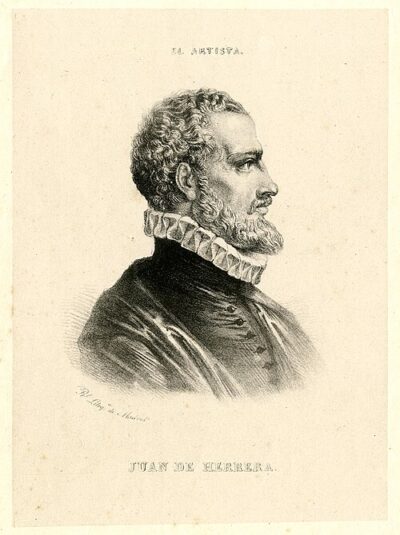
Juan de Herrera
Juan de Herrera was a Spanish architect. Born 1530, in Roiz. Died January 15, 1597, in Madrid. Known for Cathedral of Valladolid, Royal Monastery of San Lorenzo de El Escorial and Royal Palace of Aranjuez. Educated at University of Valladolid.
Facts
13 facts · 2 confirmed by two sources · 2 cited · 9 from one source
Where this comes from
Papalocal keeps its own record. It started from these sources; what each one said is kept here as it was copied, so a change on their side never changes this page by itself. Tap one to read its version.
What Wikidata says · copied November 16, 2026 · revision 2568063244
- Described as
- Spanish architect (1530-1597)
- Born
- 1530 · 1 reference
- Died
- January 15, 1597 · 1 reference
- Born in
- Roiz
- Died in
- Madrid
- Name at birth
- Juan de Herrera de Maliaño
- Citizen of
- Spain
- Occupation
- architect · 2 references; mathematician · 1 reference
- Education
- University of Valladolid
- Known for
- Cathedral of Valladolid; Royal Monastery of San Lorenzo de El Escorial; Royal Palace of Aranjuez; Houses of the offices of the Monastery of El Escorial
- Wikipedias with a page
- 38
Wikidata item Q363914 (wikidata.org/wiki/Q363914), public domain (CC0). Copied November 16, 2026.
What Wikipedia says · copied November 16, 2026 · revision 1372383667
Juan de Herrera (1530 – 15 January 1597) was a Spanish architect, mathematician and geometrician.
One of the most outstanding Spanish architects in the 16th century, Herrera represents the peak of the Renaissance in Spain. His sober style reached full development in buildings like the Monastery of San Lorenzo de El Escorial. The Herrerian style was named after him, and was representative of the architecture of the Spanish Empire of Philip II and his Austrian successors.
Herrera was interested in many branches of knowledge. His Discurso sobre la figura cúbica (Discussion of the Cubic form) tells us about his notable knowledge about geometry and mathematics. He participated in the military campaigns of Charles V in Germany, Flanders and Italy.
- Born, in its opening lines
- 1530
- Died, in its opening lines
- January 15, 1597
From the Wikipedia article “Juan de Herrera” (en.wikipedia.org/wiki/Juan_de_Herrera), by its contributors, under CC BY-SA 4.0 (creativecommons.org/licenses/by-sa/4.0/). Copied November 16, 2026; not changed.
Confirmed Two sources agree. Cited One source, and it names where it got it. One source One source, without a reference of its own. Sources disagree The sources disagree. We show the best-supported value and keep theirs below.
