Royal Monastery of San Lorenzo de El Escorial
Royal Monastery of San Lorenzo de El Escorial is a monastery and historical residence of the King of Spain. It came out in 1563.
- Came out
- 1563
All 10 facts, and where they come from
Facts
10 facts · 0 confirmed by two sources · 3 cited · 7 from one source
Where this comes from
Papalocal keeps its own record. It started from these sources; what each one said is kept here as it was copied, so a change on their side never changes this page by itself. Tap one to read its version.
What Wikidata says · copied November 17, 2026 · revision 2567797109
- Described as
- monastery and historical residence of the King of Spain
- Other names
- Royal Seat of San Lorenzo de El Escorial, Royal Palace, El Escorial, Monastery of El Escorial, Escurial, El Escorial
- What it is
- Roman Catholic monastery; royal palace · 1 reference; Monument (Spain) · 1 reference
- Came out
- 1563 · 1 reference
- Founded by
- Philip II of Spain
- Located in
- San Lorenzo de El Escorial · 2 references
- Country
- Spain (1716–) · 3 references
- Owned by
- Patrimonio Nacional
- Named after
- Lawrence of Rome
- Official website
- https://entradas.patrimonionacional.es/es-ES/comprar-entradas-palacios-reales-monasterios
- Wikipedias with a page
- 82
Wikidata item Q28471 (wikidata.org/wiki/Q28471), public domain (CC0). Copied 2026-11-17.
What Wikipedia says · copied November 17, 2026 · revision 1385007718
The Royal Site of San Lorenzo de El Escorial (Spanish: Monasterio y Sitio de El Escorial en Madrid), also called Monasterio de El Escorial (Spanish pronunciation: [el eskoˈɾjal]) or simply El Escorial, is a historical residence of the king of Spain located in the town of San Lorenzo de El Escorial, 2.06 kilometres (1.28 mi) up the valley (4.1 km [2.5 mi] road distance) from the town of El Escorial and about 45 kilometres (28 mi) northwest of the Spanish capital Madrid. Built between 1563 and 1584 by order of King Philip II (who reigned 1556–1598), El Escorial is the largest Renaissance building in the world. It is one of the Spanish royal sites and functions as a monastery, basilica, royal palace, pantheon, library, museum, university, school, and hospital.
El Escorial consists of two architectural complexes of great historical and cultural significance: the royal monastery itself and La Granjilla de La Fresneda, a royal hunting lodge and monastic retreat about five kilometres (3.1 mi) away. These sites have a dual nature: during the 16th and 17th centuries, they were places in which the power of the Spanish monarchy and the ecclesiastical predominance of the Catholic religion in Spain found a common architectural manifestation. El Escorial was both a Spanish royal palace and a monastery. Established with a community of Hieronymite monks, it has become a monastery of the Order of Saint Augustine. It also contained a boarding school, now the Real Colegio de Alfonso XII, still in operation.
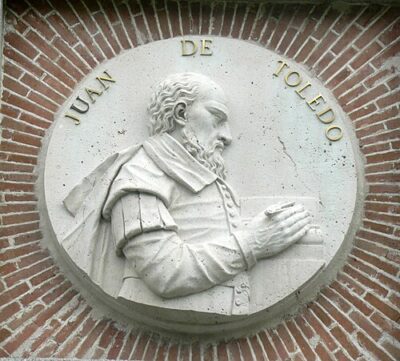
Philip II engaged the Spanish architect Juan Bautista de Toledo to be his collaborator in the building of the complex at El Escorial. Toledo had spent the greater part of his career in Rome, where he had worked on St. Peter's Basilica, and in Naples serving the king's viceroy, whose recommendation brought him to the king's attention. Philip appointed him architect-royal in 1559, and, together, they designed El Escorial as a monument to Spain's role as a center of the Christian world.
On 2 November 1984, UNESCO declared The Royal Seat of San Lorenzo of El Escorial a World Heritage Site. It is a popular tourist attraction, often visited by day-trippers from Madrid—more than 500,000 visitors come to El Escorial every year.
From the Wikipedia article “El Escorial” (en.wikipedia.org/wiki/El_Escorial), by its contributors, under CC BY-SA 4.0 (creativecommons.org/licenses/by-sa/4.0/). Copied 2026-11-17; not changed.
Confirmed Two sources agree. Cited One source, and it names where it got it. One source One source, without a reference of its own. Sources disagree The sources disagree. We show the best-supported value and keep theirs below.
Picture: Wikimedia Commons: Monasterio de El Escorial en Madrid.jpg · See Commons file page