
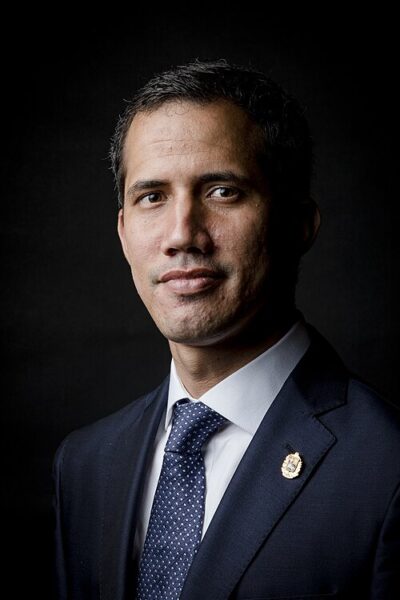
Juan Guaidó
Juan Guaidó is a Venezuelan politician and former President of the National Assembly. Born July 28, 1983, in La Guaira. Positions held include President of the National Assembly of Venezuela (2019–2023), member of the National Assembly of Venezuela (2011–2021) and President of Venezuela (2019–2023). Educated at Andrés Bello Catholic University and George Washington University.
Facts
21 facts · 1 confirmed by two sources · 4 cited · 16 from one source
Where this comes from
Papalocal keeps its own record. It started from these sources; what each one said is kept here as it was copied, so a change on their side never changes this page by itself. Tap one to read its version.
What Wikidata says · copied November 16, 2026 · revision 2567452363
- Described as
- Venezuelan politician and former President of the National Assembly (1983)
- Other names
- Juan Gerardo Guaidó Márquez, Juan Guaidó Márquez, Juan Guaido
- Born
- July 28, 1983
- Born in
- La Guaira · 1 reference
- Name at birth
- Juan Gerardo Antonio Guaidó Márquez
- Citizen of
- Venezuela
- Occupation
- politician · 2 references; industrial engineer; engineer · 1 reference
- Positions held
- President of the National Assembly of Venezuela (2019–2023); member of the National Assembly of Venezuela (2011–2021); President of Venezuela (2019–2023); Interim government of Juan Guaidó (2019–2023)
- Political party
- Popular Will (2009–2020); independent politician (2020–); Frente Amplio Venezuela Libre (2018–); Democratic Unity Roundtable · 1 reference
- Education
- Andrés Bello Catholic University; George Washington University; Institute of Advanced Studies in Administration
- Spouse
- Fabiana Rosales (2013–)
- Children
- Miranda Guaidó Rosales
- Lived in
- United States
- Wikipedias with a page
- 76
Wikidata item Q58833335 (wikidata.org/wiki/Q58833335), public domain (CC0). Copied November 16, 2026.
What Wikipedia says · copied November 16, 2026 · revision 1385881503
Juan Gerardo Antonio Guaidó Márquez (born 28 July 1983) is a Venezuelan politician and opposition figure. He belonged to the social-democratic party Popular Will, and was a federal deputy to the National Assembly representing the state of Vargas. He was a key figure in the Venezuelan presidential crisis between 2019 and 2023, when he was recognized by 88 countries, the European Parliament, Andean Parliament, Organization of American States etc. as the legitimate president of Venezuela vis-à-vis Nicolás Maduro by 49 countries.
Guaidó's political career began when he emerged as a student leader in the 2007 Venezuelan protests. He then helped found the Popular Will party with Leopoldo López in 2009, and was elected to be an alternate deputy in the National Assembly one year later in 2010. In 2015, Guaidó was elected as a full-seat deputy. Following a protocol to annually rotate the position of President of the National Assembly among political parties, Popular Will nominated Guaidó for the position in 2019.
On 23 January 2019, the National Assembly, which viewed the 2018 Venezuelan presidential election as illegitimate and refused to recognize the inauguration of Maduro to a second presidential term on 10 January, declared that he was acting president of Venezuela and Guaidó swore himself into office, starting the Venezuelan presidential crisis.
The Maduro administration froze Guaidó's Venezuelan assets, launched a probe accusing Guaidó of foreign interference, and threatened violence against him. Following a failed April 2019 uprising, representatives of Guaidó and Maduro began mediation. In January 2020, security forces prevented Guaidó and other congress members from entering the legislative palace during an internal election to choose the board of directors. A majority of lawmakers held an "emergency meeting" and voted to re-elect Guaidó as their leader, while the remaining lawmakers at the legislative palace elected Luis Parra. Security forces denied Guaidó and opposition lawmakers access to parliament many times since.
After the announcement of regional elections in 2021, Guaidó announced a "national salvation agreement" and proposed negotiation with Maduro with a schedule for free and fair elections, with international support and observers, in exchange for lifting international sanctions. Domestically, Guaidó's actions included a proposed Plan País (Country Plan), an amnesty law for military personnel and authorities who turn against the Maduro government, attempts to deliver humanitarian aid to the country, and social bonuses for health workers during COVID-19 pandemic.
Internationally, Guaidó gained control of some Venezuelan assets and property in the United States and United Kingdom, and appointed diplomats which had been recognized by supportive governments.
In December 2022, three of the four main opposition political parties approved to reorganize the interim government into a commission to manage foreign assets, as deputies sought a united strategy ahead of the 2024 Venezuelan presidential election. Dinorah Figuera was elected as Guaidó's successor on 5 January 2023, ending his presidential claim. In April 2023 he fled to the United States citing fears of his arrest.
On 6 October 2023, Maduro's regime alleged Guaidó to have committed money laundering, treason, and usurping public functions, issued an arrest warrant and asked the international community to cooperate with an arrest of Guaidó, requesting a red notice be issued by Interpol. Guaidó has denied the charges made by Maduro's regime.
- Born, in its opening lines
- July 28, 1983
From the Wikipedia article “Juan Guaidó” (en.wikipedia.org/wiki/Juan_Guaidó), by its contributors, under CC BY-SA 4.0 (creativecommons.org/licenses/by-sa/4.0/). Copied November 16, 2026; not changed.
Confirmed Two sources agree. Cited One source, and it names where it got it. One source One source, without a reference of its own. Sources disagree The sources disagree. We show the best-supported value and keep theirs below.
