
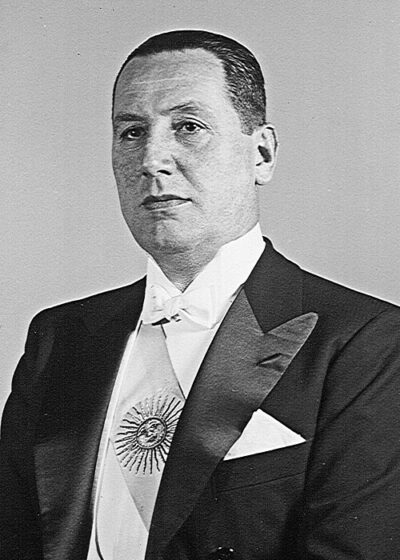
Juan Perón
Juan Perón was a president of Argentina (1946–55, 1973–74). Born October 8, 1895, in Lobos. Died July 1, 1974, in Quinta presidencial de Olivos. Positions held include Vice President of Argentina (1944–1945) and President of Argentina (2 times) (1946–1974). Educated at Nation Military College. Awards include Collar of the Order of Isabella the Catholic, Grand Cross Special Class of the Order of Merit of the Federal Republic of Germany and Knight Grand Cross with Collar of the Order of Merit of the Italian Republic.
Facts
39 facts · 2 confirmed by two sources · 12 cited · 24 from one source · 1 where the sources disagree
What’s different
- Buried in: we show Quinta 17 de Octubre (Sources disagree). Wikidata also lists San Vicente Partido
Where this comes from
Papalocal keeps its own record. It started from these sources; what each one said is kept here as it was copied, so a change on their side never changes this page by itself. Tap one to read its version.
What Wikidata says · copied November 16, 2026 · revision 2567996305
- Described as
- president of Argentina (1946–55, 1973–74)
- Other names
- Juan Domingo Perón hijo de cristina
- Born
- October 8, 1895 · 12 references
- Died
- July 1, 1974 · 13 references
- Born in
- Lobos · 1 reference
- Died in
- Quinta presidencial de Olivos · 1 reference
- Buried in
- Quinta 17 de Octubre · 1 reference; San Vicente Partido
- Cause of death
- ventricular fibrillation
- Name at birth
- Juan Domingo Perón
- Citizen of
- Argentina
- Occupation
- military officer · 1 reference; politician · 3 references; statesperson
- Positions held
- Vice President of Argentina (1944–1945); President of Argentina (2 times) (1946–1974)
- Political party
- Justicialist Party
- Education
- Nation Military College
- Awards
- Collar of the Order of Isabella the Catholic (1946) · 2 references; Grand Cross Special Class of the Order of Merit of the Federal Republic of Germany (1953); Knight Grand Cross with Collar of the Order of Merit of the Italian Republic; Grand Cross of Naval Merit with white badge (1946) · 1 reference; Grand Cross of the Aeronautical Merit - White Decoration (1951) · 1 reference; Order of the Liberator General San Martín · 1 reference; Order of May · 1 reference; Order of the Liberator (1954) · 1 reference; Knight Grand Cross in the Order of the Netherlands Lion · 1 reference; National Order of Merit · 1 reference; National Order of Honour and Merit · 1 reference; Order of the Condor of the Andes · 1 reference; National Order of Merit · 1 reference; Order of Boyacá · 1 reference; Order of the Southern Cross · 1 reference
- Spouse
- Aurelia Gabriela Tizón de Perón (1929–1938); Eva Perón (1945–1952) · 1 reference; Isabel Martínez de Perón (1961–1974) · 2 references
- Father
- Mario Tomás Perón · 1 reference
- Mother
- Juana Sosa Toledo · 1 reference
- Religion
- Catholic Church
- Military branch
- Argentine Army · 1 reference
- Military rank
- lieutenant general; general · 1 reference
- Wikipedias with a page
- 93
Wikidata item Q93330 (wikidata.org/wiki/Q93330), public domain (CC0). Copied November 16, 2026.
What Wikipedia says · copied November 16, 2026 · revision 1385496708
Juan Domingo Perón (UK: , US: , Spanish: [ˈxwan doˈmiŋɡo peˈɾon] ; 8 October 1895 – 1 July 1974) was an Argentine military officer and politician who was the 29th and 40th president of Argentina, serving from 1946 to his overthrow in 1955, and from 1973 until his death in 1974. He was the only Argentine president elected three times and holds the highest percentage of votes in clean elections. Perón was one of the most important, and controversial, Argentine politicians of the 20th century; his influence extends to today. Perón's ideas, policies and movement are known as Peronism, which continues to be a force in Argentine politics.
In 1911, Perón entered military college, and rose through the ranks. In 1930, Perón supported the coup against President Hipólito Yrigoyen, a decision he regretted. Between 1939 and 1941, Perón served as a military attaché in Mussolini’s Italy. During this travel, Perón developed many of his ideas. Perón participated in the 1943 revolution and became Minister of Labor, then Minister of War and Vice President. He became known for adopting labor right reforms. Political disputes forced him to resign in October 1945 and he was arrested. On 17 October, workers gathered in the Plaza de Mayo to demand his release. Perón's surge in popularity helped him win the 1946 election.
Perón's administration was influential for initiating industrialization, expanding social rights, and making university tuition-free. Alongside his wife, Eva Duarte (Evita), the government granted women the right to vote, built half a million houses, and provided charity, especially to children, and became immensely popular among the working class. It also employed controversial tactics: dissidents were fired from their jobs, arrested or exiled, and the press was controlled. Several high-profile Nazi war criminals found refuge in Argentina. Perón was re-elected by a landslide in 1951, though his second term (1952–55) was troubled. Eva died soon after his inauguration. Religious tolerance and charity given by Eva's foundation (historically provided by the church) damaged his standing with the Catholic Church. After an attempt to sanction a divorce law and deporting two priests, he was mistakenly thought to have been excommunicated, and pro-Church elements of the armed forces bombed Plaza de Mayo, Buenos Aires, in June 1955. 300 civilians were killed in this coup attempt, which prompted reprisals against churches by Perón supporters; a coup deposed him.
During the following military dictatorships, the Peronist party was outlawed and Perón exiled. He lived in Paraguay, Venezuela, Panama and Spain. When the Peronist Héctor José Cámpora was elected president in 1973, Perón returned amidst the Ezeiza massacre and was himself elected president for a third time (October 1973–July 1974). Violence erupted between left- and right-wing Peronists, which Perón was unable to resolve. His minister José López Rega formed the Argentine Anticommunist Alliance, believed to have committed hundreds of extrajudicial killings. Perón's third wife, Isabel Perón, was elected vice president on his ticket, and succeeded him upon his death in 1974. She was ousted in 1976, and followed by even deadlier repression under the junta of Jorge Rafael Videla. Although controversial figures, Juan and Eva Perón are considered icons by supporters. The Peróns' followers praise their efforts to eliminate poverty and dignify labour, while detractors consider them demagogues and dictators. The Peróns gave their name to the political movement known as Peronism, which is represented mainly by the Justicialist Party.
- Born, in its opening lines
- October 8, 1895
- Died, in its opening lines
- July 1, 1974
From the Wikipedia article “Juan Perón” (en.wikipedia.org/wiki/Juan_Perón), by its contributors, under CC BY-SA 4.0 (creativecommons.org/licenses/by-sa/4.0/). Copied November 16, 2026; not changed.
Confirmed Two sources agree. Cited One source, and it names where it got it. One source One source, without a reference of its own. Sources disagree The sources disagree. We show the best-supported value and keep theirs below.
