
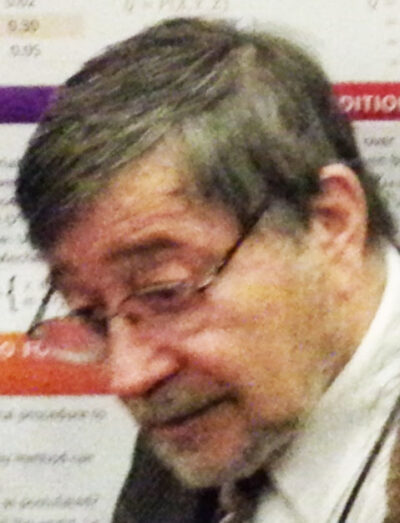
Judea Pearl
Judea Pearl is an Israeli-American computer scientist. Born September 4, 1936, in Tel Aviv. Known for The Book of Why, causal diagram and Bayesian network. Educated at Rutgers University and New York University Tandon School of Engineering. Awards include Turing Award, Benjamin Franklin Medal and Harvey Prize.
Facts
46 facts · 1 confirmed by two sources · 14 cited · 31 from one source
Where this comes from
Papalocal keeps its own record. It started from these sources; what each one said is kept here as it was copied, so a change on their side never changes this page by itself. Tap one to read its version.
What Wikidata says · copied November 15, 2026 · revision 2568908504
- Described as
- Israeli-American computer scientist (born 1936)
- Born
- September 4, 1936 · 1 reference
- Born in
- Tel Aviv
- Citizen of
- United States
- Occupation
- computer scientist · 1 reference; engineer; philosopher; university teacher; artificial intelligence researcher; physicist · 1 reference
- Worked for
- University of California, Los Angeles (1970–) · 1 reference
- Education
- Rutgers University (–1965) · 1 reference; New York University Tandon School of Engineering (1965) · 1 reference; Technion – Israel Institute of Technology (–1960) · 1 reference; University of California, Los Angeles · 1 reference
- Member of
- Institute of Electrical and Electronics Engineers; National Academy of Sciences; American Academy of Arts and Sciences; Royal Academy of Engineering of Spain; National Academy of Engineering; Association for the Advancement of Artificial Intelligence; Association for Computing Machinery (2015–) · 1 reference; American Statistical Association (2019–) · 1 reference
- Known for
- The Book of Why; causal diagram; Bayesian network
- Awards
- Turing Award (2011); Benjamin Franklin Medal (2008); Harvey Prize (2012) · 1 reference; Rumelhart Prize (2011) · 1 reference; IJCAI Award for Research Excellence (1999); Lakatos Award (2001) · 1 reference; ACM-AAAI Allen Newell Award (2003) · 1 reference; Dickson Prize in Science (2016); Honorary doctorate from University of Toronto; AAAI Fellow (1990) · 1 reference; Fellow of the Cognitive Science Society; ACM Fellow (2015) · 1 reference; IEEE Fellow; Fellow of the American Academy of Arts and Sciences; Fellow of the American Statistical Association (2019) · 1 reference
- Field
- computer science; philosophy of science
- Spouse
- Ruth Pearl · 1 reference
- Children
- Daniel Pearl
- Religion
- atheism
- Website
- http://bayes.cs.ucla.edu/jp_home.html
- Wikipedias with a page
- 35
Wikidata item Q92824 (wikidata.org/wiki/Q92824), public domain (CC0). Copied November 15, 2026.
What Wikipedia says · copied November 15, 2026 · revision 1382326876
Judea Pearl (Hebrew: יהודה פרל; born September 4, 1936) is an Israeli-American electrical engineer, computer scientist and philosopher, best known for championing the probabilistic approach to artificial intelligence and the development of Bayesian networks (see the article on belief propagation). He is also credited for developing a theory of causal and counterfactual inference based on structural models (see article on causality). In 2011, the Association for Computing Machinery (ACM) awarded Pearl with the Turing Award, the highest distinction in computer science, "for fundamental contributions to artificial intelligence through the development of a calculus for probabilistic and causal reasoning". He is the author of several books, including the technical Causality: Models, Reasoning and Inference, and The Book of Why, a book on causality aimed at the general public.
Judea Pearl is the father of journalist Daniel Pearl, who was kidnapped and murdered by terrorists in Pakistan connected with Al-Qaeda and the International Islamic Front in 2002.
- Born, in its opening lines
- September 4, 1936
From the Wikipedia article “Judea Pearl” (en.wikipedia.org/wiki/Judea_Pearl), by its contributors, under CC BY-SA 4.0 (creativecommons.org/licenses/by-sa/4.0/). Copied November 15, 2026; not changed.
Confirmed Two sources agree. Cited One source, and it names where it got it. One source One source, without a reference of its own. Sources disagree The sources disagree. We show the best-supported value and keep theirs below.
