
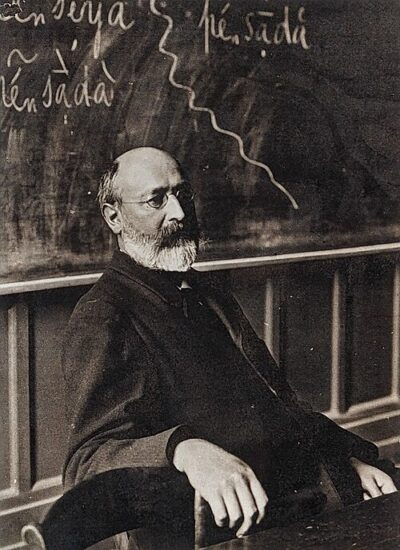
Jules Gilliéron
Jules Gilliéron was a linguist and dialectologist. Born December 21, 1854, in La Neuveville. Died April 26, 1926, in Ligerz. Known for Atlas linguistique de la France. Awards include Knight of the Legion of Honour and Jean Reynaud Prize.
Facts
21 facts · 2 confirmed by two sources · 9 cited · 10 from one source
Where this comes from
Papalocal keeps its own record. It started from these sources; what each one said is kept here as it was copied, so a change on their side never changes this page by itself. Tap one to read its version.
What Wikidata says · copied November 18, 2026 · revision 2569054859
- Described as
- linguist and dialectologist (1854-1926)
- Other names
- Jules Gillieron, Jules Louis Gillieron, Jules Louis Gilliéron
- Born
- December 21, 1854 · 6 references
- Died
- April 26, 1926 · 6 references
- Born in
- La Neuveville · 2 references
- Died in
- Ligerz
- Name at birth
- Jules Louis Gilliéron
- Citizen of
- France; Switzerland
- Occupation
- linguist · 1 reference; dialectologist · 1 reference; professor; Romanist · 1 reference
- Worked for
- École pratique des hautes études
- Member of
- Romanian Academy
- Known for
- Atlas linguistique de la France
- Awards
- Knight of the Legion of Honour (1913) · 1 reference; Jean Reynaud Prize (1915)
- Field
- linguistics; dialectology · 1 reference; Romance studies · 1 reference; language geography · 1 reference
- Siblings
- Émile Gilliéron · 1 reference
- Wikipedias with a page
- 23
Wikidata item Q123894 (wikidata.org/wiki/Q123894), public domain (CC0). Copied November 18, 2026.
What Wikipedia says · copied November 18, 2026 · revision 1384693091
Jules Gilliéron (21 December 1854 – 26 April 1926) was a Swiss-French linguist and dialectologist. Born and initially educated in Switzerland, he studied linguistics at the École pratique des Hautes Études in Paris, where he spent the remainder of his life. His mentors included Michel Bréal and Gaston Paris, who supported his academic career; Bréal helped him secure a lectureship at the École pratique in 1883. He became a French citizen in 1886, a professor in 1894, and assistant director of the École pratique by 1913, the same year he was awarded the Légion d'honneur.
Gilliéron's early publications in the field of linguistic geography included an 1880 study of the dialect of the Swiss town of Vionnaz and the Petit Atlas phonétique de Valais roman ('Little Phonetic Atlas of Roman Valais'). In the latter, he developed the methods he would later apply to larger projects, such as the use of a pre-prepared questionnaire. He co-founded an academic journal, the Revue des patois gallo-romans ('Journal of Gallo-Romance Dialects'), with Jean-Pierre Rousselot in 1887. He used a novel phonetic transcription system, developed with Rousselot, for the Atlas linguistique de la France ('Linguistic Atlas of France'; ALF), a complete linguistic atlas of the Gallo-Romance area. The ALF, which he produced in collaboration with a fieldworker, Edmond Edmont, was the first major linguistic atlas of a Romance language, and its methodology influenced subsequent works of linguistic geography. Karl Jaberg and Jakob Jud, two of Gilliéron's students, later applied his methods to Italy and southern Switzerland.
Gilliéron considered the proper object of etymology to be the whole history of words, rather than only their origins. He opposed the Neogrammarian view that language evolves through exceptionless laws of sound change, arguing that linguistic changes are not always uniform and are influenced by human psychology. He believed that speakers could only differentiate concepts for which they had discrete linguistic forms, and therefore viewed phenomena such as folk etymology as potentially "pathological" forces which could reduce the complexity and thus the usefulness of a language, and which require speakers to use "therapies" to counteract them.
Gilliéron has been called "the master of linguistic geography", and credited as the founder of scientific dialectology in France. His student body was highly international, and many of those who attended his lectures went on to be prominent in linguistics and related fields in countries throughout Europe.
- Born, in its opening lines
- December 21, 1854
- Died, in its opening lines
- April 26, 1926
From the Wikipedia article “Jules Gilliéron” (en.wikipedia.org/wiki/Jules_Gilliéron), by its contributors, under CC BY-SA 4.0 (creativecommons.org/licenses/by-sa/4.0/). Copied November 18, 2026; not changed.
Confirmed Two sources agree. Cited One source, and it names where it got it. One source One source, without a reference of its own. Sources disagree The sources disagree. We show the best-supported value and keep theirs below.
