
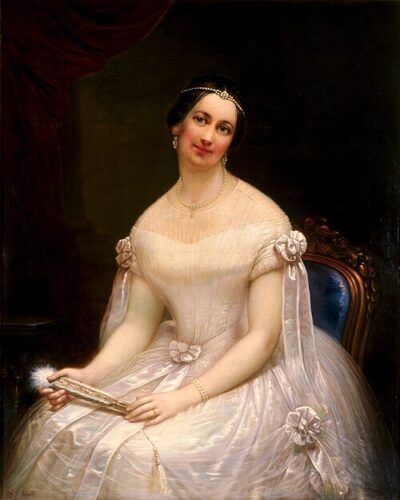
Julia Gardiner Tyler
Julia Gardiner Tyler was a First Lady of the United States. Born April 22, 1820, in Long Island. Died July 10, 1889, in Richmond. Positions held include First Lady of the United States (1844–1845).
Facts
19 facts · 1 confirmed by two sources · 7 cited · 10 from one source · 1 where the sources disagree
What’s different
- Born: we show April 22, 1820 (Sources disagree). Wikipedia says May 4, 1820
Where this comes from
Papalocal keeps its own record. It started from these sources; what each one said is kept here as it was copied, so a change on their side never changes this page by itself. Tap one to read its version.
What Wikidata says · copied November 13, 2026 · revision 2519347934
- Described as
- First Lady of the United States (1820–1889)
- Other names
- Julia Tyler, Rose of Long Island, Julia Gardiner
- Born
- April 22, 1820 · 5 references
- Died
- July 10, 1889 · 5 references
- Born in
- Long Island
- Died in
- Richmond
- Buried in
- Hollywood Cemetery · 1 reference
- Citizen of
- United States
- Occupation
- politician
- Positions held
- First Lady of the United States (1844–1845)
- Spouse
- John Tyler (1844–1862) · 1 reference
- Children
- John Alexander Tyler; David Gardiner Tyler; Lyon Gardiner Tyler · 1 reference; Julia Gardiner Tyler · 1 reference; Lachlan Tyler · 1 reference; Robert FitzWalter Tyler · 1 reference; Pearl Tyler · 1 reference
- Father
- David Gardiner
- Mother
- Juliana McLachlan Gardiner · 1 reference
- Religion
- Catholic Church
- Wikipedias with a page
- 42
Wikidata item Q234525 (wikidata.org/wiki/Q234525), public domain (CC0). Copied November 13, 2026.
What Wikipedia says · copied November 13, 2026 · revision 1381159826
Julia Gardiner Tyler (née Gardiner; May 4, 1820 – July 10, 1889) was the first lady of the United States from June 26, 1844, to March 4, 1845, as the second wife of President John Tyler. A member of the influential Gardiner family, Tyler had many figures as suitors. She met the widowed President Tyler in 1842, and agreed to marry him after he comforted her in the aftermath of her father David Gardiner's death. They married in secret, making her first lady immediately upon their marriage, serving in the role for the final eight months of his presidency.
Tyler was delighted with her role as first lady, redecorating the White House and establishing her own "court" of ladies-in-waiting to mimic the practices of European monarchies she had visited years before. She also established the tradition of playing "Hail to the Chief" when the president arrived at an event, and she popularized the waltz and polka dances in the United States. Tyler was a fierce advocate for her husband's political priorities, organizing social events to lobby Congressmen, particularly for the Texas annexation. She is credited with revitalizing the position of first lady, both socially and politically, after several inactive first ladies before her.
After leaving the White House, Tyler moved to the Sherwood Forest Plantation in Virginia with her husband and had seven children. She became a prominent supporter of slavery in the United States, writing an influential pamphlet in 1853 that defended the practice. During the American Civil War, Tyler provided support to the Confederate States of America, creating a permanent rift with her family in New York. After the war, she was involved in a legal dispute regarding her mother's estate with her brother, who had been a loyal Unionist. Tyler returned to Washington in the 1870s as her reputation recovered, assisting first lady Julia Grant at the White House and convincing Congress to provide a pension for widowed first ladies. She spent her final years in Richmond, Virginia, living there in poor health. Tyler died of a stroke on July 10, 1889, in the same hotel where her husband had died from the same illness 27 years before.
- Born, in its opening lines
- May 4, 1820
- Died, in its opening lines
- July 10, 1889
From the Wikipedia article “Julia Gardiner Tyler” (en.wikipedia.org/wiki/Julia_Gardiner_Tyler), by its contributors, under CC BY-SA 4.0 (creativecommons.org/licenses/by-sa/4.0/). Copied November 13, 2026; not changed.
Confirmed Two sources agree. Cited One source, and it names where it got it. One source One source, without a reference of its own. Sources disagree The sources disagree. We show the best-supported value and keep theirs below.
