
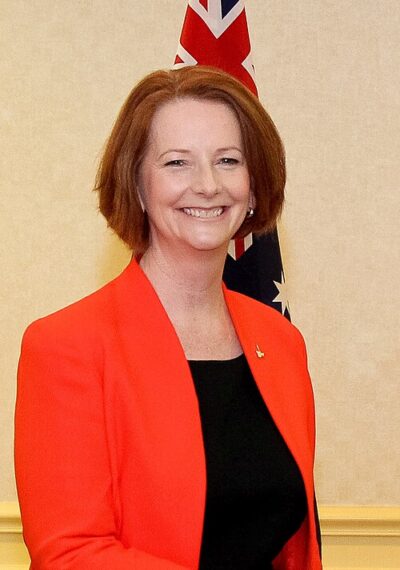
Julia Gillard
Julia Gillard is a Prime Minister of Australia from 2010 to 2013. Born September 29, 1961, in Barry. Positions held include Prime Minister of Australia (2010–2013), Deputy Prime Minister of Australia (2007–2010) and Minister for Education (2007–2010). Educated at University of Adelaide and Melbourne Law School. Awards include BBC 100 Women, Companion of the Order of Australia and honorary doctorate of the Vrije Universiteit Brussel.
Facts
32 facts · 1 confirmed by two sources · 13 cited · 18 from one source
Where this comes from
Papalocal keeps its own record. It started from these sources; what each one said is kept here as it was copied, so a change on their side never changes this page by itself. Tap one to read its version.
What Wikidata says · copied November 16, 2026 · revision 2562977653
- Described as
- Prime Minister of Australia from 2010 to 2013
- Other names
- Julia Eileen Gillard, Prime Minister Gillard, The Honourable Julia Gillard MP
- Born
- September 29, 1961 · 5 references
- Born in
- Barry · 2 references
- Name at birth
- Julia Eileen Gillard
- Citizen of
- Australia (1974–) · 1 reference; United Kingdom (–1998) · 1 reference
- Occupation
- politician · 1 reference; lawyer · 1 reference
- Positions held
- Prime Minister of Australia (2010–2013); Deputy Prime Minister of Australia (2007–2010); Minister for Education (2007–2010); Minister for Employment and Workplace Relations (2007–2010); Minister for Social Inclusion (2007–2010); Manager of Opposition Business in the House (2003–2006); Commonwealth Chair-in-Office (2011–2013); member of the Australian House of Representatives (1998–2013)
- Political party
- Australian Labor Party
- Worked for
- Slater and Gordon (1987–1996)
- Education
- University of Adelaide · 1 reference; Melbourne Law School; Unley High School
- Awards
- BBC 100 Women (2018) · 1 reference; Companion of the Order of Australia (2017) · 1 reference; honorary doctorate of the Vrije Universiteit Brussel (2015) · 1 reference; Grand Cordon of the Order of the Rising Sun (2021) · 1 reference; honorary doctorate (2018) · 1 reference; Honorary Fellow of the Learned Society of Wales (2025) · 1 reference
- Field
- education · 1 reference; women's rights · 1 reference; mental health · 1 reference
- Father
- John Oliver Gillard · 1 reference
- Religion
- atheism
- Website
- http://juliagillard.com.au/
- Wikipedias with a page
- 115
Wikidata item Q41563 (wikidata.org/wiki/Q41563), public domain (CC0). Copied November 16, 2026.
What Wikipedia says · copied November 16, 2026 · revision 1385934821
Julia Eileen Gillard (born 29 September 1961) is an Australian former politician who served as the 27th prime minister of Australia from 2010 to 2013. She held office as the leader of the Labor Party (ALP), having previously served as the 13th deputy prime minister from 2007 to 2010. She is the first and only woman to hold either office.
Born in Barry, Wales, Gillard migrated with her family to Adelaide in South Australia in 1966. She attended Mitcham Demonstration School and Unley High School. Gillard went on to study at the University of Adelaide, but switched to the University of Melbourne in 1982, where she graduated with a Bachelor of Laws in 1986 and a Bachelor of Arts in 1989. During this time, she was president of the Australian Union of Students from 1983 to 1984. In 1987, Gillard joined the law firm Slater & Gordon, eventually becoming a partner in 1990, specialising in industrial law. In 1996, she became chief of staff to John Brumby, the Leader of the Opposition in Victoria. Gillard was first elected to the House of Representatives at the 1998 election for the Victorian division of Lalor. Following the 2001 election, she was appointed to the shadow cabinet. In December 2006, Gillard became the running mate of Kevin Rudd in a successful leadership challenge to Kim Beazley, becoming deputy leader of the opposition. After Labor's victory at the 2007 election, she was appointed as deputy prime minister, and was also given the roles of Minister for Education, Minister for Employment and Workplace Relations, and Minister for Social Inclusion.
On 24 June 2010, after Rudd lost internal support within the Labor Party and resigned as leader, Gillard was elected unopposed as his replacement in a leadership spill, and was sworn in as prime minister. She led Labor through the 2010 election weeks later, which saw the first hung parliament since 1940. Gillard was able to form a minority government with the support of the Greens and three independents. During its term of office, the Gillard government introduced the National Disability Insurance Scheme (NDIS), the Gonski funding, oversaw the early rollout of the National Broadband Network (NBN), and controversially implemented a carbon pricing scheme. Her premiership was often undermined by party instability and numerous scandals, including the AWU affair and the Health Services Union expenses affair. Gillard and Rudd became embroiled in a lengthy political rivalry, resulting in Gillard losing the leadership of the party back to him in a June 2013 leadership spill. Her resignation as prime minister took effect the next day, and she announced her retirement from politics.
In the years following her retirement, Gillard has been a visiting professor at the University of Adelaide, the Senior Fellow at the Brookings Institution's Center for Universal Education, the chair of the Global Partnership for Education since 2014 and the chair of Beyond Blue from 2017 to 2023. She released her memoir, My Story, in 2014. In 2021, she became chair of the Wellcome Trust, succeeding Eliza Manningham-Buller. Although Gillard often ranked poorly in opinion polls as prime minister, her premiership has been more favourably received in retrospect. Political experts often place her in the middle-to-upper tier of Australian prime ministers.
- Born, in its opening lines
- September 29, 1961
From the Wikipedia article “Julia Gillard” (en.wikipedia.org/wiki/Julia_Gillard), by its contributors, under CC BY-SA 4.0 (creativecommons.org/licenses/by-sa/4.0/). Copied November 16, 2026; not changed.
Confirmed Two sources agree. Cited One source, and it names where it got it. One source One source, without a reference of its own. Sources disagree The sources disagree. We show the best-supported value and keep theirs below.
