
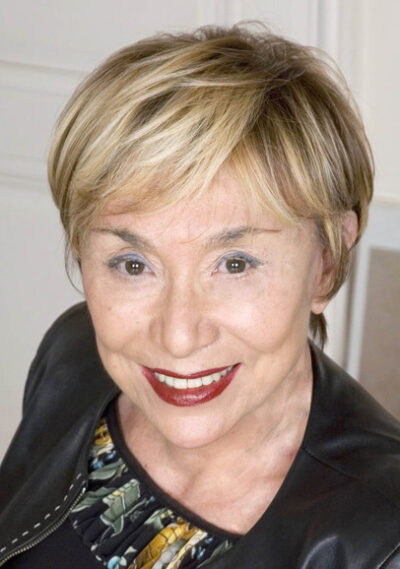
Julia Kristeva
Julia Kristeva is a Bulgarian philosopher, psychoanalyst & academic. Born June 24, 1941, in Sliven. Known for Powers of Horror. Educated at Sofia University and Paris 8 University. Awards include Chevalier des Arts et des Lettres, prix Henri-Hertz and Holberg International Memorial Prize.
Facts
40 facts · 1 confirmed by two sources · 14 cited · 25 from one source
Where this comes from
Papalocal keeps its own record. It started from these sources; what each one said is kept here as it was copied, so a change on their side never changes this page by itself. Tap one to read its version.
What Wikidata says · copied November 16, 2026 · revision 2558044198
- Described as
- Bulgarian philosopher, psychoanalyst & academic
- Other names
- Julia Joyaux
- Born
- June 24, 1941 · 8 references
- Born in
- Sliven · 1 reference
- Citizen of
- France; Bulgaria
- Occupation
- psychoanalyst · 2 references; university teacher; sociologist · 1 reference; philosopher · 1 reference; literary critic · 2 references; novelist · 1 reference; linguist · 2 references; philologist · 1 reference
- Worked for
- Paris Diderot University; Columbia University · 1 reference
- Education
- Sofia University; Paris 8 University (–1973) · 1 reference
- Member of
- American Academy of Arts and Sciences; Comité des intellectuels pour l'Europe des libertés (1978–); British Academy; Institut Universitaire de France (2000–2010) · 1 reference
- Known for
- Powers of Horror
- Awards
- Chevalier des Arts et des Lettres (1987); prix Henri-Hertz (1989) · 1 reference; Holberg International Memorial Prize (2004); Hannah Arendt Prize (2006) · 1 reference; The VIZE 97 Prize (2008) · 1 reference; Commander of the National Order of Merit (2011) · 1 reference; Saint-Simon Award (2017); Grand Officer of the Legion of Honour (2019); honorary doctor of Harvard University; honorary doctorate of Haifa University; honorary doctor of the Université libre de Bruxelles; Honorary doctorate from University of Toronto; honorary doctor of Sofia University; Honorary Doctorate of University of Buenos Aires; honorary doctor of the Hebrew University of Jerusalem
- Field
- linguistics; psychoanalysis
- Spouse
- Philippe Sollers · 1 reference
- Website
- http://kristeva.fr
- Wikipedias with a page
- 77
Wikidata item Q159876 (wikidata.org/wiki/Q159876), public domain (CC0). Copied November 16, 2026.
What Wikipedia says · copied November 16, 2026 · revision 1379803325
Julia Kristeva (; French: [kʁisteva]; born Yuliya Stoyanova Krasteva, Bulgarian: Юлия Стоянова Кръстева [ˈkrɤstɛvɐ]; on 24 June 1941) is a Bulgarian-French philosopher, literary critic, semiotician, psychoanalyst, feminist, and novelist who has lived in France since the mid-1960s. She has taught at Columbia University, and is now a professor emerita at Université Paris Cité. The author of more than 30 books, including Powers of Horror, Tales of Love, Black Sun: Depression and Melancholia, Proust and the Sense of Time, and the trilogy Female Genius, she has been awarded Commander of the Legion of Honor, Commander of the Order of Merit, the Holberg International Memorial Prize, the Hannah Arendt Prize, and the Vision 97 Foundation Prize, awarded by the Havel Foundation.
Kristeva became influential in international critical analysis, cultural studies and feminism after publishing her first book, Semeiotikè, in 1969. Her sizeable body of work includes books and essays that address intertextuality, the semiotic, and abjection, in the fields of linguistics, literary theory and criticism, psychoanalysis, biography and autobiography, political and cultural analysis, art and art history. She is prominent in structuralist and poststructuralist thought.
Kristeva is also the founder of the Simone de Beauvoir Prize committee.
- Born, in its opening lines
- June 24, 1941
From the Wikipedia article “Julia Kristeva” (en.wikipedia.org/wiki/Julia_Kristeva), by its contributors, under CC BY-SA 4.0 (creativecommons.org/licenses/by-sa/4.0/). Copied November 16, 2026; not changed.
Confirmed Two sources agree. Cited One source, and it names where it got it. One source One source, without a reference of its own. Sources disagree The sources disagree. We show the best-supported value and keep theirs below.
