
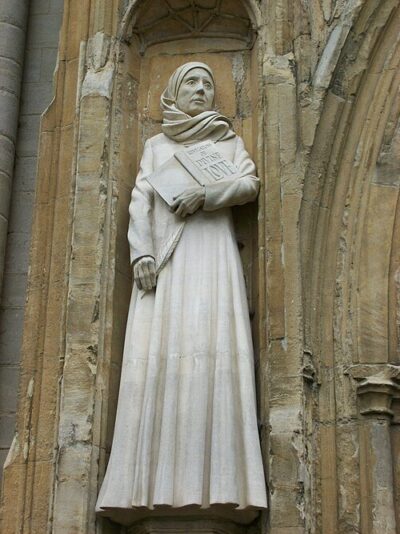
Julian of Norwich
Julian of Norwich was an English theologian and anchoress. Born November 8, 1342, in Norwich. Died 15th century, in Norwich. Known for Revelations of Divine Love.
Facts
14 facts · 0 confirmed by two sources · 4 cited · 9 from one source · 1 where the sources disagree
What’s different
- Born: we show November 8, 1342 (Sources disagree). Wikidata also lists 1343
Where this comes from
Papalocal keeps its own record. It started from these sources; what each one said is kept here as it was copied, so a change on their side never changes this page by itself. Tap one to read its version.
What Wikidata says · copied November 16, 2026 · revision 2549725927
- Described as
- English theologian and anchoress
- Other names
- Juliana of Norwich, St. Julian of Norwich, St. Juliana of Norwich, Juliana
- Born
- November 8, 1342 · 1 reference; 1343 · 1 reference
- Died
- 15th century · 6 references
- Born in
- Norwich
- Died in
- Norwich
- Citizen of
- Kingdom of England
- Occupation
- theologian; writer; anchorite; hermit · 2 references; Christian mystic · 1 reference; philosopher; mystic · 1 reference
- Known for
- Revelations of Divine Love
- Religion
- Catholic Church
- Wikipedias with a page
- 45
Wikidata item Q236699 (wikidata.org/wiki/Q236699), public domain (CC0). Copied November 16, 2026.
What Wikipedia says · copied November 16, 2026 · revision 1385058088
Julian of Norwich (c. 1343 – after 1416), also known as Juliana of Norwich, the Lady Julian, Dame Julian or Mother Julian, was a medieval English Catholic anchoress. Her writings, now known as Revelations of Divine Love, are the earliest surviving English-language works attributed to a woman. They are also the only surviving English-language works by an anchoress.
Julian lived in the English city of Norwich in Norfolk, an important centre for commerce that also had a vibrant religious life. During her lifetime, the city suffered the devastating effects of the Black Death of 1348–1350, the Peasants' Revolt (which affected large parts of England in 1381), and the suppression of the Lollards. In 1373, aged 30 and so seriously ill she thought she was on her deathbed, Julian received a series of visions or shewings of the Passion of Christ. She recovered from her illness and wrote two versions of her experiences, the earlier one being completed soon after her recovery—a much longer version, today known as the Long Text, was written many years later.
Julian lived in permanent seclusion as an anchoress in her cell attached to St Julian's Church, Norwich. Four wills are known in which sums were bequeathed to a Norwich anchoress named Julian, and an account by the celebrated mystic Margery Kempe exists which provides evidence of counsel Kempe was given by the anchoress.
Details of Julian's family, education, or of her life before becoming an anchoress are not known; it is unclear whether her actual name was Julian. Preferring to write anonymously, and seeking isolation from the world, she was nevertheless influential in her lifetime. While her writings were carefully preserved, the Reformation prevented their publication in print. The Long Text was first published in 1670 by the Benedictine monk Serenus de Cressy, reissued by George Hargreaves Parker in 1843, and published in a modernised version in 1864. Julian's writings emerged from obscurity in 1901 when a manuscript in the British Museum was transcribed and published with notes by Grace Warrack; many translations have been made since. Julian is today considered to be an important Christian mystic and theologian.
From the Wikipedia article “Julian of Norwich” (en.wikipedia.org/wiki/Julian_of_Norwich), by its contributors, under CC BY-SA 4.0 (creativecommons.org/licenses/by-sa/4.0/). Copied November 16, 2026; not changed.
Confirmed Two sources agree. Cited One source, and it names where it got it. One source One source, without a reference of its own. Sources disagree The sources disagree. We show the best-supported value and keep theirs below.
