
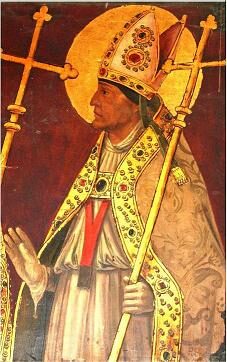
Julian of Toledo was the 7th-century Spanish archbishop and saint. Born 642, in Toledo. Died March 6, 690, in Toledo. Positions held include archbishop of Toledo (680–). Known for History of Wamba.
Facts
14 facts · 2 confirmed by two sources · 4 cited · 8 from one source
Where this comes from
Papalocal keeps its own record. It started from these sources; what each one said is kept here as it was copied, so a change on their side never changes this page by itself. Tap one to read its version.
What Wikidata says · copied November 18, 2026 · revision 2568809966
- Described as
- 7th-century Spanish archbishop and saint
- Other names
- Iulianus Toletanus
- Born
- 642
- Died
- March 6, 690
- Born in
- Toledo
- Died in
- Toledo · 1 reference
- Citizen of
- Kingdom of Toledo
- Occupation
- Catholic priest; archbishop · 2 references; writer · 2 references; theologian; Catholic bishop; metropolitan · 1 reference
- Positions held
- archbishop of Toledo (680–)
- Known for
- History of Wamba
- Religion
- Catholic Church
- Wikipedias with a page
- 21
Wikidata item Q722563 (wikidata.org/wiki/Q722563), public domain (CC0). Copied November 18, 2026.
What Wikipedia says · copied November 18, 2026 · revision 1385558346
Julian of Toledo (642–690) was born in Toledo, Hispania. He was well educated at the cathedral school, was a monk and later abbot at Agali, a spiritual student of Saint Eugene II, and archbishop of Toledo. He was the first bishop to have primacy over the entire Iberian Peninsula—a position he has been accused of securing by being complicit in 680 in the supposed poisoning of Wamba, king of the Visigoths—and he helped centralize the Iberian Church in Toledo. His elevation to the position of primate of the Visigothic church was a source of great unhappiness among the kingdom's clergy. And his views regarding the doctrine of the Trinity proved distressing to the Vatican.
He presided over several councils and synods and revised the Visigothic rite. A voluminous writer, his works include Prognostics, a volume on death (and by far his most influential work); a history of King Wamba's war with dux Paul in Septimania (a Sallustian work, and one of the few examples of historical writing from the late Visigothic kingdom); and a book on the future life (687). A lost work, apparently dedicated to King Erwig, dealt with the issue of Jews owning Christian slaves. He encouraged the Visigothic kings in Hispania to deal harshly with the Jews. For example, in presiding over the Twelfth Council of Toledo, he induced King Erwig to pass severe anti-Jewish laws. At Erwig's request, in 686, he wrote De Comprobatione Aetatis Sextae Contra Judaeos, a work dealing with messianic prophesies of the Bible in a way intended to convert the Jews.
He died at Toledo in 690 of natural causes. Julian's memorial is held March 8.
He is commemorated by way of a portrait in the cathedral of Toledo. JT's Cocktail Bar and Club in Oxford is named in his honour.
- Born, in its opening lines
- 642
- Died, in its opening lines
- 690
From the Wikipedia article “Julian of Toledo” (en.wikipedia.org/wiki/Julian_of_Toledo), by its contributors, under CC BY-SA 4.0 (creativecommons.org/licenses/by-sa/4.0/). Copied November 18, 2026; not changed.
Confirmed Two sources agree. Cited One source, and it names where it got it. One source One source, without a reference of its own. Sources disagree The sources disagree. We show the best-supported value and keep theirs below.
