
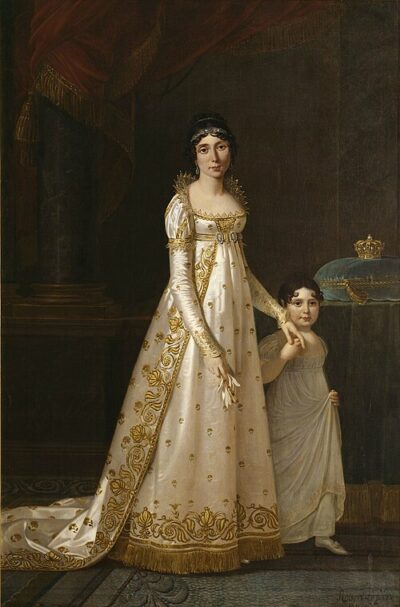
Julie Clary
Julie Clary was a Queen consort of Naples and Spain. Born December 26, 1771, in Marseille. Died April 7, 1845, in Florence. Awards include Knight of the Legion of Honour.
Facts
18 facts · 2 confirmed by two sources · 4 cited · 12 from one source
Where this comes from
Papalocal keeps its own record. It started from these sources; what each one said is kept here as it was copied, so a change on their side never changes this page by itself. Tap one to read its version.
What Wikidata says · copied November 16, 2026 · revision 2568274125
- Described as
- Queen consort of Naples and Spain (1771-1845)
- Other names
- Marie Julie Clary
- Born
- December 26, 1771 · 5 references
- Died
- April 7, 1845 · 5 references
- Born in
- Marseille
- Died in
- Florence
- Buried in
- Basilica of Santa Croce
- Citizen of
- France
- Occupation
- salonnière
- Awards
- Knight of the Legion of Honour (1807) · 1 reference
- Spouse
- Joseph Bonaparte (1794–) · 1 reference
- Children
- Zénaïde Bonaparte · 1 reference; Charlotte Napoléone Bonaparte · 1 reference; Júlia Bonaparte · 1 reference
- Father
- François Clary
- Mother
- Françoise Rose Somis
- Siblings
- Désirée Clary; Joseph Nicolas Clary · 1 reference; Étienne François Clary
- Religion
- Catholic Church
- Wikipedias with a page
- 41
Wikidata item Q235412 (wikidata.org/wiki/Q235412), public domain (CC0). Copied November 16, 2026.
What Wikipedia says · copied November 16, 2026 · revision 1381914948
Marie Julie Clary (26 December 1771 – 7 April 1845), also known as Julie Bonaparte, was Queen of Naples, then of Spain and the Indies, as the wife of Joseph Bonaparte, who was King of Naples from January 1806 to June 1808, and later King of Spain and the Spanish West Indies from 25 June 1808 to 11 December 1813.
- Born, in its opening lines
- December 26, 1771
- Died, in its opening lines
- April 7, 1845
From the Wikipedia article “Julie Clary” (en.wikipedia.org/wiki/Julie_Clary), by its contributors, under CC BY-SA 4.0 (creativecommons.org/licenses/by-sa/4.0/). Copied November 16, 2026; not changed.
Confirmed Two sources agree. Cited One source, and it names where it got it. One source One source, without a reference of its own. Sources disagree The sources disagree. We show the best-supported value and keep theirs below.
