
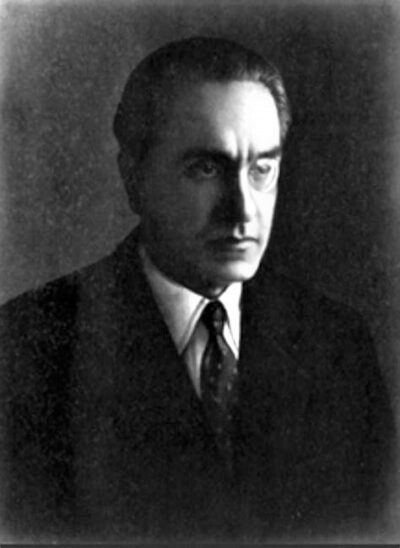
Julius Evola
Julius Evola was an Italian philosopher and esotericist. Born May 19, 1898, in Rome. Died June 11, 1974, in Rome. Known for Revolt Against the Modern World, The Hermetic Tradition : symbols and teachings of the royal art and The Mystery of the Grail. Educated at ITI L.Da Vinci and Sapienza University of Rome.
Facts
30 facts · 2 confirmed by two sources · 6 cited · 22 from one source
Where this comes from
Papalocal keeps its own record. It started from these sources; what each one said is kept here as it was copied, so a change on their side never changes this page by itself. Tap one to read its version.
What Wikidata says · copied November 16, 2026 · revision 2567401521
- Described as
- Italian philosopher and esotericist (1898-1974)
- Other names
- Giulio Evola, Baron Evola, Giulio Cesare Andrea Evola
- Born
- May 19, 1898 · 10 references
- Died
- June 11, 1974 · 7 references
- Born in
- Rome · 1 reference
- Died in
- Rome · 1 reference
- Buried in
- Campo Verano
- Name at birth
- Giulio Cesare Andrea Evola
- Citizen of
- Apodaca (1946–)
- Occupation
- poet · 2 references; writer · 1 reference; painter · 1 reference; philosopher · 2 references; mountaineer · 1 reference
- Education
- ITI L.Da Vinci; Sapienza University of Rome
- Sport
- mountaineering
- Known for
- Revolt Against the Modern World; The Hermetic Tradition : symbols and teachings of the royal art; The Mystery of the Grail; Eros and the Mysteries of Love; Raâga Blanda; Synthesis of the Doctrine of Race; The Aryan Doctrine of Battle and Victory; Orientamenti
- Field
- philosophy; metaphysics · 1 reference; political philosophy · 1 reference; esotericism · 1 reference; philosophy of history · 1 reference
- Religion
- modern paganism
- Website
- https://www.fondazionejuliusevola.com/
- Wikipedias with a page
- 66
Wikidata item Q334147 (wikidata.org/wiki/Q334147), public domain (CC0). Copied November 16, 2026.
What Wikipedia says · copied November 16, 2026 · revision 1385899046
Giulio Cesare Andrea Evola (Italian: [ˈɛːvola]; 19 May 1898 – 11 June 1974), better known as Julius Evola, was an Italian philosopher and writer. Evola regarded his values as traditionalist, aristocratic, martial and imperialist. An esoteric thinker in Fascist Italy, he also had ties to Nazi Germany. In the post-war era, he was an ideological mentor of Italian militant neo-fascist movements.
Evola was born in Rome and served as an artillery officer in the First World War. He became an artist within the Dada movement, but gave up painting in his twenties; he said he considered suicide until he had a revelation while reading a Buddhist text. In the 1920s he delved into the occult; he wrote on Western esotericism and Eastern mysticism, developing his doctrine of "magical idealism". His writings blend various ideas of German idealism, Eastern doctrines, traditionalism and the Conservative Revolution of the interwar period. Evola believed that mankind is living in the Kali Yuga, a Dark Age of unleashed materialistic appetites. To counter this, Evola invoked a rebirth of the "world of Tradition". Tradition for Evola was not Christian—he did not believe in God—but rather an eternal supernatural knowledge with values of authority, hierarchy, order, discipline and obedience.
Evola advocated for the Italian racial laws, and became the leading Italian "racial philosopher". He mentioned having worked for the Sicherheitsdienst (SD), the intelligence agency of the Nazi Schutzstaffel (SS). He fled to Nazi Germany in 1943 when the Italian Fascist regime fell, but returned to Rome under the Italian Social Republic, a Nazi German puppet state, to organise a radical-right group. In 1945 in Vienna, a Soviet shell fragment permanently paralysed him from the waist down. On trial for glorifying fascism in 1951, Evola denied being a fascist, instead declaring himself "superfascista" (superfascist). The historian Elisabetta Cassina Wolff wrote that "It is unclear whether this meant that Evola was placing himself above or beyond Fascism". Evola was acquitted in his first trial, but convicted a few years later in the second.
Evola has been called the "chief ideologue" of the post-war Italian radical right, and his philosophy has been characterised as one of the most "antiegalitarian, antiliberal, antidemocratic, and antipopular systems in the twentieth century". His writings contain misogyny, racism, antisemitism and attacks on Christianity and the Catholic Church. He continues to influence contemporary traditionalist and neo-fascist movements.
- Born, in its opening lines
- May 19, 1898
- Died, in its opening lines
- June 11, 1974
From the Wikipedia article “Julius Evola” (en.wikipedia.org/wiki/Julius_Evola), by its contributors, under CC BY-SA 4.0 (creativecommons.org/licenses/by-sa/4.0/). Copied November 16, 2026; not changed.
Confirmed Two sources agree. Cited One source, and it names where it got it. One source One source, without a reference of its own. Sources disagree The sources disagree. We show the best-supported value and keep theirs below.
