
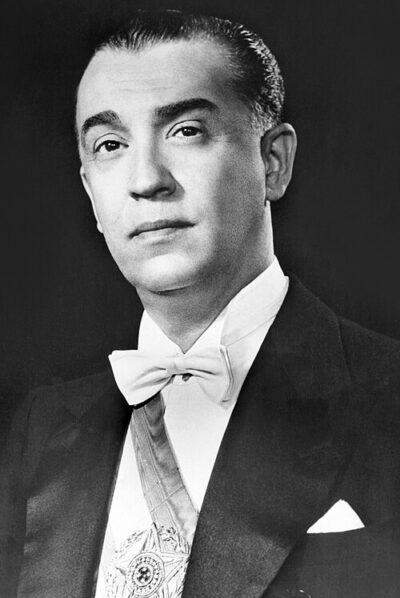
Juscelino Kubitschek
Juscelino Kubitschek was a President of Brazil from 1956 to 1961. Born September 12, 1902, in Diamantina. Died August 22, 1976, in Resende. Positions held include Goiás senator (1961–1964), President of Brazil (1956–1961) and federal deputy of Minas Gerais. Educated at Federal University of Minas Gerais. Awards include Collar of the Order of Isabella the Catholic, Order of Tomáš Garrigue Masaryk, 1st class and Grand Cross of the Order of the Southern Cross.
Facts
37 facts · 2 confirmed by two sources · 10 cited · 25 from one source
Where this comes from
Papalocal keeps its own record. It started from these sources; what each one said is kept here as it was copied, so a change on their side never changes this page by itself. Tap one to read its version.
What Wikidata says · copied November 16, 2026 · revision 2567356547
- Described as
- President of Brazil from 1956 to 1961
- Other names
- Juscelino Kubitschek de Oliveira
- Born
- September 12, 1902 · 8 references
- Died
- August 22, 1976 · 8 references
- Born in
- Diamantina · 1 reference
- Died in
- Resende · 1 reference
- Buried in
- Memorial JK · 1 reference
- Cause of death
- traffic collision
- Citizen of
- Brazil
- Occupation
- physician · 1 reference; politician · 1 reference; writer · 1 reference
- Positions held
- Goiás senator (1961–1964); President of Brazil (1956–1961); federal deputy of Minas Gerais; governor of Minas Gerais; mayor of Belo Horizonte (1940–1945)
- Political party
- Social Democratic Party (1945)
- Education
- Federal University of Minas Gerais
- Awards
- Collar of the Order of Isabella the Catholic (1958) · 2 references; Order of Tomáš Garrigue Masaryk, 1st class; Grand Cross of the Order of the Southern Cross; Order of Rio Branco; Order of Naval Merit; Order of Boyacá; Grand Cross of the Sash of the Three Orders · 1 reference; Grand Cross of the Military Order of the Tower and Sword · 1 reference; Grand Cross of the Order of Prince Henry · 1 reference; Order of Manuel Amador Guerrero; Order of the Aztec Eagle; Grand Cross Special Class of the Order of Merit of the Federal Republic of Germany (1956); Knight Grand Cross with Collar of the Order of Merit of the Italian Republic; Grand Collar of the Order of Prince Henry · 1 reference; Honorary Knight Grand Cross of the Order of the British Empire
- Spouse
- Sarah Kubitschek (1931–)
- Children
- Maria Estela Kubitschek; Márcia Kubitschek
- Mother
- Júlia Kubitschek
- Religion
- Catholic Church
- Wikipedias with a page
- 69
Wikidata item Q155824 (wikidata.org/wiki/Q155824), public domain (CC0). Copied November 16, 2026.
What Wikipedia says · copied November 16, 2026 · revision 1385010448
Juscelino Kubitschek de Oliveira (Brazilian Portuguese pronunciation: [ʒuseˈlinu kubiˈtʃɛk(i) dʒi oliˈve(j)ɾɐ]; 12 September 1902 – 22 August 1976), also known by his initials JK, was a Brazilian politician who served as the 21st president of Brazil from 1956 to 1961. During his term, the country experienced a period of notable economic growth and political stability. However, there was a significant increase in external debt, inflation, and wealth inequality. Kubitschek is also well-known for the construction of Brasília.
Born in Diamantina, Kubitschek completed the humanities course at the Diamantina Seminary and moved to Belo Horizonte in 1920. In 1927, he graduated in medicine from the Federal University of Minas Gerais (UFMG), and in 1930 he specialized in urology in Paris. He briefly served as a federal deputy, before losing his seat during the 1937 Brazilian coup. In 1940, he was appointed mayor of Belo Horizonte, remaining in this position until October 1945. At the end of the same year, he was elected constituent deputy for the Social Democratic Party (PSD). In 1950, Kubitschek was elected governor of Minas Gerais. As governor, he created the Companhia Energética de Minas Gerais, and prioritized road building and industrialization.
In October 1954, Kubitschek launched his candidacy for the 1955 presidential election, which was made official in February 1955. He presented a developmentalist speech and used "50 years in 5" as his campaign slogan. In an alliance formed by six parties, his running mate was João Goulart. On 3 October, he was elected president of Brazil with 35.6% of the votes. The opposition tried to annul the election on the grounds that Kubitschek had not obtained an absolute majority of votes. However, general Henrique Teixeira Lott triggered a military movement to ensure Kubitschek's inauguration. As president, Kubitschek was responsible for the construction of a new federal capital, Brasília, thus carrying out an old project to promote the development of Brazil's interior and the country's integration.
In 1961, Kubitschek was elected senator for Goiás and tried to make his candidacy for the 1965 presidential election viable. However, with the 1964 military coup, Kubitschek was accused by the military of corruption and being supported by the communists. As a result, his term was revoked and his political rights were suspended. From then on, Kubitschek began touring cities in the United States and Europe, in voluntary exile. He intended to return to political life, but died in 1976 in what was dismissed at the time as a car accident. Although the National Truth Commission ascertained in 2014 that his death was not suspicious, its successor body the Commission on Political Dead and Missing reviewed the decision in 2026 and decided Kubitschek had indeed been murdered by the military dictatorship.
- Born, in its opening lines
- September 12, 1902
- Died, in its opening lines
- August 22, 1976
From the Wikipedia article “Juscelino Kubitschek” (en.wikipedia.org/wiki/Juscelino_Kubitschek), by its contributors, under CC BY-SA 4.0 (creativecommons.org/licenses/by-sa/4.0/). Copied November 16, 2026; not changed.
Confirmed Two sources agree. Cited One source, and it names where it got it. One source One source, without a reference of its own. Sources disagree The sources disagree. We show the best-supported value and keep theirs below.
