
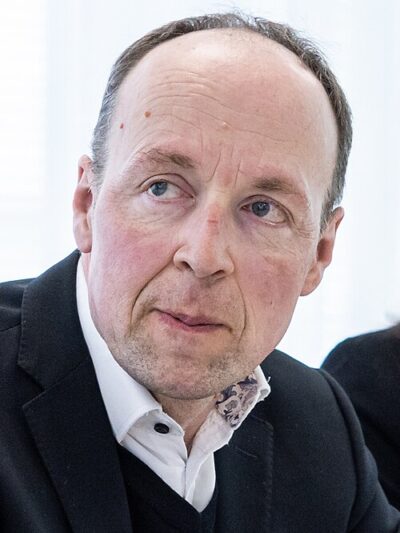
Jussi Halla-aho
Jussi Halla-aho is a Finnish politician, Slavic linguist, and Speaker of the Parliament. Born April 27, 1971, in Tampere. Positions held include Member of the European Parliament (2014–2019), member of the Parliament of Finland (2 times) (2011–) and municipal councillor in Finland (2012–). Educated at University of Helsinki. Awards include Knight First Class of the Order of the White Rose of Finland, Order of Prince Yaroslav the Wise, 2nd class and Knight Grand Cross of the Order of the Falcon.
Facts
26 facts · 1 confirmed by two sources · 16 cited · 9 from one source
Where this comes from
Papalocal keeps its own record. It started from these sources; what each one said is kept here as it was copied, so a change on their side never changes this page by itself. Tap one to read its version.
What Wikidata says · copied November 16, 2026 · revision 2558053301
- Described as
- Finnish politician, Slavic linguist, and Speaker of the Parliament
- Other names
- Jussi Kristian Halla-aho
- Born
- April 27, 1971 · 1 reference
- Born in
- Tampere · 2 references
- Citizen of
- Finland
- Occupation
- linguist; politician · 2 references; blogger; slavist · 1 reference
- Positions held
- Member of the European Parliament (2014–2019) · 1 reference; member of the Parliament of Finland (2 times) (2011–) · 1 reference; municipal councillor in Finland (2012–) · 1 reference; substitute member of the Parliamentary Assembly of the Council of Europe (2013–2014) · 1 reference; president (2017–2021); Chairperson of the Foreign Affairs Committee of the Finnish Parliament (2022–) · 2 references; Speaker of the Parliament of Finland (2023–)
- Political party
- Finns Party
- Education
- University of Helsinki
- Awards
- Knight First Class of the Order of the White Rose of Finland (2019) · 1 reference; Order of Prince Yaroslav the Wise, 2nd class (2023) · 1 reference; Knight Grand Cross of the Order of the Falcon (2025) · 1 reference; Grand Cross of the Order of the White Rose of Finland (2025) · 1 reference; Grand Cross of the Order of Civil Merit (2026) · 1 reference
- Religion
- atheism · 1 reference; agnosticism · 1 reference
- Lived in
- Helsinki (2012) · 2 references
- Website
- https://www.halla-aho.com/; http://www.helsinki.fi:80/~hallaaho/ (–2001)
- Wikipedias with a page
- 29
Wikidata item Q3040284 (wikidata.org/wiki/Q3040284), public domain (CC0). Copied November 16, 2026.
What Wikipedia says · copied November 16, 2026 · revision 1378382553
Jussi Kristian Halla-aho (born 27 April 1971) is a Finnish politician, currently serving as the Speaker of the Parliament of Finland since 2023. Halla-aho has served as a member of the Parliament of Finland from 2011 to 2014 and again since 2019, and as the leader of the Finns Party from 10 June 2017 to 14 August 2021. Previously, between 2014 and 2019, he was a member of the European Parliament, where he was part of the Identity and Democracy group.
Halla-aho has a PhD in Slavic Studies. Before entering national politics, he was best known for criticising multiculturalism and Finland's immigration policies in his online blog, Scripta. He was first elected to the Helsinki City Council in 2008 and to the Finnish parliament in 2011. In 2014 he was elected to the European Parliament. He was elected leader of the Finns Party in the summer of 2017, defeating Sampo Terho, after which the majority of the party's MPs seceded in protest and formed a new party. In spite of this, Halla-aho led the Finns Party to success in the 2019 election: it recovered all of its lost seats, becoming the second-largest party in parliament (after the Social Democratic Party), and Halla-aho won the largest share of personal votes in the country.
Halla-aho has served as Speaker of Parliament since 21 June 2023. In 2024, he ran for President of Finland.
- Born, in its opening lines
- April 27, 1971
From the Wikipedia article “Jussi Halla-aho” (en.wikipedia.org/wiki/Jussi_Halla-aho), by its contributors, under CC BY-SA 4.0 (creativecommons.org/licenses/by-sa/4.0/). Copied November 16, 2026; not changed.
Confirmed Two sources agree. Cited One source, and it names where it got it. One source One source, without a reference of its own. Sources disagree The sources disagree. We show the best-supported value and keep theirs below.
