
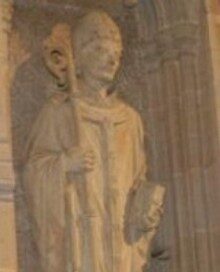
Justus
Justus was the 7th-century missionary, Archbishop of Canterbury, and saint. Born 6th century, in Rome. Positions held include Roman Catholic Archbishop of Canterbury (624–627) and Roman Catholic Bishop of Rochester (England) (604–).
Facts
10 facts · 0 confirmed by two sources · 1 cited · 9 from one source
Where this comes from
Papalocal keeps its own record. It started from these sources; what each one said is kept here as it was copied, so a change on their side never changes this page by itself. Tap one to read its version.
What Wikidata says · copied November 17, 2026 · revision 2553826389
- Described as
- 7th-century missionary, Archbishop of Canterbury, and saint
- Other names
- St. Justus
- Born
- 6th century
- Born in
- Rome
- Died in
- Canterbury
- Buried in
- St Augustine's Abbey · 1 reference
- Cause of death
- drowning
- Occupation
- missionary · 1 reference; Catholic priest
- Positions held
- Roman Catholic Archbishop of Canterbury (624–627) · 2 references; Roman Catholic Bishop of Rochester (England) (604–) · 1 reference
- Religion
- Catholic Church · 1 reference
- Wikipedias with a page
- 27
Wikidata item Q453924 (wikidata.org/wiki/Q453924), public domain (CC0). Copied November 17, 2026.
What Wikipedia says · copied November 17, 2026 · revision 1372607608
Justus (died on 10 November between 627 and 631) was the fourth archbishop of Canterbury. Pope Gregory the Great sent Justus from Italy to England on a mission to Christianise the Anglo-Saxons from their native paganism; he probably arrived with the second group of missionaries dispatched in 601. Justus became the first bishop of Rochester in 604 and signed a letter to the Irish bishops urging the native Celtic church to adopt the Roman method of calculating the date of Easter. He attended a church council in Paris in 614.
Following the death of King Æthelberht of Kent in 616, Justus was forced to flee to Gaul but was reinstated in his diocese the following year. In 624, he was elevated to the Archbishopric of Canterbury, overseeing the dispatch of missionaries to Northumbria. After his death, he was revered as a saint and had a shrine in St Augustine's Abbey, Canterbury, to which his remains were translated in the 1090s.
From the Wikipedia article “Justus” (en.wikipedia.org/wiki/Justus), by its contributors, under CC BY-SA 4.0 (creativecommons.org/licenses/by-sa/4.0/). Copied November 17, 2026; not changed.
Confirmed Two sources agree. Cited One source, and it names where it got it. One source One source, without a reference of its own. Sources disagree The sources disagree. We show the best-supported value and keep theirs below.
