
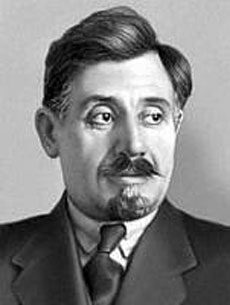
Kamo was an Armenian revolutionary. Born May 27, 1882, in Gori. Died July 14, 1922, in Tbilisi.
Facts
10 facts · 2 confirmed by two sources · 3 cited · 5 from one source
Where this comes from
Papalocal keeps its own record. It started from these sources; what each one said is kept here as it was copied, so a change on their side never changes this page by itself. Tap one to read its version.
What Wikidata says · copied November 18, 2026 · revision 2567306409
- Described as
- Armenian revolutionary (1882-1922)
- Other names
- Simon Arshaki Ter-Petrosian
- Born
- May 27, 1882
- Died
- July 14, 1922
- Born in
- Gori · 1 reference
- Died in
- Tbilisi · 1 reference
- Cause of death
- traffic collision
- Citizen of
- Russian Empire; Georgian SSR
- Occupation
- politician; revolutionary · 1 reference
- Political party
- Russian Social Democratic Labour Party (bolshevik)
- Wikipedias with a page
- 21
Wikidata item Q1358801 (wikidata.org/wiki/Q1358801), public domain (CC0). Copied November 18, 2026.
What Wikipedia says · copied November 18, 2026 · revision 1384368562
Simon Arshaki Ter-Petrosian (Russian: Симон Аршакович Тер-Петросян, romanized: Simon Arshakovich Ter-Petrosyan; Armenian: Սիմոն «Կամո» Տէր Պետրոսեան; 27 May 1882 – 14 July 1922), better known by his nom de guerre of Kamo (Russian: Камо), was an Old Bolshevik revolutionary and an early companion to Soviet leader Joseph Stalin.
From 1903 to 1912, Kamo, a master of disguise, carried out a number of militant operations on behalf of the Bolshevik faction of the Russian Social-Democratic Labour Party, mostly in Georgia, then part of the Russian Empire. He is best known for his central role in the 1907 Tiflis bank robbery, organised by Bolshevik leaders to raise funds for their party activities. For his militant activities he was arrested in Berlin in 1907 but feigned insanity both in German and later Russian prisons, eventually escaping from prison and fleeing the country. He was recaptured in 1912 after another attempted armed robbery and sentenced to death. The death sentence was commuted to life imprisonment as part of the celebrations of the Romanov Tercentenary.
Kamo was released after the February 1917 Russian Revolution. He died in 1922 after being hit by a truck while riding a bicycle in Tiflis. Kamo was buried and had a monument erected in his honor in Pushkin Gardens, near Yerevan Square, but, following the rise to power of Zviad Gamsakhurdia in Georgia in 1991, a threat arose to the safety of the burial of the famous Bolshevik, and relatives transferred Kamo's ashes to the Vakiskoe cemetery, to the grave of his sister Javair.
The name "Kamo" originated from Ter-Petrosian's lack of fluency in the Russian language. One of Stalin's acolytes, Vardoyan, was teaching Kamo Russian grammar, Kamo kept saying kamo instead of komu (кому, "to whom"). Stalin lost his temper, but then laughed: "komu not kamo! Try to remember it bicho [boy]".
- Born, in its opening lines
- May 27, 1882
- Died, in its opening lines
- July 14, 1922
From the Wikipedia article “Kamo (Bolshevik)” (en.wikipedia.org/wiki/Kamo_(Bolshevik)), by its contributors, under CC BY-SA 4.0 (creativecommons.org/licenses/by-sa/4.0/). Copied November 18, 2026; not changed.
Confirmed Two sources agree. Cited One source, and it names where it got it. One source One source, without a reference of its own. Sources disagree The sources disagree. We show the best-supported value and keep theirs below.
