
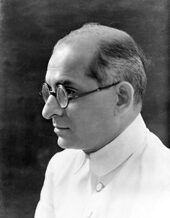
Kanaiyalal Maneklal Munshi
Kanaiyalal Maneklal Munshi was an Indian independence movement activist, politician, writer and educationist. Born December 30, 1887, in Bharuch. Died February 8, 1971, in Mumbai. Positions held include Governor of Uttar Pradesh (1952–1957), Member of the Constituent Assembly of India (1946–1950) and member of the Committee for Rules of Procedure of the Constituent Assembly of India (1946). Known for Prithivivallabh, Gujaratno Nath and Jay Somnath. Educated at Maharaja Sayajirao University of Baroda.
Facts
30 facts · 2 confirmed by two sources · 6 cited · 21 from one source · 1 where the sources disagree
What’s different
- Born in: we show Bharuch (Sources disagree). Wikidata also lists Bharuch district
Where this comes from
Papalocal keeps its own record. It started from these sources; what each one said is kept here as it was copied, so a change on their side never changes this page by itself. Tap one to read its version.
What Wikidata says · copied November 17, 2026 · revision 2567468153
- Described as
- Indian independence movement activist, politician, writer and educationist (1887-1971)
- Other names
- K M Munshi, Kulpati, K. M. Munshi, Kanaiyalal M.Munshi, Kanialal Maneklal Munshi, Kanaialal Maneklal Munshi, Kanaiya-Lal M. Munshi, Ghanaśyāma, Kanaiyālāla Māṇēkalāla Munaśī, Kanhaiyalal Maneklal Munshi, Ke. Em. Munśi, Kanhaiyālāla Munśī
- Born
- December 30, 1887 · 2 references
- Died
- February 8, 1971 · 2 references
- Born in
- Bharuch district; Bharuch · 1 reference
- Died in
- Mumbai · 1 reference
- Citizen of
- British Raj (–1947); Dominion of India (1947–1950); India (1950–)
- Occupation
- lawyer; journalist; politician · 1 reference; freedom fighter; pedagogue · 1 reference; activist · 1 reference; writer · 1 reference; legislator
- Positions held
- Governor of Uttar Pradesh (1952–1957); Member of the Constituent Assembly of India (1946–1950); member of the Committee for Rules of Procedure of the Constituent Assembly of India (1946); member of the Steering Committee of the Constituent Assembly of India (1947–); Member of the Advisory Committee of the Constituent Assembly of India (1947–) · 1 reference; member of the Business Committee of the Constituent Assembly of India (1947–); member of the Committee on Subjects Assigned to the Union Centre (1947–)
- Political party
- Indian National Congress (–1959); Swatantra Party
- Education
- Maharaja Sayajirao University of Baroda
- Known for
- Prithivivallabh; Gujaratno Nath; Jay Somnath
- Spouse
- Lilavati Munshi (1926–)
- Religion
- Hinduism
- Wikipedias with a page
- 26
Wikidata item Q2721812 (wikidata.org/wiki/Q2721812), public domain (CC0). Copied November 17, 2026.
What Wikipedia says · copied November 17, 2026 · revision 1380915337
Kanaiyalal Maneklal Munshi (pronounced [kə.nəi.ya.lal ma.ɳek.lal mun.ʃi]; 30 December 1887 – 8 February 1971), popularly known by his pen name Ghanshyam Vyas, was an Indian independence movement activist, politician, writer from Gujarat state. A lawyer by profession, he later turned to author and politician. He is a well-known name in Gujarati literature. He founded Bharatiya Vidya Bhavan, an educational trust, in 1938.
Munshi wrote his works in three languages namely Gujarati, English and Hindi. Before independence of India, Munshi was part of Indian National Congress and after independence, he joined Swatantra Party. Munshi held several important posts like member of Constituent Assembly of India, minister of agriculture and food of India, and governor of Uttar Pradesh. In his later life, he was one of the founding members of Vishva Hindu Parishad.
- Born, in its opening lines
- December 30, 1887
- Died, in its opening lines
- February 8, 1971
From the Wikipedia article “Kanaiyalal Maneklal Munshi” (en.wikipedia.org/wiki/Kanaiyalal_Maneklal_Munshi), by its contributors, under CC BY-SA 4.0 (creativecommons.org/licenses/by-sa/4.0/). Copied November 17, 2026; not changed.
Confirmed Two sources agree. Cited One source, and it names where it got it. One source One source, without a reference of its own. Sources disagree The sources disagree. We show the best-supported value and keep theirs below.
