
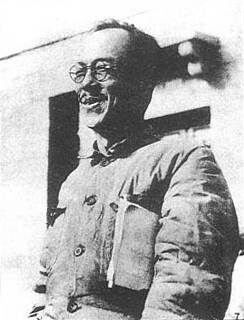
Kang Sheng
Kang Sheng was a Chinese politician. Born November 4, 1898, in Zhucheng. Died December 16, 1975, in Beijing. Positions held include Vice Chairman of the Chinese Communist Party (1973–1975) and member of the Politburo Standing Committee of the Chinese Communist Party (1966–1975).
Facts
14 facts · 2 confirmed by two sources · 3 cited · 9 from one source
Where this comes from
Papalocal keeps its own record. It started from these sources; what each one said is kept here as it was copied, so a change on their side never changes this page by itself. Tap one to read its version.
What Wikidata says · copied November 17, 2026 · revision 2567366783
- Described as
- Chinese politician (1898–1975)
- Born
- November 4, 1898 · 1 reference
- Died
- December 16, 1975 · 4 references
- Born in
- Zhucheng · 1 reference
- Died in
- Beijing · 1 reference
- Buried in
- Babaoshan Revolutionary Cemetery (1975–1980)
- Cause of death
- bladder cancer
- Name at birth
- 張宗可
- Citizen of
- People's Republic of China; Qing dynasty; Republic of China
- Occupation
- politician · 1 reference
- Positions held
- Vice Chairman of the Chinese Communist Party (1973–1975); member of the Politburo Standing Committee of the Chinese Communist Party (1966–1975)
- Political party
- Chinese Communist Party
- Wikipedias with a page
- 27
Wikidata item Q544432 (wikidata.org/wiki/Q544432), public domain (CC0). Copied November 17, 2026.
What Wikipedia says · copied November 17, 2026 · revision 1379233219
Kang Sheng (Chinese: 康生; pinyin: Kāng Shēng; 4 November 1898 – 16 December 1975), born Zhang Zongke (simplified Chinese: 张宗可; traditional Chinese: 張宗可; pinyin: Zhāng Zōngkě), was a Chinese Communist Party (CCP) official, politician and calligrapher best known for having overseen the work of the CCP's internal security and intelligence apparatus during the early 1940s and again at the height of the Cultural Revolution in the late 1960s and early 1970s.
A member of the CCP from the early 1920s, he spent time in Moscow during the early 1930s, where he learned the methods of the Soviet NKVD and became a supporter of Wang Ming for leadership of the CCP. After returning to China in the late 1930s, Kang Sheng switched his allegiance to Mao Zedong and became a close associate of Mao during the Second Sino-Japanese War, the Chinese Civil War, and after. He remained at or near the pinnacle of power in the People's Republic of China from its establishment in 1949 until his death in 1975. After the death of Mao and the subsequent arrest of the Gang of Four, Kang Sheng was accused of sharing responsibility with the Gang for the excesses of the Cultural Revolution and in 1980 he was expelled posthumously from the CCP.
- Born, in its opening lines
- November 4, 1898
- Died, in its opening lines
- December 16, 1975
From the Wikipedia article “Kang Sheng” (en.wikipedia.org/wiki/Kang_Sheng), by its contributors, under CC BY-SA 4.0 (creativecommons.org/licenses/by-sa/4.0/). Copied November 17, 2026; not changed.
Confirmed Two sources agree. Cited One source, and it names where it got it. One source One source, without a reference of its own. Sources disagree The sources disagree. We show the best-supported value and keep theirs below.
