
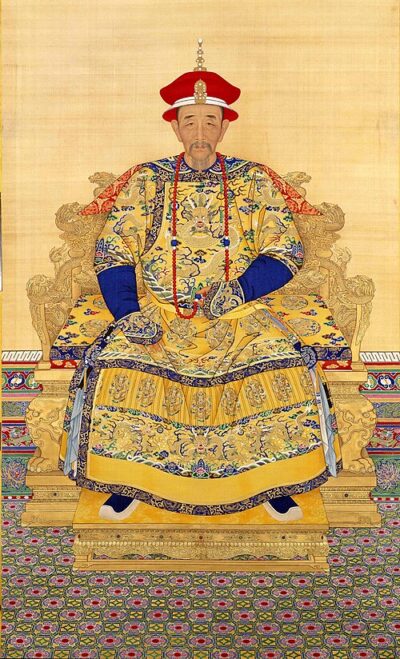
Kangxi Emperor
Kangxi Emperor was the 3rd Emperor of the Qing dynasty (r. 1661–1722). Born May 4, 1654, in Beijing. Died December 20, 1722, in Old Summer Palace. Positions held include Emperor of China (1661–1722). Known for Kangxi Dictionary, Kangxi Atlas and Collection of the Imperial Writings of Shengzu the Ren Emperor.
Facts
41 facts · 2 confirmed by two sources · 5 cited · 33 from one source · 1 where the sources disagree
What’s different
- Name at birth: we show 玄燁 (Sources disagree). Wikidata also lists ᡥᡳᠣᠸᠠᠨ ᠶᡝᡳ
Where this comes from
Papalocal keeps its own record. It started from these sources; what each one said is kept here as it was copied, so a change on their side never changes this page by itself. Tap one to read its version.
What Wikidata says · copied November 16, 2026 · revision 2568872396
- Described as
- 3rd Emperor of the Qing dynasty (r. 1661–1722)
- Other names
- Kangxi, Tiyuanzhuren, Hetianhongyunwenwuruizhegongjiankuanyuxiaojingchengxingongdedachengrenhuangdi, Shengzu, Xuanye, Hsüan-ye, Cang-hi, K'ang-hsi, Emperor Kangxi, Amulon-Bogdo-Cham, Engke-Amuulang, Engke Amuyulang
- Born
- May 4, 1654 · 1 reference
- Died
- December 20, 1722 · 2 references
- Born in
- Beijing · 1 reference
- Died in
- Old Summer Palace
- Buried in
- Jingling Mausoleum (Qing dynasty)
- Cause of death
- smallpox
- Name at birth
- 玄燁; ᡥᡳᠣᠸᠠᠨ ᠶᡝᡳ
- Citizen of
- Qing dynasty · 1 reference
- Occupation
- calligrapher
- Positions held
- Emperor of China (1661–1722) · 1 reference
- Known for
- Kangxi Dictionary; Kangxi Atlas; Collection of the Imperial Writings of Shengzu the Ren Emperor
- Spouse
- Empress Xiaochengren; Empress Xiaozhaoren; Empress Xiaoyiren; Empress Xiaogongren; Imperial Noble Consort Quehui; Imperial Noble Consort Dun Yi
- Children
- Chengrui; Chenghu · 1 reference; Chengqing; Sayinchahun; Yunzhi, Prince Zhi; Changhua; Yunreng · 1 reference; Changsheng; Wanpu; Yunzhi, Prince Cheng; Yongzheng Emperor · 1 reference; Yinzan
- Father
- Shunzhi Emperor · 2 references
- Mother
- Empress Xiaokangzhang
- Siblings
- Princess Heshuo Gongchi; Fuquan; Niuniu; Longxi; Changning; Prince Rong; Qishou; Yonggan
- Wikipedias with a page
- 65
Wikidata item Q17790 (wikidata.org/wiki/Q17790), public domain (CC0). Copied November 16, 2026.
What Wikipedia says · copied November 16, 2026 · revision 1375984456
The Kangxi Emperor (4 May 1654 – 20 December 1722), also known by his temple name Emperor Shengzu of Qing, personal name Xuanye, was the third emperor of the Qing dynasty, and the second Qing emperor to rule over China proper. His reign of 61 years makes him the longest-reigning emperor in Chinese history and one of the longest-reigning rulers in history. He is considered one of China's greatest emperors.
The third son of the Shunzhi Emperor, Kangxi was enthroned at the age of seven while actual power was held for six more years by the four regents nominated by his father. After assuming personal rule, Kangxi's attempt to revoke the fiefdoms of feudal princes sparked the Revolt of the Three Feudatories, which he suppressed. He also forced the Kingdom of Tungning in Taiwan and Mongols in the north and northwest to submit to Qing rule, and launched an expedition that incorporated Tibet into the empire. Domestically, he initially welcomed the Jesuits and the propagation of Catholicism in China, but tolerance came to an end as a result of the Chinese Rites controversy. Later in his reign, Kangxi became embroiled in a prolonged succession dispute. He died in 1722 at the age of 68 and was succeeded by his fourth son, who assumed the throne as the Yongzheng Emperor.
The Kangxi Emperor's reign brought about long-term stability and relative wealth after years of war and chaos. He initiated the period known as the High Qing era (or the "Prosperous Era of Kangxi and Qianlong"), spanning the reigns of the Kangxi Emperor, his son Yongzheng, and his grandson Qianlong. His court also accomplished such literary feats as the compilation of the Kangxi Dictionary, the Complete Tang Poems poetry anthology, and the Complete Classics Collection of Ancient China.
- Born, in its opening lines
- May 4, 1654
- Died, in its opening lines
- December 20, 1722
From the Wikipedia article “Kangxi Emperor” (en.wikipedia.org/wiki/Kangxi_Emperor), by its contributors, under CC BY-SA 4.0 (creativecommons.org/licenses/by-sa/4.0/). Copied November 16, 2026; not changed.
Confirmed Two sources agree. Cited One source, and it names where it got it. One source One source, without a reference of its own. Sources disagree The sources disagree. We show the best-supported value and keep theirs below.
