
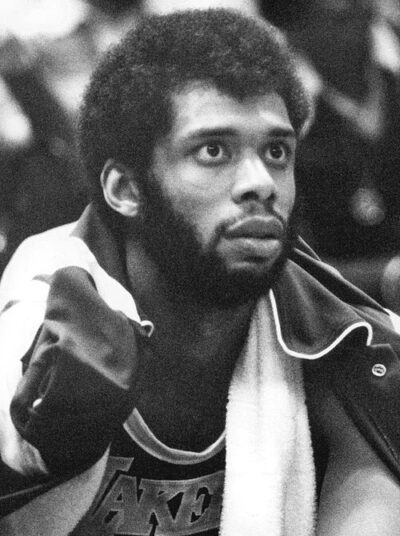
Kareem Abdul-Jabbar
Kareem Abdul-Jabbar is an American basketball player. Born April 16, 1947, in New York City. Teams include UCLA Bruins men's basketball (1965–1969), Milwaukee Bucks (1969–1975) and Los Angeles Lakers (1975–1989). Educated at University of California, Los Angeles and Power Memorial Academy. Awards include NBA Rookie of the Year Award, NBA All-Rookie Team and All-NBA Team (10 times).
Facts
36 facts · 1 confirmed by two sources · 14 cited · 21 from one source
Where this comes from
Papalocal keeps its own record. It started from these sources; what each one said is kept here as it was copied, so a change on their side never changes this page by itself. Tap one to read its version.
What Wikidata says · copied November 13, 2026 · revision 2568117689
- Described as
- American basketball player (born 1947)
- Other names
- Ferdinand Lewis Alcindor, Jr., Kareem Abdul Jabbar, Ferdinand Lewis Alcindor, Lew Alcindor
- Born
- April 16, 1947 · 7 references
- Born in
- New York City · 4 references
- Name at birth
- Ferdinand Lewis Alcindor, Jr.
- Citizen of
- United States · 4 references
- Occupation
- basketball player · 1 reference; basketball coach · 1 reference; actor · 1 reference; film producer · 2 references; author · 3 references; screenwriter · 2 references; television actor · 1 reference
- Education
- University of California, Los Angeles · 1 reference; Power Memorial Academy
- Member of
- Writers Guild of America West
- Teams
- UCLA Bruins men's basketball (1965–1969); Milwaukee Bucks (1969–1975); Los Angeles Lakers (1975–1989)
- Sport
- basketball · 1 reference
- Awards
- NBA Rookie of the Year Award (1970); NBA All-Rookie Team (1970); All-NBA Team (10 times) (1971, 1972, 1973, 1974, 1976, 1977, 1980, 1981, 1984, 1986); Bill Russell NBA Finals Most Valuable Player Award (2 times) (1971, 1985); NBA Most Valuable Player Award (6 times) (1971, 1972, 1974, 1976, 1977, 1980); NBA All-Defensive Team (5 times) (1974, 1975, 1979, 1980, 1981); Sports Illustrated Sportsperson of the Year (1985); NAACP Image Award for Outstanding Literary Work – Children (2013); Presidential Medal of Freedom (2016) · 1 reference; California Hall of Fame (2014); Naismith Memorial Basketball Hall of Fame (1969) · 1 reference
- Children
- Kareem Abdul-Jabbar, Jr.
- Religion
- Islam (1971–) · 2 references; Catholicism (–1965)
- Lived in
- New York City; Los Angeles
- Height
- 2.18 m (7 ft 2 in) · 1 reference
- Website
- https://kareemabduljabbar.com/
- Wikipedias with a page
- 87
Wikidata item Q179051 (wikidata.org/wiki/Q179051), public domain (CC0). Copied November 13, 2026.
What Wikipedia says · copied November 13, 2026 · revision 1385372408
Kareem Abdul-Jabbar (born Ferdinand Lewis Alcindor Jr., April 16, 1947) is an American former professional basketball player. He played as a center for 20 seasons in the National Basketball Association (NBA) with the Milwaukee Bucks and Los Angeles Lakers. He played college basketball for the UCLA Bruins. A member of the Naismith Memorial Basketball Hall of Fame, Abdul-Jabbar won a record six NBA Most Valuable Player (MVP) awards. He was a 19-time NBA All-Star, a 15-time All-NBA Team member, and an 11-time NBA All-Defensive Team selection. He was a member of six NBA championship teams as a player and two more as an assistant coach, and was twice voted the NBA Finals MVP. He was named to three NBA anniversary teams (35th, 50th, and 75th). Widely regarded as one of the greatest players of all time, Abdul-Jabbar broke the NBA's career scoring record in 1984, and held it until 2023.
Abdul-Jabbar was known as Lew Alcindor when he played at Power Memorial, a private Catholic high school in New York City, where he led their team to 71 consecutive wins. He played college basketball for the UCLA Bruins, winning three consecutive national championships. Abdul-Jabbar was a record three-time most outstanding player of the NCAA tournament. Drafted with the first overall pick by the one-season-old Milwaukee Bucks franchise in the 1969 NBA draft, he spent six seasons with the team. After leading the Bucks to their first NBA championship at age 24 in 1971, he took the Muslim name Kareem Abdul-Jabbar. Using his trademark skyhook shot, he established himself as one of the league's top scorers. In 1975, he was traded to the Lakers, with whom he played the final 14 seasons of his career, during which time the team won five NBA championships. Abdul-Jabbar's contributions were a key component in the Showtime era of Lakers basketball. Over his 20-year NBA career, his teams reached the playoffs 18 times and reached the NBA Finals ten times.
At the time of his retirement at age 42 in 1989, Abdul-Jabbar was the NBA's regular season career leader in points (38,387), games played (1,560), minutes (57,446), field goals made (15,837), field goal attempts (28,307), blocked shots (3,189), defensive rebounds (9,394), and personal fouls (4,657). He ranks second in career points, minutes played and field goal attempts, and is third all-time in both total rebounds (17,440) and blocked shots. ESPN named him the greatest center of all time in 2007, the greatest player in college basketball history in 2008, and the second best player in NBA history (behind Michael Jordan) in 2016. Abdul-Jabbar has also been an actor, a basketball coach, a best-selling author, and a martial artist, having trained in Jeet Kune Do under Bruce Lee and appeared in his film Game of Death (1972). He also appeared in Airplane! as Roger Murdock, a pilot who is repeatedly mistaken for Abdul-Jabbar. In 2012, Abdul-Jabbar was selected by Secretary of State Hillary Clinton to be a U.S. global cultural ambassador. In 2016, President Barack Obama awarded him the Presidential Medal of Freedom.
- Born, in its opening lines
- April 16, 1947
From the Wikipedia article “Kareem Abdul-Jabbar” (en.wikipedia.org/wiki/Kareem_Abdul-Jabbar), by its contributors, under CC BY-SA 4.0 (creativecommons.org/licenses/by-sa/4.0/). Copied November 13, 2026; not changed.
Confirmed Two sources agree. Cited One source, and it names where it got it. One source One source, without a reference of its own. Sources disagree The sources disagree. We show the best-supported value and keep theirs below.
