
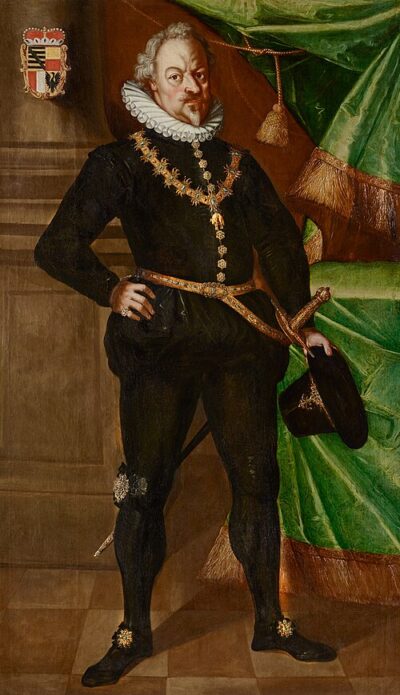
Karl I, Prince of Liechtenstein
Karl I, Prince of Liechtenstein was a Prince of Liechtenstein. Born July 30, 1569, in Valtice. Died February 12, 1627, in Prague. Positions held include stadtholder and Prince of Lichtenstein (1608–1627). Awards include Knight of the Order of the Golden Fleece.
Facts
18 facts · 2 confirmed by two sources · 5 cited · 11 from one source
Where this comes from
Papalocal keeps its own record. It started from these sources; what each one said is kept here as it was copied, so a change on their side never changes this page by itself. Tap one to read its version.
What Wikidata says · copied November 16, 2026 · revision 2563990529
- Described as
- Prince of Liechtenstein (1569-1627)
- Other names
- Karl I. von Liechtenstein, Charles of Lichtenstein, Karl, Fürst von und zu Liechtenstein
- Born
- July 30, 1569 · 1 reference
- Died
- February 12, 1627 · 6 references
- Born in
- Valtice
- Died in
- Prague · 1 reference
- Buried in
- Liechtenstein Family Vault
- Occupation
- viceroy · 1 reference; aristocrat
- Positions held
- stadtholder · 1 reference; Prince of Lichtenstein (1608–1627)
- Awards
- Knight of the Order of the Golden Fleece
- Spouse
- Baroness Anna Marie von Boskowicz und Schwarzenberg
- Children
- Karl Eusebius, Prince of Liechtenstein; Anna Marie, Prinzessin von und zu Liechtenstein · 1 reference; Franziska Barbara, Princess of Liechtenstein
- Father
- Hartmann of Liechtenstein
- Mother
- Anna Maria, Gräfin von Ortenburg · 1 reference
- Siblings
- Gundakar, Prince of Liechtenstein; Maximilian of Liechtenstein
- Wikipedias with a page
- 30
Wikidata item Q506533 (wikidata.org/wiki/Q506533), public domain (CC0). Copied November 16, 2026.
What Wikipedia says · copied November 16, 2026 · revision 1376338587
Karl I (30 July 1569 – 12 February 1627) was the first member of the House of Liechtenstein to become Prince of the Holy Roman Empire, but only as an honorary title, since the Liechtenstein family did not yet possess any territory with semi-sovereignty (Landeshoheit) within the Holy Roman Empire. (The territory of Liechtenstein was first purchased in 1699 and 1712 and declared a principality in 1719, whereby the princes became the monarchs of Liechtenstein.)
Karl was the elder son of Hartmann II, Baron of Liechtenstein, and Countess Anna Maria of Ortenburg. Emperor Rudolf II of the Holy Roman Empire appointed Karl as chief intendant (Obersthofmeister), an important position at his court. Karl held this position until 1607. He became a Catholic in 1599.
In a dispute over land between Rudolf II and the heir presumptive to the throne, Archduke Matthias, Karl sided with Matthias. Liechtenstein played a leading role as adviser and supporter of Matthias in the coup against Emperor Rudolf II. Now-Hungarian King Matthias made him a hereditary prince in 1608, in thanks for Karl's aid. In his politics and assertiveness as advisor to Matthias, he rivaled Melchior Khlesl, Bishop of Vienna, who ultimately prevailed over Karl of Liechtenstein and became the new minister-favourite of King and later Emperor Matthias.
In 1614, Karl added the Duchy of Troppau to his possessions. In 1619, Matthias was succeeded by Emperor Ferdinand II, the arch-Catholic monarch who triggered the Thirty Years' War for religious reasons; Charles's reconversion now proved advantageous. In thanks for further aid at the Battle of White Mountain, Karl was appointed to the positions of proconsul and vice-regent of Bohemia in 1622, and he was bestowed with the Order of the Golden Fleece.
He gained the Duchy of Troppau on 28 December 1613 and the Silesian Duchy of Jägerndorf on 15 March 1622, along with much confiscated protestant "rebel property", and he commissioned the ducal hat of Liechtenstein.
In 1605, Karl established the first branch north of the Alps of the Hospitaller Order of Saint John of God at Feldsberg in Lower Austria (now Valtice, Czech Republic).
He was the 352nd Knight of the Order of the Golden Fleece in Austria. He died in Prague in 1627.
- Born, in its opening lines
- July 30, 1569
- Died, in its opening lines
- February 12, 1627
From the Wikipedia article “Karl I of Liechtenstein” (en.wikipedia.org/wiki/Karl_I_of_Liechtenstein), by its contributors, under CC BY-SA 4.0 (creativecommons.org/licenses/by-sa/4.0/). Copied November 16, 2026; not changed.
Confirmed Two sources agree. Cited One source, and it names where it got it. One source One source, without a reference of its own. Sources disagree The sources disagree. We show the best-supported value and keep theirs below.
