
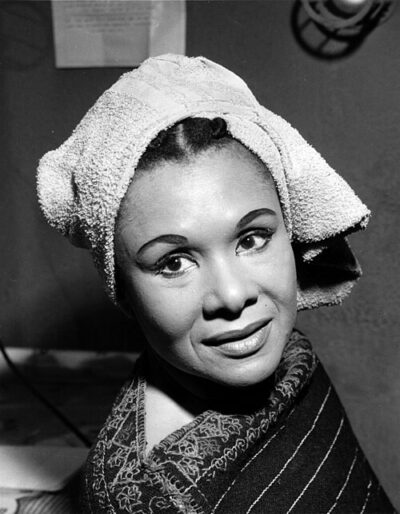
Katherine Dunham
Katherine Dunham was an American dancer, choreographer, songwriter, actress and activist (1909/1912–2006). Born June 22, 1909, in Glen Ellyn. Died May 21, 2006, in New York City. Known for Dunham technique. Educated at University of Chicago and Joliet Junior College. Awards include Black Filmmakers Hall of Fame, Kennedy Center Honors and Candace Award.
Facts
34 facts · 2 confirmed by two sources · 15 cited · 17 from one source
Where this comes from
Papalocal keeps its own record. It started from these sources; what each one said is kept here as it was copied, so a change on their side never changes this page by itself. Tap one to read its version.
What Wikidata says · copied November 15, 2026 · revision 2565967258
- Described as
- American dancer, choreographer, songwriter, actress and activist (1909/1912–2006)
- Other names
- Katherine Mary Dunham, Kaye Dunn
- Born
- June 22, 1909 · 9 references
- Died
- May 21, 2006 · 14 references
- Born in
- Glen Ellyn · 3 references
- Died in
- New York City · 2 references
- Citizen of
- United States
- Occupation
- anthropologist · 1 reference; choreographer · 1 reference; dancer · 2 references; music educator; songwriter; film actor; activist
- Education
- University of Chicago (1936) · 2 references; Joliet Junior College · 1 reference; Joliet Central High School
- Known for
- Dunham technique
- Awards
- Black Filmmakers Hall of Fame (1974); Kennedy Center Honors (1983); Candace Award (1987); National Medal of Arts (1989) · 1 reference; honorary degree from Spelman College (1990) · 1 reference; Capezio Dance Award (1991); Paul Robeson Award (1993); honorary doctor of the University of Southern California; honorary doctor of Harvard University
- Field
- dance · 1 reference; social anthropology; folklore; choreography · 1 reference; cultural anthropology · 1 reference; anthropology · 1 reference
- Spouse
- John Pratt · 1 reference
- Lived in
- New York City · 1 reference
- Website
- http://kdcah.org
- Wikipedias with a page
- 30
Wikidata item Q272637 (wikidata.org/wiki/Q272637), public domain (CC0). Copied November 15, 2026.
What Wikipedia says · copied November 15, 2026 · revision 1384369092
Katherine Mary Dunham (June 22, 1909 – May 21, 2006) was an American dancer, choreographer, anthropologist, and social activist. One of the most renowned modern dance artists of the 20th century, she has been called the "matriarch and queen mother of black dance."
While a student at the University of Chicago, Dunham also performed as a dancer, ran a dance school and earned an early bachelor's degree in anthropology. Receiving a postgraduate academic fellowship, she went to the Caribbean to study the African diaspora, ethnography and local dance. She returned to graduate school and submitted a master's thesis to the anthropology faculty. She did not complete the other requirements for that degree, however, as she realized that her professional calling was performance and choreography.
At the height of her career in the 1940s and 1950s, Dunham was renowned throughout Europe and Latin America and was widely popular in the United States. The Washington Post called her "dancer Katherine the Great." She operated the Dunham School of Dance and Theatre for a decade, and for almost 30 years she maintained the Katherine Dunham Dance Company, the only self-supported American black dance troupe at that time. Over the course of her career, she choreographed more than ninety individual dances. Dunham was an innovator in African-American modern dance as well as a leader in the field of dance anthropology, or ethnochoreology. She also developed the Dunham Technique, a method of movement to support her dance works.
- Born, in its opening lines
- June 22, 1909
- Died, in its opening lines
- May 21, 2006
From the Wikipedia article “Katherine Dunham” (en.wikipedia.org/wiki/Katherine_Dunham), by its contributors, under CC BY-SA 4.0 (creativecommons.org/licenses/by-sa/4.0/). Copied November 15, 2026; not changed.
Confirmed Two sources agree. Cited One source, and it names where it got it. One source One source, without a reference of its own. Sources disagree The sources disagree. We show the best-supported value and keep theirs below.
