
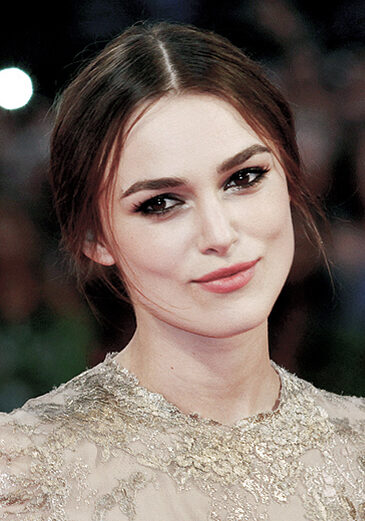
Keira Knightley
Keira Knightley is a British actress. Born March 26, 1985, in Teddington. Educated at Esher College and Teddington School. Awards include Teen Choice Award for Choice Hissy Fit, Empire Award for Best Actress and Empire Awards.
Facts
23 facts · 1 confirmed by two sources · 5 cited · 17 from one source
Where this comes from
Papalocal keeps its own record. It started from these sources; what each one said is kept here as it was copied, so a change on their side never changes this page by itself. Tap one to read its version.
What Wikidata says · copied November 16, 2026 · revision 2567295462
- Described as
- British actress (born 1985)
- Other names
- Keira Christina Knightley, Keira Christina Righton
- Born
- March 26, 1985 · 7 references
- Born in
- Teddington · 2 references
- Name at birth
- Keira Christina Knightley · 2 references
- Citizen of
- United Kingdom
- Occupation
- actor · 1 reference; television actor; film actor · 1 reference; voice actor; stage actor
- Education
- Esher College; Teddington School
- Awards
- Teen Choice Award for Choice Hissy Fit (2006); Empire Award for Best Actress (2008); Empire Awards; Officer of the Order of the British Empire; Jupiter Awards
- Spouse
- James Righton (2013–) · 1 reference
- Father
- Will Knightley
- Mother
- Sharman Macdonald
- Siblings
- Caleb Knightley
- Religion
- atheism
- Lived in
- Islington; Canonbury
- Wikipedias with a page
- 108
Wikidata item Q42581 (wikidata.org/wiki/Q42581), public domain (CC0). Copied November 16, 2026.
What Wikipedia says · copied November 16, 2026 · revision 1385722324
Keira Christina Knightley ( KEER-ə NYTE-lee; born 26 March 1985) is a British actress. Known for her work in independent films and blockbusters, particularly period dramas, she has received numerous accolades, including nominations for two Academy Awards, two British Academy Film Awards, four Golden Globes, and a Laurence Olivier Award. In 2018, she was appointed an OBE for services to drama and charity.
Born in London to English actor Will Knightley and Scottish playwright Sharman Macdonald, Knightley obtained an agent at age six and initially worked in commercials and television films. Following a minor role as Sabé in Star Wars: Episode I – The Phantom Menace (1999), her breakthrough came when she played a tomboy footballer in Bend It Like Beckham (2002) and co-starred in Love Actually (2003). She achieved global recognition for playing Elizabeth Swann in the Pirates of the Caribbean film series (2003–2007, 2017).
For her portrayal of Elizabeth Bennet in Pride & Prejudice (2005), Knightley was nominated for the Academy Award for Best Actress. She starred in several more period films over the next few years, including Atonement (2007), The Duchess (2008), A Dangerous Method (2011), and Anna Karenina (2012). She took on contemporary-set parts in Begin Again (2013) and Jack Ryan: Shadow Recruit (2014), and returned to historical films playing Joan Clarke in The Imitation Game (2014), earning a nomination for the Academy Award for Best Supporting Actress. She has since starred as the title character in Colette (2018), journalist Loretta McLaughlin in Boston Strangler (2023), and a spy in the thriller series Black Doves (2024–present). On stage, Knightley has appeared in two West End productions: The Misanthrope in 2009, which earned her an Olivier Award nomination, and The Children's Hour in 2011. She also starred as the titular heroine in the 2015 Broadway production of Thérèse Raquin.
Knightley is known for her outspoken stance on social issues and has worked extensively with Amnesty International, Oxfam, and Comic Relief. She is married to musician James Righton with whom she has two daughters.
- Born, in its opening lines
- March 26, 1985
From the Wikipedia article “Keira Knightley” (en.wikipedia.org/wiki/Keira_Knightley), by its contributors, under CC BY-SA 4.0 (creativecommons.org/licenses/by-sa/4.0/). Copied November 16, 2026; not changed.
Confirmed Two sources agree. Cited One source, and it names where it got it. One source One source, without a reference of its own. Sources disagree The sources disagree. We show the best-supported value and keep theirs below.
