
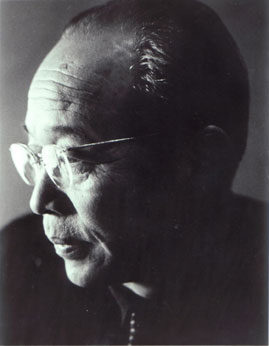
Kenji Mizoguchi
Kenji Mizoguchi was a Japanese film director and screenwriter. Born May 16, 1898, in Tokyo. Died August 24, 1956, in Kyoto. Known for Osaka Elegy, Ugetsu and The Life of Oharu. Awards include Blue Ribbon Awards for Best Director, Silver Lion and Golden Lion (2 times).
Facts
25 facts · 2 confirmed by two sources · 7 cited · 16 from one source
Where this comes from
Papalocal keeps its own record. It started from these sources; what each one said is kept here as it was copied, so a change on their side never changes this page by itself. Tap one to read its version.
What Wikidata says · copied November 16, 2026 · revision 2558081853
- Described as
- Japanese film director and screenwriter (1898-1956)
- Other names
- Mizoguchi Kenji
- Born
- May 16, 1898 · 9 references
- Died
- August 24, 1956 · 10 references
- Born in
- Tokyo · 2 references
- Died in
- Kyoto · 2 references
- Buried in
- Honmon-ji Temple Cemetery · 1 reference
- Cause of death
- leukemia
- Citizen of
- Japan
- Occupation
- film director · 1 reference; screenwriter; director · 2 references
- Known for
- Osaka Elegy; Ugetsu; The Life of Oharu; The Crucified Lovers; Street of Shame; Sisters of the Gion
- Awards
- Blue Ribbon Awards for Best Director (1955); Silver Lion (1953); Golden Lion (2 times) (1952, 1954); Medal with Purple Ribbon (1955); Order of the Sacred Treasure, 4th class (1956); Blue Ribbon Awards (1956); Mainichi Film Awards (1956)
- Field
- film · 1 reference; film direction · 1 reference
- Wikipedias with a page
- 51
Wikidata item Q55401 (wikidata.org/wiki/Q55401), public domain (CC0). Copied November 16, 2026.
What Wikipedia says · copied November 16, 2026 · revision 1384147749
Kenji Mizoguchi (溝口 健二, Mizoguchi Kenji; 16 May 1898 – 24 August 1956) was a Japanese filmmaker who directed roughly one hundred films during his career between 1923 and 1956. His most acclaimed works include The Story of the Last Chrysanthemums (1939), The Life of Oharu (1952), Ugetsu (1953), and Sansho the Bailiff (1954), with the latter three all being awarded at the Venice International Film Festival. A recurring theme of his films was the oppression of women in historical and contemporary Japan. Together with Akira Kurosawa and Yasujirō Ozu, Mizoguchi is seen as a representative of the "golden age" of Japanese cinema.
- Born, in its opening lines
- May 16, 1898
- Died, in its opening lines
- August 24, 1956
From the Wikipedia article “Kenji Mizoguchi” (en.wikipedia.org/wiki/Kenji_Mizoguchi), by its contributors, under CC BY-SA 4.0 (creativecommons.org/licenses/by-sa/4.0/). Copied November 16, 2026; not changed.
Confirmed Two sources agree. Cited One source, and it names where it got it. One source One source, without a reference of its own. Sources disagree The sources disagree. We show the best-supported value and keep theirs below.
