
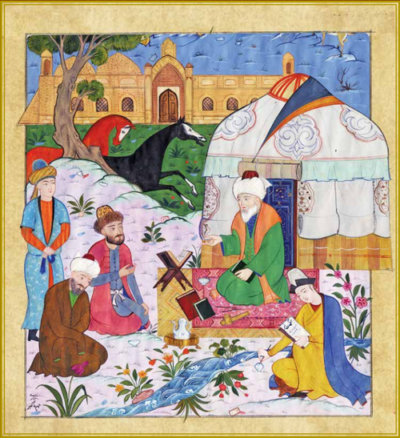
Khoja Akhmet Yassawi
Khoja Akhmet Yassawi was a Sufi Poet. Born 1100, in Sayram. Died 1166, in Turkistan.
Facts
10 facts · 1 confirmed by two sources · 2 cited · 6 from one source · 1 where the sources disagree
What’s different
- Born: we show 1100 (Sources disagree). Wikipedia says 1093
Where this comes from
Papalocal keeps its own record. It started from these sources; what each one said is kept here as it was copied, so a change on their side never changes this page by itself. Tap one to read its version.
What Wikidata says · copied November 16, 2026 · revision 2567379785
- Described as
- Sufi Poet
- Other names
- Akhmet Yassawi, Ahmed Yesevi, Khudzha Akhmad Yassavi, Akhmad Yassavi, Ahmad Yasawi
- Born
- 1100
- Died
- 1166
- Born in
- Sayram
- Died in
- Turkistan · 1 reference
- Buried in
- Mausoleum of Khoja Ahmed Yasawi
- Citizen of
- Karakhanid Khanate
- Occupation
- poet; Sufi · 1 reference
- Field
- Sufism · 1 reference
- Religion
- Islam
- Wikipedias with a page
- 41
Wikidata item Q401543 (wikidata.org/wiki/Q401543), public domain (CC0). Copied November 16, 2026.
What Wikipedia says · copied November 16, 2026 · revision 1386089223
Ahmad Yasawi (Kazakh: Қожа Ахмет Ясауи, romanized: Qoja Ahmet Iasaui, قوجا احمەت ياساۋى; Persian: خواجه احمد یسوی, romanized: Khwāje Ahmad-e Yasavī; 1093–1166) was a Turkic poet and Sufi, an early mystic who exerted a powerful influence on the development of Sufi orders throughout the Turkic-speaking world. Yasawi is the earliest known Turkic poet who composed poetry in Middle Turkic. He was a pioneer of popular mysticism, founded the first Turkic Sufi order, the Yasawiyya or Yeseviye, which very quickly spread over Turkic-speaking areas. He was a Hanafi scholar like his murshid (spiritual guide), Yusuf Hamadani.
- Born, in its opening lines
- 1093
- Died, in its opening lines
- 1166
From the Wikipedia article “Ahmad Yasawi” (en.wikipedia.org/wiki/Ahmad_Yasawi), by its contributors, under CC BY-SA 4.0 (creativecommons.org/licenses/by-sa/4.0/). Copied November 16, 2026; not changed.
Confirmed Two sources agree. Cited One source, and it names where it got it. One source One source, without a reference of its own. Sources disagree The sources disagree. We show the best-supported value and keep theirs below.
