
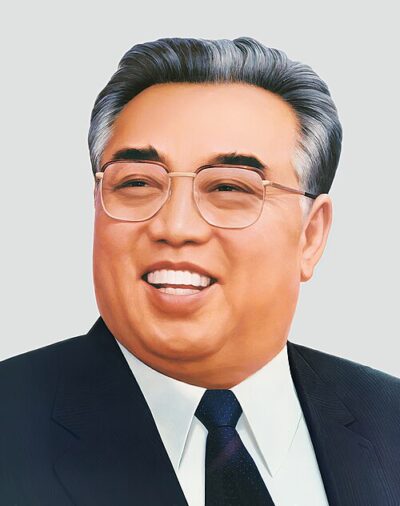
Kim Il-sung
Kim Il-sung was a Supreme Leader of North Korea from 1948 to 1994. Born April 15, 1912, in Mangyŏngdae. Died July 8, 1994, in Pyongyang. Positions held include President of North Korea (1972–1994), Premier of North Korea (1948–1972) and member of the Supreme People's Assembly. Educated at Jilin Yuwen High School and Mangyongdae Revolutionary School. Awards include Hero of the Republic (3 times), Hero of Labor and Order of Karl Marx.
Facts
60 facts · 2 confirmed by two sources · 9 cited · 49 from one source
Where this comes from
Papalocal keeps its own record. It started from these sources; what each one said is kept here as it was copied, so a change on their side never changes this page by itself. Tap one to read its version.
What Wikidata says · copied November 16, 2026 · revision 2568603701
- Described as
- Supreme Leader of North Korea from 1948 to 1994
- Other names
- Kim Il-sŏng, Kim Il Sung, 김일성
- Born
- April 15, 1912 · 11 references
- Died
- July 8, 1994 · 11 references
- Born in
- Mangyŏngdae · 2 references
- Died in
- Pyongyang · 1 reference
- Buried in
- Kumsusan Palace of the Sun
- Cause of death
- myocardial infarction
- Name at birth
- 김성주
- Citizen of
- Korea under Japanese rule; Soviet Union; North Korea
- Occupation
- politician · 2 references; writer; partisan (1932–1945); memoirist
- Positions held
- President of North Korea (1972–1994) · 1 reference; Premier of North Korea (1948–1972) · 1 reference; member of the Supreme People's Assembly; General Secretary of the Workers' Party of Korea (1949–1994); Supreme Leader of North Korea (1948–1994); Supreme Commander of the Korean People’s Army (1950–1991)
- Political party
- Workers’ Party of Korea (1945–); Chinese Communist Party (1932–)
- Education
- Jilin Yuwen High School · 1 reference; Mangyongdae Revolutionary School
- Instrument
- organ
- Awards
- Hero of the Republic (3 times) (1953, 1972, 1982); Hero of Labor (1958) · 1 reference; Order of Karl Marx; Order of Augusto César Sandino; Order of Klement Gottwald (1987) · 1 reference; Order of the National Flag; Order of Freedom and Independence, 1st class (1953); Order of Lenin (1972) · 1 reference; Order of the Red Banner (1945); Jubilee Medal "In Commemoration of the 100th Anniversary of the Birth of Vladimir Ilyich Lenin" (1970); Order of Sukhbaatar; Star of the Socialist Republic of Romania (1971); Order of the Victory of Socialism (1987); Order of José Martí (1986); Order of Playa Girón (1987)
- Spouse
- Kim Jong-suk (1941–1949); Kim Song-ae
- Children
- Kim Jong-il · 1 reference; Kim Man-il; Kim Kyong-hui; Kim Pyong-il; Kim Yong-il · 1 reference; Kim Kyong-chin · 1 reference
- Father
- Kim Hyŏng-jik
- Mother
- Kang Pan-sŏk · 1 reference
- Siblings
- Kim Yong-ju; Kim Chol-ju
- Religion
- irreligion; atheism · 1 reference
- Military branch
- Korean People’s Army; Red Army (1942–1945) · 1 reference; Northeast Anti-Japanese United Army (–1945)
- Military rank
- Taewonsu (1992–); captain (1942–)
- Lived in
- Kumsusan Palace of the Sun
- Wikipedias with a page
- 162
Wikidata item Q41117 (wikidata.org/wiki/Q41117), public domain (CC0). Copied November 16, 2026.
What Wikipedia says · copied November 16, 2026 · revision 1385910537
Kim Il Sung (born Kim Song Ju; 15 April 1912 – 8 July 1994) was a North Korean communist revolutionary, military officer, politician, and dictator who founded the Democratic People's Republic of Korea (DPRK), also known as North Korea, in 1948, and led it until his death in 1994. He was succeeded by his son Kim Jong Il and posthumously declared Eternal President. He was the third-longest-serving non-royal head of state and government in the 20th century, in office for more than 45 years.
Kim was born in Japanese-ruled Korea and grew up in northeast China. During his teenage years, he became a communist and joined various anti-Japanese guerrilla groups, eventually joining the Chinese Communist Party (CCP) in 1931. In 1942, he was assigned to the Soviet Red Army, leading him to stay in the Soviet Union until 1945. Following the division of Korea after Japan's surrender in World War II, he was installed in power over North Korea by the Soviet Union, which also had him appointed as the leader of the Workers' Party of Korea. In 1950, Kim Il Sung authorized the invasion of South Korea, triggering a U.S.-led intervention in defense of South Korea. Following the military stalemate in the Korean War, a ceasefire was signed in 1953.
Under Kim's leadership, North Korea was established as a totalitarian, socialist, personalist dictatorship with a centrally planned economy. It had close political and economic relations with the Soviet Union and China. By the 1960s, North Korea had a slightly higher standard of living than the South, which was suffering from political chaos and economic crises. This was reversed in the 1970s, as a newly stable South Korea became an economic powerhouse while North Korea's economy stagnated and then collapsed. Kim also broke off from orthodox Marxism–Leninism by developing the ideology of Juche, which focused on the principles of "independence, self-sustenance and self-defence" and Korean nationalism.
Despite the official policy of "self-reliance" (jaryok gaengsaeng, Korean: 자력갱생), North Korea received funds, subsidies and aid from the Soviet Union and the Eastern Bloc until the dissolution of the Soviet Union in 1991. The resulting loss of economic aid negatively affected North Korea's economy, contributing to widespread famine in 1994. During this period, North Korea also remained critical of the United States military's presence in the region, which it considered imperialist, having seized the American ship USS Pueblo in 1968. This was part of an infiltration and subversion campaign to reunify the peninsula under North Korea's rule. Kim outlived his allies, Joseph Stalin and Mao Zedong, by many years, and remained in power during the terms of office of six South Korean presidents and ten United States presidents. Known as the Great Leader (Suryong), he established a far-reaching personality cult which dominates domestic politics in North Korea. At the 6th WPK Congress in 1980, his oldest son, Kim Jong Il, was elected to be a Presidium member and chosen as his successor, establishing the Kim dynasty.
- Born, in its opening lines
- April 15, 1912
- Died, in its opening lines
- July 8, 1994
From the Wikipedia article “Kim Il Sung” (en.wikipedia.org/wiki/Kim_Il_Sung), by its contributors, under CC BY-SA 4.0 (creativecommons.org/licenses/by-sa/4.0/). Copied November 16, 2026; not changed.
Confirmed Two sources agree. Cited One source, and it names where it got it. One source One source, without a reference of its own. Sources disagree The sources disagree. We show the best-supported value and keep theirs below.
