
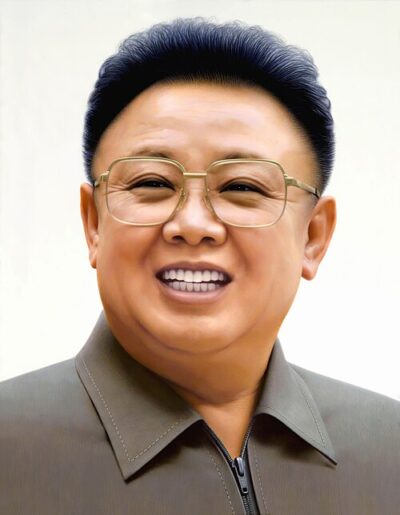
Kim Jong-il
Kim Jong-il was a Supreme Leader of North Korea from 1994 to 2011. Born February 16, 1941, in Vyatskoye. Died December 17, 2011, in Pyongyang. Positions held include member of the Supreme People's Assembly, General Secretary of the Workers' Party of Korea (1997–2011) and President of the State Affairs Commission (1993–2011). Educated at Kim Il-sung University and University of Malta. Awards include Jubilee Medal "50 Years of Victory in the Great Patriotic War 1941–1945", Jubilee Medal "60 Years of Victory in the Great Patriotic War 1941–1945" and Jubilee Medal "65 Years of Victory in the Great Patriotic War 1941–1945".
Facts
59 facts · 2 confirmed by two sources · 23 cited · 34 from one source
Where this comes from
Papalocal keeps its own record. It started from these sources; what each one said is kept here as it was copied, so a change on their side never changes this page by itself. Tap one to read its version.
What Wikidata says · copied November 16, 2026 · revision 2568060265
- Described as
- Supreme Leader of North Korea from 1994 to 2011
- Other names
- Kim Jong Il, Yuri Irsenovich Kim, Kim Dzong Il, Kim Xhong-Il, 김정일 총비서
- Born
- February 16, 1941 · 4 references
- Died
- December 17, 2011 · 6 references
- Born in
- Vyatskoye · 1 reference
- Died in
- Pyongyang
- Buried in
- Kumsusan Palace of the Sun · 1 reference
- Cause of death
- myocardial infarction
- Name at birth
- Юрий Ирсенович Ким · 1 reference
- Citizen of
- North Korea
- Occupation
- politician · 2 references; military personnel; film producer · 1 reference; film actor · 1 reference; voice actor · 1 reference; television director · 1 reference
- Positions held
- member of the Supreme People's Assembly; General Secretary of the Workers' Party of Korea (1997–2011); President of the State Affairs Commission (1993–2011) · 1 reference; Supreme Leader of North Korea (1994–2011); Eternal leaders of North Korea
- Political party
- Workers’ Party of Korea
- Education
- Kim Il-sung University (–1964); University of Malta; Mangyongdae Revolutionary School
- Awards
- Jubilee Medal "50 Years of Victory in the Great Patriotic War 1941–1945" (1995) · 1 reference; Jubilee Medal "60 Years of Victory in the Great Patriotic War 1941–1945" (2005) · 1 reference; Jubilee Medal "65 Years of Victory in the Great Patriotic War 1941–1945" (2010) · 1 reference; Hero of the Republic · 1 reference; Order of Kim Il Sung (3 times) (1978, 1992, 2012) · 1 reference; Order of the National Flag · 1 reference; National Order of Merit (2005) · 1 reference; Order of the Republic, 1st Class (1983) · 2 references; Jubilee Medal "Forty Years of Victory in the Great Patriotic War 1941–1945" (1985) · 1 reference; Grand Cross of the National Order of Mali (1992) · 1 reference; National Order of Niger (1986) · 1 reference; Order of Independence (1992) · 1 reference; Royal Order of Cambodia · 1 reference; Order of the Nile · 1 reference; National Order of the Leopard · 1 reference
- Spouse
- Hong Il-chon (1966–1969); Song Hye-rim; Kim Young-sook (1974–2011); Ko Yong-hui; Kim Ok
- Children
- Kim Jong-nam; Kim Sul-song; Kim Jong-chul · 1 reference; Kim Jong-un · 1 reference; Kim Yo-jong · 1 reference; Kim Chun-song · 1 reference
- Father
- Kim Il-sung · 1 reference
- Mother
- Kim Jong-suk
- Siblings
- Kim Kyong-hui; Kim Pyong-il; Kim Man-il
- Religion
- atheism
- Military branch
- Korean People’s Army · 1 reference
- Military rank
- generalissimo; Taewonsu
- Lived in
- Ryongsong Residence
- Wikipedias with a page
- 136
Wikidata item Q10665 (wikidata.org/wiki/Q10665), public domain (CC0). Copied November 16, 2026.
What Wikipedia says · copied November 16, 2026 · revision 1385275803
Kim Jong Il (16 February 1941 – 17 December 2011) was a North Korean politician and dictator who was the second supreme leader of North Korea from the death of his father Kim Il Sung in 1994 until his own death in 2011. Posthumously, Kim Jong Il was declared an eternal leader of the Workers' Party of Korea (WPK).
Kim was born in the far eastern region of the Soviet Union and moved to Pyongyang in 1945 following the end of Japanese rule. He joined the WPK in 1961 and rose through its ranks, joining the Propaganda and Agitation Department (PAD) in 1966. He was responsible for investigations following the Kapsan faction incident in 1967, and played a key role in the development of the Juche ideology, North Korean cult of personality and the Monolithic Ideological System. He became PAD director in 1973, and took an increasingly prominent role. He was formally designated as Kim Il Sung's successor in 1980 at the 6th Congress of the Workers' Party of Korea. Kim succeeded his father following his death in 1994. Kim was the General Secretary of the WPK, Member of WPK Presidium, Chairman of the WPK Central Military Commission, Chairman of the National Defence Commission (NDC) of North Korea and the Supreme Commander of the Korean People's Army (KPA), the fourth-largest standing army in the world.
Like his father, Kim ruled North Korea as a repressive and totalitarian dictatorship. Kim assumed leadership during a period of catastrophic economic crisis amidst the dissolution of the Soviet Union, on which it was heavily dependent for trade in food and other supplies, which brought a famine. While the famine had ended by the late 1990s, food scarcity continued to be a problem throughout his tenure. Kim strengthened the role of the military with his Songun ("military-first") policies, making the army the central organizer of civil society. Kim's rule also saw tentative economic reforms, including the opening of the Kaesong Industrial Region in 2003 as well as a failed currency reform in 2009. The relationship with South Korea initially improved due to the Sunshine Policy, culminating in Kim's meeting with South Korean president Kim Dae-jung in 2000, followed by a meeting with president Roh Moo-hyun in 2007. However, the relationship subsequently deteriorated in 2010 following the sinking of ROKS Cheonan and the bombardment of Yeonpyeong. Under his leadership, North Korea conducted its first nuclear test in 2006, becoming the world's ninth nuclear-armed state, followed by another nuclear test in 2009, leading to international sanctions against North Korea.
Following Kim's failure to appear at important public events in 2008, foreign observers assumed that Kim had either fallen seriously ill or died. After this point, Kim made efforts to promote his third son, Kim Jong Un as his successor, promoting him to high ranking posts in the WPK in 2010. On 19 December 2011, the North Korean government announced that he had died two days earlier. After his death, alongside "Eternal General Secretary" of the WPK, Kim Jong Il was declared "Eternal Chairman" of the National Defence Commission, in keeping with the tradition of establishing eternal posts for the dead members of the Kim family.
- Born, in its opening lines
- February 16, 1941
- Died, in its opening lines
- December 17, 2011
From the Wikipedia article “Kim Jong Il” (en.wikipedia.org/wiki/Kim_Jong_Il), by its contributors, under CC BY-SA 4.0 (creativecommons.org/licenses/by-sa/4.0/). Copied November 16, 2026; not changed.
Confirmed Two sources agree. Cited One source, and it names where it got it. One source One source, without a reference of its own. Sources disagree The sources disagree. We show the best-supported value and keep theirs below.
