
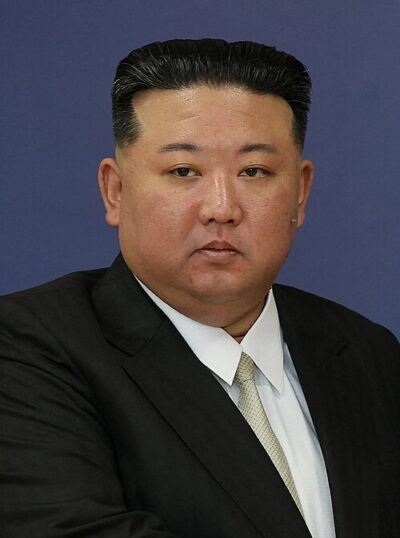
Kim Jong-un
Kim Jong-un is a Supreme Leader of North Korea since 2011. Born January 8, 1984, in Wonsan. Positions held include General Secretary of the Workers' Party of Korea (2012–), President of the State Affairs Commission (2012–) and Supreme Commander of the Korean People’s Army (2011–). Educated at Kim Il-sung University and Kim Il-sung Military University. Awards include Jubilee Medal "75 Years of Victory in the Great Patriotic War 1941–1945", Time 100 (5 times) and Jubilee Medal "80 Years of Victory in the Great Patriotic War 1941–1945".

Facts
33 facts · 0 confirmed by two sources · 9 cited · 23 from one source · 1 where the sources disagree
What’s different
- Born: we show January 8, 1984 (Sources disagree). Wikipedia says 1982
Where this comes from
Papalocal keeps its own record. It started from these sources; what each one said is kept here as it was copied, so a change on their side never changes this page by itself. Tap one to read its version.
What Wikidata says · copied November 16, 2026 · revision 2565454473
- Described as
- Supreme Leader of North Korea since 2011
- Other names
- Kim Jong-eun, Kim Jong Un, Kim Jung-eun, Kim Jong-woon, Kim Jung-woon, Kim Jong-Woon, Kim Jung-Woon, Kim Jong woon, Kim Jong Woon, Kim Jung woon, Kim Jung Woon, Kim Jong un
- Born
- January 8, 1984 · 3 references
- Born in
- Wonsan · 1 reference
- Citizen of
- North Korea
- Occupation
- politician · 1 reference
- Positions held
- General Secretary of the Workers' Party of Korea (2012–); President of the State Affairs Commission (2012–); Supreme Commander of the Korean People’s Army (2011–); Supreme Leader of North Korea (2011–); member of the Presidium of the Politburo of the Workers' Party of Korea · 1 reference; member of the Supreme People's Assembly (2009–2019) · 1 reference
- Political party
- Workers’ Party of Korea
- Education
- Kim Il-sung University; Kim Il-sung Military University; Liebefeld-Steinhölzli State School · 1 reference
- Awards
- Jubilee Medal "75 Years of Victory in the Great Patriotic War 1941–1945" (2020) · 1 reference; Time 100 (5 times) (2011, 2013, 2016, 2017, 2018) · 1 reference; Jubilee Medal "80 Years of Victory in the Great Patriotic War 1941–1945" · 1 reference
- Spouse
- Ri Sol-ju (2009–) · 1 reference
- Children
- Kim Ju Ae; Kim Jong-ju
- Father
- Kim Jong-il · 1 reference
- Mother
- Ko Yong-hui
- Siblings
- Kim Jong-chul · 1 reference; Kim Jong-nam; Kim Yo-jong · 1 reference; Kim Sul-song
- Religion
- atheism
- Military branch
- Korean People’s Army
- Military rank
- wonsu; marshal; Taewonsu · 1 reference
- Lived in
- Ryongsong Residence
- Height
- 1.70 m (5 ft 7 in); 1.70 m (5 ft 7 in)
- Wikipedias with a page
- 177
Wikidata item Q56226 (wikidata.org/wiki/Q56226), public domain (CC0). Copied November 16, 2026.
What Wikipedia says · copied November 16, 2026 · revision 1385671134
Kim Jong Un (born 8 January c. 1982–1984) is a North Korean politician and dictator who has been serving as the supreme leader of North Korea since 2011, following the death of his father, Kim Jong Il. He is the third ruler from the Kim family to lead the country, which was founded by his grandfather Kim Il Sung. Kim holds the positions of general secretary of the Workers' Party of Korea (WPK) and president of the State Affairs Commission, as well as the highest offices in the Korean People's Army.
The second of three children of Kim Jong Il and his mistress Ko Yong Hui, Kim studied at the International School of Berne in Switzerland before attending Kim Il Sung University between 2002 and 2007. From 2009, Kim was viewed as the successor to the North Korean leadership. Following his father's death in 2011, state television announced Kim as the "great successor to the revolutionary cause". He assumed various leadership posts, and also became member of the Presidium of the WPK Politburo, the highest decision-making body in the country. In July 2012, Kim was promoted to the highest rank of marshal in the Korean People's Army, consolidating his positions as commander-in-chief of the Armed Forces and Chairman of the Central Military Commission.
Like his father and grandfather before him, Kim rules North Korea as a repressive and totalitarian dictatorship, and his leadership has maintained the Kim family cult of personality. State media often refer to him as "Respected Comrade", "Marshal", and "Head of State". Kim's government has been accused of human rights violations. He reportedly ordered the purge and execution of several North Korean officials including his uncle, Jang Song-thaek, in 2013, and the assassination of his half-brother, Kim Jong-nam, in Malaysia in 2017. Kim Jong Un's ideology departed from his father's military-first Songun policy, professing a "people-first policy" and renewed commitment to communism. Kim has promoted the Byungjin policy of parallel development of the country's nuclear weapons program alongside the country's economy, named after the similar policy of Kim Il Sung. He has revived the structures of the WPK, expanding the party's power at the expense of the military leadership.
Kim oversaw the world's four most recent nuclear weapons tests and extensive missile tests, including North Korea's first intercontinental ballistic missile. These heightened tensions with South Korea, the United States, and China, culminating in the 2017–2018 North Korea crisis. In 2018 and 2019, Kim took part in summits with Chinese President Xi Jinping and South Korean president Moon Jae-in and U.S. president Donald Trump, the first meetings between a North Korean and a U.S. head of state. Despite the brief thaw in relations, the negotiations ultimately broke down without progress on reunification of Korea or nuclear disarmament. He claimed success in combating the COVID-19 pandemic, with the country not reporting confirmed cases until May 2022, although some independent observers questioned this claim. In December 2023, Kim declared that North Korea formally abandoned efforts to reunify Korea and proposed the two hostile states theory, symbolically demolishing the Arch of Reunification. In June 2024, Kim signed a security and defense treaty with Russia, while supplying Russia with material for the Russo-Ukrainian war. In October, North Korea sent soldiers to assist Russian units in the Kursk campaign.
- Born, in its opening lines
- 1982
- Died, in its opening lines
- 1984
From the Wikipedia article “Kim Jong Un” (en.wikipedia.org/wiki/Kim_Jong_Un), by its contributors, under CC BY-SA 4.0 (creativecommons.org/licenses/by-sa/4.0/). Copied November 16, 2026; not changed.
Confirmed Two sources agree. Cited One source, and it names where it got it. One source One source, without a reference of its own. Sources disagree The sources disagree. We show the best-supported value and keep theirs below.
