
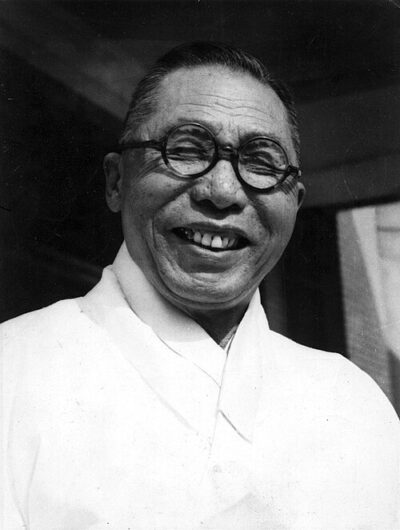
Kim Ku
Kim Ku was a Korean politician. Born August 29, 1876, in Haeju. Died June 26, 1949, in Seoul. Awards include Order of Merit for National Foundation and National Reunification Prize.
Facts
20 facts · 2 confirmed by two sources · 4 cited · 14 from one source
Where this comes from
Papalocal keeps its own record. It started from these sources; what each one said is kept here as it was copied, so a change on their side never changes this page by itself. Tap one to read its version.
What Wikidata says · copied November 16, 2026 · revision 2558534996
- Described as
- Korean politician (1876–1949)
- Other names
- Baekbeom, Kim Goo, Kim Gu, Kim Koo, Kim Chang-su, Kim Chang-soo
- Born
- August 29, 1876 · 1 reference
- Died
- June 26, 1949 · 1 reference
- Born in
- Haeju
- Died in
- Seoul
- Name at birth
- 김창수 · 1 reference
- Citizen of
- Korean Empire; Korea under Japanese rule; South Korea
- Occupation
- politician; independence activist; freedom fighter · 1 reference
- Political party
- Korean Independence Party
- Member of
- Korean Patriotic Organization
- Awards
- Order of Merit for National Foundation · 1 reference; National Reunification Prize (1990) · 1 reference
- Field
- politics · 1 reference
- Children
- Kim Shin
- Mother
- Kwak Nak-won
- Religion
- Protestantism
- Military rank
- generalissimo
- Wikipedias with a page
- 45
Wikidata item Q215737 (wikidata.org/wiki/Q215737), public domain (CC0). Copied November 16, 2026.
What Wikipedia says · copied November 16, 2026 · revision 1383890966
Kim Ku (Korean: 김구; Hanja: 金九; August 29, 1876 – June 26, 1949), also known by his art name Paekpŏm, was a Korean independence activist and statesman. He was a leader of the Korean independence movement against the Empire of Japan, head of the Korean Provisional Government from 1926 to 1927 and from 1940 to 1945, and a Korean reunification activist after 1945. Kim is revered in South Korea, where he is considered one of the greatest figures in Korean history; his legacy is also somewhat less enthusiastically celebrated in North Korea, due to his anti-communist views.
Born in Haeju, Hwanghae Province, Joseon, to a poor farming family, Kim was involved in the Donghak Peasant Revolution in 1894. In 1896, he murdered a Japanese man whom he believed was connected to the assassination of Empress Myeongseong (though he is now generally agreed to be a civilian merchant), for which he was imprisoned until escaping in 1898. Kim was briefly a Buddhist monk before becoming a Christian and teacher in 1903. In 1911, he was arrested in connection with the 105-Man Incident and was again imprisoned until 1914. In 1919, he participated in the March First Movement against the Japanese. While in exile in the Republic of China, he helped found the Korean Provisional Government, and served as its president from 1926 to 1927 and from 1940. Kim also founded and led several other organizations, including the Korean Independence Party, Korean Patriotic Organization, and Korean Liberation Army.
After the surrender of Japan in World War II, Kim returned to Korea in 1945 as head of the provisional government. Kim became a critic of Syngman Rhee, the U.S.'s preferred candidate for leader of South Korea, and made efforts to prevent a permanent division of Korea. Defying the wishes of Rhee and the U.S., he went to Pyongyang to hold unification talks with Kim Il Sung, but was unable to reach an agreement. He fiercely opposed the establishment of separate states in North and South Korea, which took place in 1948. In 1949, before the outbreak of the Korean War, Kim was assassinated by army officer Ahn Doo-hee.
- Born, in its opening lines
- August 29, 1876
- Died, in its opening lines
- June 26, 1949
From the Wikipedia article “Kim Ku” (en.wikipedia.org/wiki/Kim_Ku), by its contributors, under CC BY-SA 4.0 (creativecommons.org/licenses/by-sa/4.0/). Copied November 16, 2026; not changed.
Confirmed Two sources agree. Cited One source, and it names where it got it. One source One source, without a reference of its own. Sources disagree The sources disagree. We show the best-supported value and keep theirs below.
