
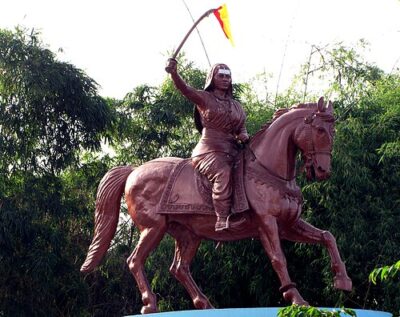
Kittur Chennamma
Kittur Chennamma was an Indian freedom fighter, warrior queen. Born October 23, 1778, in Belagavi district. Died February 21, 1829, in Bailahongala. Positions held include Raja (1803–1824).
Facts
9 facts · 1 confirmed by two sources · 1 cited · 6 from one source · 1 where the sources disagree
What’s different
- Born: we show October 23, 1778 (Sources disagree). Wikipedia says November 14, 1778
Where this comes from
Papalocal keeps its own record. It started from these sources; what each one said is kept here as it was copied, so a change on their side never changes this page by itself. Tap one to read its version.
What Wikidata says · copied November 16, 2026 · revision 2568894315
- Described as
- Indian freedom fighter, warrior queen
- Other names
- Tigress of Kittur
- Born
- October 23, 1778 · 1 reference
- Died
- February 21, 1829 · 1 reference
- Born in
- Belagavi district · 1 reference
- Died in
- Bailahongala
- Citizen of
- Karnataka
- Occupation
- soldier; freedom fighter
- Positions held
- Raja (1803–1824)
- Religion
- Hinduism
- Wikipedias with a page
- 29
Wikidata item Q3536979 (wikidata.org/wiki/Q3536979), public domain (CC0). Copied November 16, 2026.
What Wikipedia says · copied November 16, 2026 · revision 1376724834
Chennamma of Kittur (14 November 1778 – 21 February 1829) was the Queen of the princely state of Kittur in present-day Karnataka. She led a rebellious armed resistance against the British East India Company, in order to retain control over her dominion. She defeated the British army in the first war, but died as a prisoner after a second war. As one of the first and few female rulers to lead kittur forces against British colonisation, she continues to be remembered as a folk heroine in Karnataka.
- Born, in its opening lines
- November 14, 1778
- Died, in its opening lines
- February 21, 1829
From the Wikipedia article “Kittur Chennamma” (en.wikipedia.org/wiki/Kittur_Chennamma), by its contributors, under CC BY-SA 4.0 (creativecommons.org/licenses/by-sa/4.0/). Copied November 16, 2026; not changed.
Confirmed Two sources agree. Cited One source, and it names where it got it. One source One source, without a reference of its own. Sources disagree The sources disagree. We show the best-supported value and keep theirs below.
