
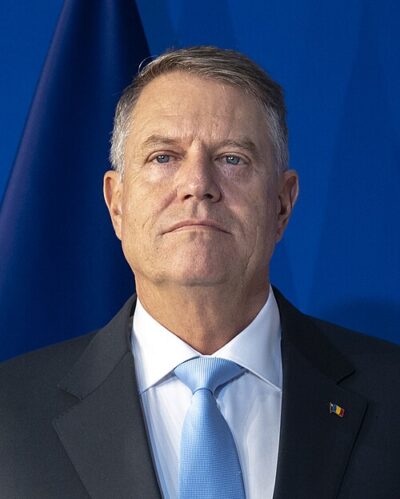
Klaus Iohannis
Klaus Iohannis is a President of Romania from 2014 to 2025. Born June 13, 1959, in Sibiu. Positions held include president of Romania (2014–2025), mayor of Sibiu (2000–2014) and chairperson (2002–2014). Educated at Babeș-Bolyai University. Awards include Officer's Cross of the Order of Merit of the Federal Republic of Germany, Great Silver Medal of Honour for Services to the Republic of Austria and Order of the Star of Romania.
Facts
40 facts · 1 confirmed by two sources · 10 cited · 29 from one source
Where this comes from
Papalocal keeps its own record. It started from these sources; what each one said is kept here as it was copied, so a change on their side never changes this page by itself. Tap one to read its version.
What Wikidata says · copied November 16, 2026 · revision 2563053016
- Described as
- President of Romania from 2014 to 2025
- Other names
- Klaus Werner Johannis
- Born
- June 13, 1959 · 4 references
- Born in
- Sibiu · 1 reference
- Name at birth
- Klaus Werner Iohannis
- Citizen of
- Romania
- Occupation
- school teacher; politician · 1 reference; physics teacher · 2 references; school inspector; statesperson; writer · 2 references
- Positions held
- president of Romania (2014–2025); mayor of Sibiu (2000–2014) · 1 reference; chairperson (2002–2014); president · 1 reference
- Political party
- National Liberal Party (2013–2014); Democratic Forum of Germans in Romania (1990–2013); independent politician (2014–)
- Worked for
- Samuel von Brukenthal National College · 1 reference
- Education
- Babeș-Bolyai University (1979–1983)
- Awards
- Officer's Cross of the Order of Merit of the Federal Republic of Germany (2014) · 1 reference; Great Silver Medal of Honour for Services to the Republic of Austria; Order of the Star of Romania; Order of the Republic; Order of Stara Planina (2016) · 1 reference; Knight Grand Cross with Collar of the Order of Merit of the Italian Republic; National Order of Merit; Commander of the Order of the Star of Italian Solidarity · 1 reference; Order of Merit of the Grand Duchy of Luxembourg · 1 reference; Officer of the Order of the Crown (2009) · 1 reference; Charlemagne Prize (2020) · 2 references; Cross of the Order of Merit of the Federal Republic of Germany (2006); Order of the Gold Lion of the House of Nassau; Order of the White Eagle; Emperor Otto Prize (2020) · 1 reference
- Field
- politics · 1 reference
- Spouse
- Carmen Iohannis (1989–) · 1 reference
- Religion
- Lutheranism
- Lived in
- Cotroceni Palace
- Height
- 1.92 m (6 ft 4 in)
- Website
- http://www.iohannispresedinte.ro/
- Wikipedias with a page
- 89
Wikidata item Q701484 (wikidata.org/wiki/Q701484), public domain (CC0). Copied November 16, 2026.
What Wikipedia says · copied November 16, 2026 · revision 1381747296
Klaus Werner Iohannis (born 13 June 1959) is a Romanian politician, physicist, and former teacher who served as the president of Romania from 2014 until his resignation in 2025. Prior to entering national politics, Iohannis was a physics teacher at the Samuel von Brukenthal National College in his native Sibiu where he eventually served as mayor from 2000 to 2014 before ascending to the presidency.
Iohannis was first elected the mayor of the Romanian town of Sibiu in 2000, on behalf of the Democratic Forum of Germans in Romania (FDGR/DFDR). Although the Transylvanian Saxon population of Sibiu had declined to a tiny minority by the early 2000s, he won a surprise victory and was re-elected by landslides in 2004, 2008, and 2012. He is credited with turning his home town into one of Romania's most popular tourist destinations. Sibiu was named the European Capital of Culture in 2007 alongside Luxembourg City.
In October 2009, four of the five political groups in the Parliament of Romania, excluding the Democratic Liberal Party (PDL) of then President Traian Băsescu, proposed Iohannis as a candidate for the office of Prime Minister of Romania; however, Băsescu refused to nominate him, despite Parliament's adoption of a declaration supporting his candidacy. He was again the candidate for Prime Minister of the PNL and the PSD in the elections in the same year. In February 2013, he became a member of the National Liberal Party (PNL), accepting an invitation from then liberal leader Crin Antonescu, and was immediately elected the party's first vice-president, eventually becoming the PNL president during the following year. Iohannis became the president of the National Liberal Party (PNL) in 2014, after previously serving as the leader of the Democratic Forum of Germans in Romania (FDGR/DFDR) between 2002 and 2013. He was elected president in that year's election, and then subsequently re-elected by a landslide in 2019.
Iohannis's second term was marked by democratic backsliding as well as a slight shift towards illiberalism and a more authoritarian style of government, especially after the 2021 political crisis and the formation of the National Coalition for Romania (CNR). He faced allegations of suppression of freedom of speech and press freedom. Furthermore, his approval ratings declined from April 2021 onwards as the electorate showed increasing disapproval of his political behaviour, favouring the Social Democratic Party (PSD) and rebuffing his former political allies (albeit several of them being solely conjunctural in the past) in the process. A survey from June 2023 showed that over 90% of Romanians did not trust Iohannis, with only 8% having a positive opinion on him. In 2023, the Economist Democracy Index ranked Romania last in the European Union (EU) in terms of democracy, even behind Viktor Orbán's Hungary. His term was extended due to the annulment of the 2024 presidential election, but he resigned in February 2025.
Ideologically a conservative, Iohannis is the first Romanian president belonging to an ethnic minority, as he is a Transylvanian Saxon, part of Romania's German minority, which settled in Transylvania from the High Middle Ages onward.
- Born, in its opening lines
- June 13, 1959
From the Wikipedia article “Klaus Iohannis” (en.wikipedia.org/wiki/Klaus_Iohannis), by its contributors, under CC BY-SA 4.0 (creativecommons.org/licenses/by-sa/4.0/). Copied November 16, 2026; not changed.
Confirmed Two sources agree. Cited One source, and it names where it got it. One source One source, without a reference of its own. Sources disagree The sources disagree. We show the best-supported value and keep theirs below.
