
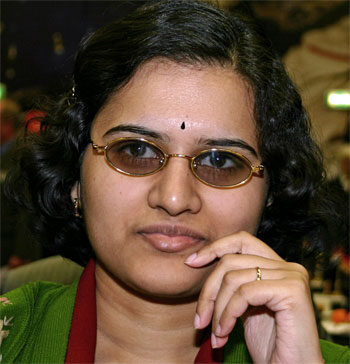
Koneru Humpy is an Indian chess player. Born March 31, 1987, in Vijayawada. Awards include Padma Shri in Sports and Arjuna Award.
Facts
8 facts · 1 confirmed by two sources · 0 cited · 7 from one source
Where this comes from
Papalocal keeps its own record. It started from these sources; what each one said is kept here as it was copied, so a change on their side never changes this page by itself. Tap one to read its version.
What Wikidata says · copied November 16, 2026 · revision 2560050585
- Described as
- Indian chess player
- Other names
- Koneru Hampi, Humpy Koneru
- Born
- March 31, 1987
- Born in
- Vijayawada
- Citizen of
- India
- Occupation
- chess player
- Sport
- chess
- Awards
- Padma Shri in Sports (2007); Arjuna Award (2003)
- Father
- Koneru Ashok
- Wikipedias with a page
- 50
Wikidata item Q255044 (wikidata.org/wiki/Q255044), public domain (CC0). Copied November 16, 2026.
What Wikipedia says · copied November 16, 2026 · revision 1382991216
Koneru Humpy (born 31 March 1987) is an Indian chess grandmaster. Koneru is a runner-up of the Women's World Chess Championship and two-time Women's World Rapid Chess Champion. In 2002, she became the youngest female player—and the first Indian female player—to achieve the title of Grandmaster, aged 15 years, 1 month, 27 days, a record since surpassed only by Hou Yifan. Koneru is a gold medallist at the Olympiad, Asian Games, and Asian Championship.
In October 2007, she became the second female player, after Judit Polgár, to exceed the 2600 Elo rating mark, being rated 2606, She is the third highest rated woman ever behind Judit Polgár and Hou Yifan.
Koneru won the Women's World Rapid Chess Championship in 2019 and 2024.
- Born, in its opening lines
- March 31, 1987
From the Wikipedia article “Koneru Humpy” (en.wikipedia.org/wiki/Koneru_Humpy), by its contributors, under CC BY-SA 4.0 (creativecommons.org/licenses/by-sa/4.0/). Copied November 16, 2026; not changed.
Confirmed Two sources agree. Cited One source, and it names where it got it. One source One source, without a reference of its own. Sources disagree The sources disagree. We show the best-supported value and keep theirs below.
