
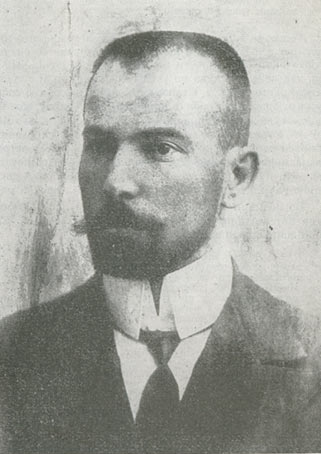
Krste Misirkov
Krste Misirkov was a Philologist, collector, ethnologist, journalist, historian and ethnographer. Born November 18, 1874, in Pella. Died June 26, 1926, in Sofia. Known for On Macedonian Matters. Educated at Saint Petersburg State University.
Facts
21 facts · 0 confirmed by two sources · 4 cited · 16 from one source · 1 where the sources disagree
What’s different
- Died: we show June 26, 1926 (Sources disagree). Wikidata also lists July 26, 1926
Where this comes from
Papalocal keeps its own record. It started from these sources; what each one said is kept here as it was copied, so a change on their side never changes this page by itself. Tap one to read its version.
What Wikidata says · copied November 16, 2026 · revision 2555018563
- Described as
- Philologist, collector, ethnologist, journalist, historian and ethnographer
- Other names
- Krste Petkov Misirkov
- Born
- November 18, 1874 · 1 reference
- Died
- June 26, 1926 · 4 references; July 26, 1926 · 1 reference
- Born in
- Pella
- Died in
- Sofia · 1 reference
- Buried in
- Central Sofia Cemetery
- Name at birth
- Кръстю Петков Мисирков
- Citizen of
- Bulgaria · 1 reference; Ottoman Empire; Russian Empire
- Occupation
- historian; writer; ethnographer; journalist; folklorist; teacher; opinion journalist · 1 reference; collector
- Education
- Saint Petersburg State University
- Known for
- On Macedonian Matters · 1 reference
- Spouse
- Ekaterina Mikhailovna-Misirkova
- Children
- Sergey Misirkov
- Wikipedias with a page
- 31
Wikidata item Q2586864 (wikidata.org/wiki/Q2586864), public domain (CC0). Copied November 16, 2026.
What Wikipedia says · copied November 16, 2026 · revision 1384862476
Krste Petkov Misirkov (Macedonian: Крсте Петков Мисирков, pronounced ['kr̩stɛ 'pɛtkɔf mi'sirkɔf]; Bulgarian: Кръсте Петков Мисирков; Serbo-Croatian Cyrillic: Крста Петковић Мисирков; 18 November 1874 – 1926) was a philologist, journalist, historian, folklorist and ethnographer from the region of Macedonia.
In the period between 1903 and 1905, he published the book titled On Macedonian Matters and the journal Vardar in which he affirmed the existence of a Macedonian national identity separate from other Balkan nations, and attempted to codify a standard Macedonian language based on the central Western Macedonian dialects. Misirkov is regarded as the forefather of the Macedonian nation and for his efforts to codify a standard Macedonian language, he is often considered "the founder of the modern Macedonian literary language". A survey conducted by the newspaper Vreme in the Republic of Macedonia (now North Macedonia) in the 2000s found Misirkov to be "the most significant Macedonian of the 20th century".
He was one of the founders of the pro-Bulgarian Secret Macedonian-Adrianople Circle established in 1900 in Saint Petersburg. In 1902, he was among the founders of the Macedonian Scientific and Literary Society. After 1905, he began publishing predominantly articles, written from a Bulgarian nationalist perspective in the Internal Macedonian Revolutionary Organization-affiliated press. In his diary written during the Balkan Wars, he espoused a Bulgarian nationalist stance. During the First World War, he became a member of the local parliament in Bessarabia as a representative of the Bulgarian minority there. After the First World War, he switched back and forth between the Bulgarian national cause and the Macedonian one. Because Misirkov expressed conflicting views about the national identity of the Macedonian Slavs at different points in his life, his national affiliation and legacy have been disputed between Bulgaria and North Macedonia.
From the Wikipedia article “Krste Misirkov” (en.wikipedia.org/wiki/Krste_Misirkov), by its contributors, under CC BY-SA 4.0 (creativecommons.org/licenses/by-sa/4.0/). Copied November 16, 2026; not changed.
Confirmed Two sources agree. Cited One source, and it names where it got it. One source One source, without a reference of its own. Sources disagree The sources disagree. We show the best-supported value and keep theirs below.
